Dragon's Back Ridges Myth Meaning & Symbolism
A primordial dragon's sacrifice forms the world's mountain ranges, its spine becoming the enduring ridges that define the land and the human spirit.
The Tale of Dragon's Back Ridges
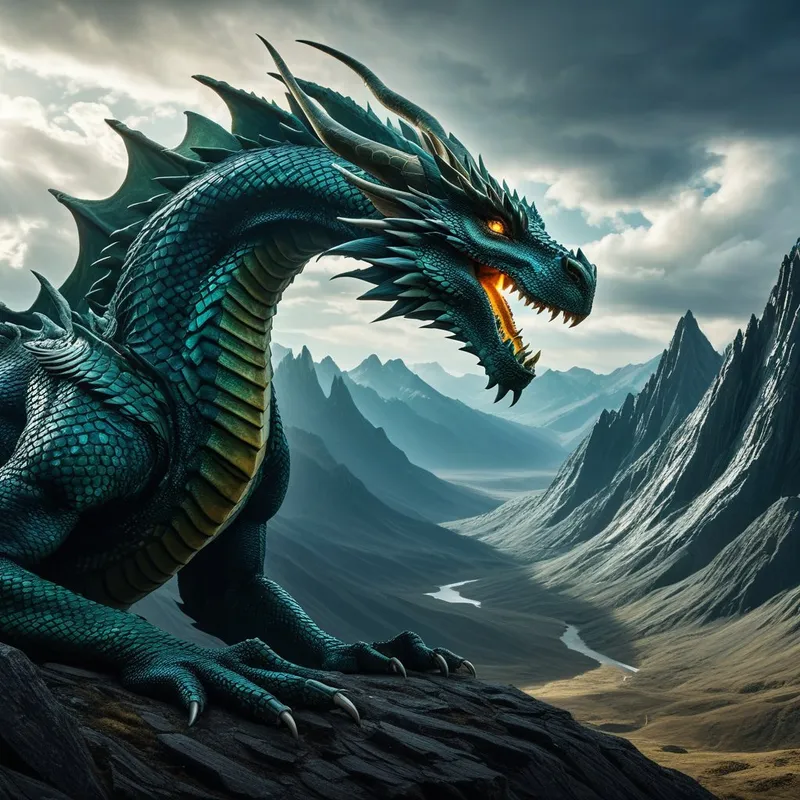
Listen, and hear the story written in stone, whispered by the wind through high passes. In the time before time, when the world was a formless sea of mist and potential, there existed a being of pure, coiled energy: the Great Dragon. It was not a beast of malice, but of profound solitude, a consciousness as vast as the void it swam through. It dreamed of shape, of texture, of a world to hold its dreams.
For eons it swam the starless deep, its longing a silent song that stirred the primal mud. But a world of only mud and mist is a lonely cradle. The Dragon’s dream grew heavy, a weight upon its own spirit. It yearned not just to imagine form, but to become form, to offer its very substance as a foundation. One day, as it gazed upon the featureless expanse, a resolve—sharp and final as a cracking stone—settled in its heart.
With a roar that was the first sound, a vibration that parted the mists, the Dragon began its great labor. It did not fight another. Its battle was with the endless softness of the unformed. It dove deep, pressing its colossal belly into the yielding mud of the world’s bottom. Then, with an agony of purpose that was also an ecstasy of creation, it began to arch.
Muscle and scale, sinew and bone, groaned against the formless pressure. Its spine, a chain of living mountains, pushed upward. The world resisted, then yielded. The mud firmed into clay, the clay baked into bedrock. Up and up its back rose, a colossal ridge tearing through the veil of mist to meet the first light of a sun that had only just kindled in response to its act. The light fell upon scales that were already cooling, hardening, transforming from luminous jade and sapphire to the grey of granite, the brown of iron-rich stone, the white of quartz.
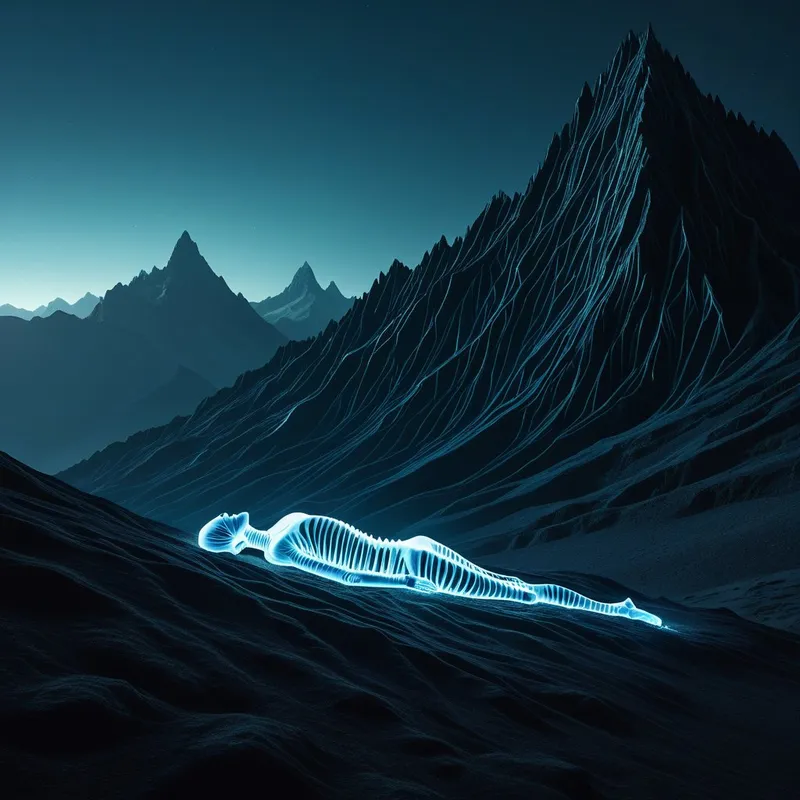
The Dragon held the pose, a frozen curve of ultimate effort. Its breath, once the wind of the void, became the winds that scour peaks and carry seeds. The fire in its heart cooled, sinking deep to become the warm magma veins of the world. Its final, exhalation was a sigh that settled as soil in the high valleys. Where its spine pierced the world-skin, the land was forever changed—jagged, defiant, beautiful. The Dragon’s body became the continent; its ridged back, the mountain ranges that stitch the world together. It did not die, but transformed, its consciousness dissolving into the steadfastness of the stone, the patience of the mountain, the memory held in deep crystal.

Cultural Origins & Context
The myth of the Dragon's Back Ridges is a foundational narrative found in fragments across numerous highland and mountainous cultures, from the Himalayas to the Andes, and in the folklore of island chains born of volcanic fire. It is a "Various" myth not of a single people, but a recurring psychic blueprint that emerges wherever humans live in the long shadow of immense, terrain-shaping geology.
This was not a tale confined to temple scrolls, but one told by firelight in shepherd's huts, sung as a rhythmic chant by porters on steep trails, and pointed out by elders to children: "See that line of peaks? That is the Old One's spine." Its primary tellers were the people of the high places—those whose lives were intimately shaped by the ascent, the thin air, and the enduring presence of the mountains. The myth served as an origin story for the land itself, explaining not just how the mountains came to be, but why they feel alive, demanding, and sacred. It provided a cosmological framework where the landscape was not inert matter, but the fossilized body of a sacred sacrifice, instilling a sense of living within a divine anatomy. This fostered a relationship of respect, not domination, with the environment.
Symbolic Architecture
At its core, the myth is a profound allegory for the act of creation through self-sacrifice and the establishment of enduring structure from chaotic potential.
The Primordial Mists represent the undifferentiated unconscious, the plenum of possibilities where nothing has yet taken form. The Great Dragon symbolizes the creative libido, the driving psychic energy that seeks to manifest, to give shape to the contents of the soul. Its longing is the creative urge present in every individual.
The central, terrifying, and beautiful act is not a battle with an external monster, but the turning of creative force inward, using the self as the raw material for world-building.
The Dragon’s spine is the ultimate symbol of axial structure—the world axis, or axis mundi. Its transformation into mountains represents the crystallization of spirit into enduring form, of fleeting inspiration into lasting art, law, or personality. The ridges are the backbone of the world, and by extension, the backbone of the psyche—the principles, values, and traumas that give our inner landscape its defining shape and resistance. The myth tells us that true foundation requires a sacrifice of our former, fluid nature. We must become, in part, the rigid structure that supports our own existence.

The Dreamer's Resonance
When the motif of the Dragon’s Back Ridges surfaces in modern dreams, it often signals a profound process of psychic structuring or a confrontation with one's own foundational supports.
To dream of climbing the ridges suggests a conscious engagement with one's core identity, values, or a monumental life task. It is hard, breathless work, reflecting the effort of building or confronting one's own character. To dream of being the ridge, or feeling one's own spine as stone and mountain, can indicate a sense of becoming rigid, overburdened, or carrying the weight of one's world—a feeling of being the sole support structure, perhaps petrified by responsibility or trauma.
Conversely, dreaming of the ridges cracking or shifting is a powerful symbol of a foundational psychic change. An earthquake along the Dragon’s Back in a dream can herald a deconstruction of core beliefs, a shaking of the very pillars of the personality. It is a terrifying but potentially liberating event, mirroring the Dragon’s own cataclysmic act of creation, which began with the destruction of its former, unbound state.
Alchemical Translation
For the modern individual navigating the path of individuation, the Dragon’s Back Ridges model the alchemical stage of Coagulatio—the process of condensation, of making solid and enduring what was once volatile and intangible.
The journey begins in the Prima Materia of our personal mists: our chaotic emotions, unformed talents, and nebulous potential. The Dragon’s longing is our own inner call to create a coherent Self, to build a life of meaning. The agonizing arching of the spine is the difficult, often painful, work of discipline, commitment, and choice. It is the decision to forge an ethic, to complete a life's work, to solidify a boundary, or to make a lasting sacrifice for a greater whole.
We are both the Dragon and the landscape it creates. The sacrifice is the realization that to become who we are, we must give up who we were.
The resulting "ridges" are the enduring aspects of our character: our integrity (our inner spine), our achievements that outlive us, and the personal "geology"—the layered experiences of joy and suffering—that gives our psyche its unique, rugged topography. The myth ultimately teaches that wholeness is not found in remaining fluid and free, but in the courageous, sacrificial act of becoming one's own foundation. We find our strength not by avoiding the weight of existence, but by consciously transforming ourselves into the mountain that can bear it, allowing our deepest struggles to become the very structures that define and elevate our human experience.
Associated Symbols
Explore related symbols from the CaleaDream lexicon: