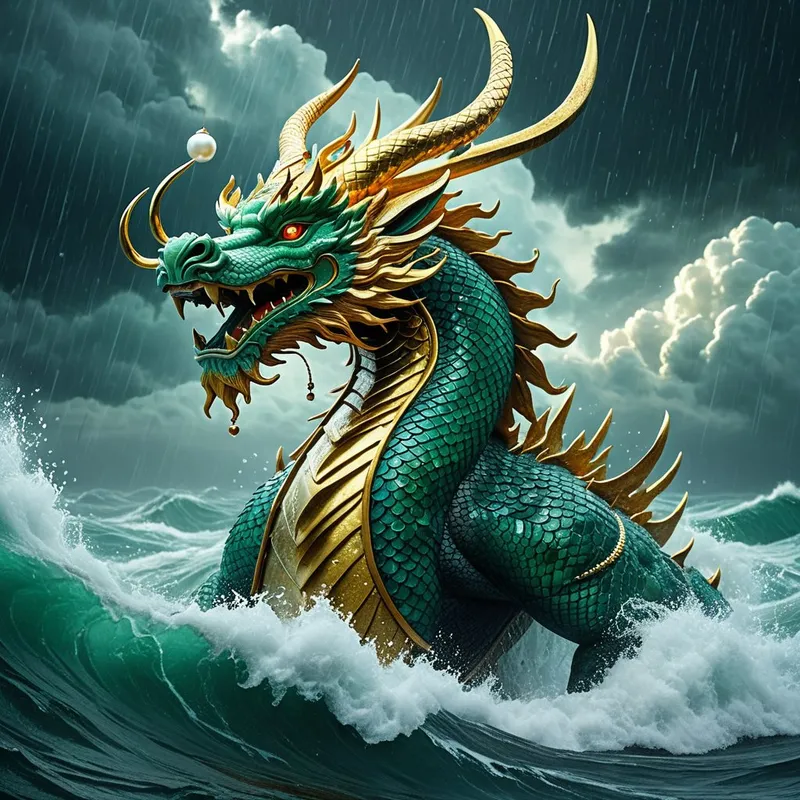
Dragon Kings Myth Meaning & Symbolism
The myth of the Dragon Kings, sovereigns of the waters, embodies the reconciliation of chaos and order, nature's power, and the psyche's journey to wholeness.
The Tale of Dragon Kings
Beneath [the world](/myths/the-world “Myth from Tarot culture.”/) of mortals, where the sun’s light grows dim and cold stone gives way to liquid shadow, lies a kingdom untouched by time. This is the domain of the [Longwang](/myths/longwang “Myth from Chinese culture.”/), [the Dragon Kings](/myths/the-dragon-kings “Myth from Chinese culture.”/). Their palaces are not of marble, but of coral and mother-of-[pearl](/myths/pearl “Myth from Chinese culture.”/), lit by the cold fire of luminous pearls. Their courts are not filled with nobles, but with scaled ministers—turtles, fish, and shrimp—who move to the eternal rhythm of the deep currents.
Once, in the age when emperors were sons of heaven and farmers knew the names of every spirit, a great drought fell upon the land of the Middle Kingdom. The rivers shrank to muddy threads. [The earth](/myths/the-earth “Myth from Hindu culture.”/) cracked like a broken bowl. The people’s prayers rose with the dust, thin and desperate.
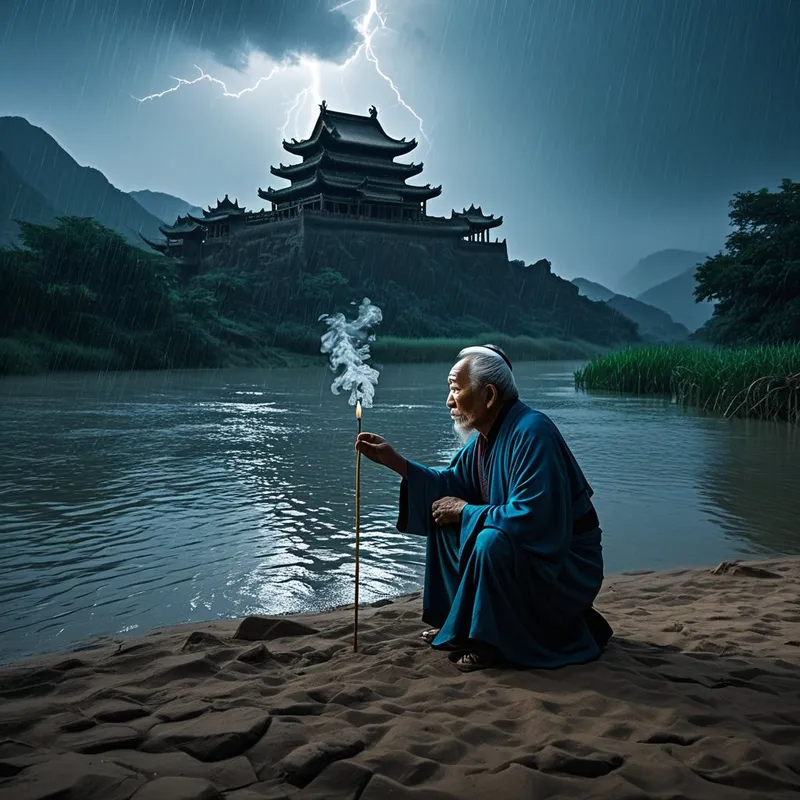
In a village by the Huang He, an elder named Lao Xu, whose bones ached with the memory of rain, took the last of the village’s grain and wine. He journeyed to the barren riverbank, where the ghost of the [water](/myths/water “Myth from Chinese culture.”/) lingered in the air. He built a simple altar of river stones, lit three sticks of sandalwood incense, and began to beat a worn drum, its sound a hollow echo of the thunder they longed for. He did not beg. He spoke with the respect one sovereign shows another, recounting the virtues of the people, their labors, and their respect for the natural order.
Deep in the Donghai, in his palace of crystalline waves, Ao Guang felt the vibration of that drum. It was not the clamor of demand, but the resonant tone of rightful appeal. He rose from his throne, his form shifting the tides. With a flick of his pearl-adorned beard, he summoned his cloud-stepping chariot. He did not come as a monster, but as a bureaucrat of the cosmos, a divine minister answering a formal petition.
[The sky](/myths/the-sky “Myth from Persian culture.”/) above Lao Xu darkened, not with the gloom of despair, but with the pregnant grey of gathering clouds. A wind, cool and smelling of distant oceans, swept the dust from the fields. Then, without roar or fury, the rain began. It fell not in a torrent, but in a steady, soaking benediction—a measured response from a measured king. [The river](/myths/the-river “Myth from Buddhist culture.”/) sighed and filled. The earth drank deeply. And in that moment, the [covenant](/myths/covenant “Myth from Christian culture.”/) between heaven, water, and humanity was reaffirmed: not through domination, but through reciprocal respect. [The Dragon](/myths/the-dragon “Myth from Chinese culture.”/) King had listened, and the balance was restored.
Cultural Origins & Context
The myth of the [Dragon](/myths/dragon “Myth from Chinese culture.”/) Kings is not a single story from a single text, but a vast, fluid tapestry woven from ancient animism, Daoist cosmology, and imperial bureaucracy. Its roots sink into the earliest Chinese reverence for water spirits and long as bringers of rain. As Chinese society evolved into a centralized empire, so too did its [pantheon](/myths/pantheon “Myth from Roman culture.”/). The wild, unpredictable river gods were organized, much like the earthly government, into a coherent celestial ministry.
This myth was passed down through countless channels: the oral tales of fishermen and farmers who depended on the water’s mercy; the official state rituals where the emperor, the Tianzi, would sacrifice to the Dragon Kings for timely rains and flood prevention; and through popular literature like [Journey to the West](/myths/journey-to-the-west “Myth from Chinese culture.”/), where the Dragon Kings are complex, sometimes petty, but ultimately integral figures in the cosmic order. Their societal function was profound: they personified the terrifying yet essential power of nature, making it comprehensible and negotiable. They provided a mythological framework for understanding disaster (a king’s displeasure) and bounty (a king’s favor), transforming chaotic natural forces into matters of ritual protocol and moral order.
Symbolic Architecture
Psychologically, the [Dragon](/symbols/dragon “Symbol: Dragons are potent symbols of power, wisdom, and transformation, often embodying the duality of creation and destruction.”/) [King](/symbols/king “Symbol: A symbol of ultimate authority, leadership, and societal order, often representing the dreamer’s inner power or external control figures.”/) is the [archetype](/symbols/archetype “Symbol: A universal, primordial pattern or prototype in the collective unconscious that shapes human experience, behavior, and creative expression.”/) of the ruling principle within the unconscious. He does not represent raw, id-like instinct, but instinct organized and elevated to sovereignty. His domain is the emotional and psychic waters—the deep, often unseen currents of feeling, [intuition](/symbols/intuition “Symbol: The immediate, non-rational understanding of truth or insight, often described as a ‘gut feeling’ or inner knowing that bypasses conscious reasoning.”/), and ancestral [memory](/symbols/memory “Symbol: Memory symbolizes the past, lessons learned, and the narratives we construct about our identities.”/).
The Dragon King is the psyche’s natural governor, who transforms the flood of emotion into the nourishing rain of conscious insight.
The four kings of the cardinal seas and directions symbolize the totality of the unconscious, segmented yet interconnected. The [dragon pearl](/symbols/dragon-pearl “Symbol: A luminous pearl held by a dragon, symbolizing wisdom, enlightenment, and the pursuit of ultimate spiritual power or hidden knowledge.”/) they often guard or [chase](/symbols/chase “Symbol: Dreaming of a chase often symbolizes avoidance of anxiety or confrontation, manifesting as fleeing from something threatening or overwhelming in one’s waking life.”/) is the [symbol](/symbols/symbol “Symbol: A symbol can represent an idea, concept, or belief, serving as a powerful tool for communication and understanding.”/) of the integrated Self, the ultimate prize of psychological wholeness. The myth’s central [drama](/symbols/drama “Symbol: Drama signifies narratives, emotional expression, and the exploration of human experiences.”/)—the [drought](/symbols/drought “Symbol: Drought signifies a period of emotional scarcity, lack of resources, or feelings of deprivation leading to anxiety or intense longing.”/) and the petition—encodes the critical [relationship](/symbols/relationship “Symbol: A representation of connections we have with others in our lives, often reflecting our emotional state.”/) between the conscious ego (the [village](/symbols/village “Symbol: Symbolizes community, connection, and a reflection of one’s roots or origins.”/), the elder) and the ruling power of the unconscious (the Dragon King). Ignore or insult this inner sovereign, and the [psyche](/myths/psyche “Myth from Greek culture.”/) becomes parched, rigid, lifeless. Approach it with respect and proper [ritual](/symbols/ritual “Symbol: Rituals signify structured, meaningful actions carried out regularly, reflecting cultural beliefs and emotional needs.”/) (conscious [attention](/symbols/attention “Symbol: Attention in dreams signifies focus, awareness, and the priorities in one’s life, often indicating where the dreamer’s energy is invested.”/) and respect), and it grants the nourishing [energy](/symbols/energy “Symbol: Energy symbolizes vitality, motivation, and the drive that fuels actions and ambitions.”/) needed for [life](/symbols/life “Symbol: The symbol of ‘Life’ represents a journey of growth, interconnectedness, and existential meaning, encompassing both the joys and challenges that define human experience.”/) and growth.
The Dreamer’s Resonance
When the Dragon King swims into modern dreams, he announces a crisis or opportunity related to inner authority and emotional sovereignty. Dreaming of a drought-stricken landscape points to an emotional or creative barrenness, where the dreamer’s feelings have been suppressed or ignored. A dream of flooding, conversely, suggests a feeling of being overwhelmed by unconscious contents—a tidal wave of anger, grief, or desire that [the ego](/myths/the-ego “Myth from Jungian culture.”/) cannot control.
To dream of meeting the Dragon King, whether in his palace or at the water’s edge, signifies the ego coming into direct contact with the organizing principle of the deep psyche. This can feel awe-inspiring or terrifying. The somatic experience might be one of profound pressure (the weight of water) or exhilarating fluidity. Such a dream often occurs at life junctures requiring major decisions, asking the dreamer: Who is truly ruling your inner world? Is it the anxious ego, or have you made space for the deeper, older wisdom that governs the waters of your soul? It is an invitation to establish a conscious dialogue with one’s own depths.
Alchemical Translation
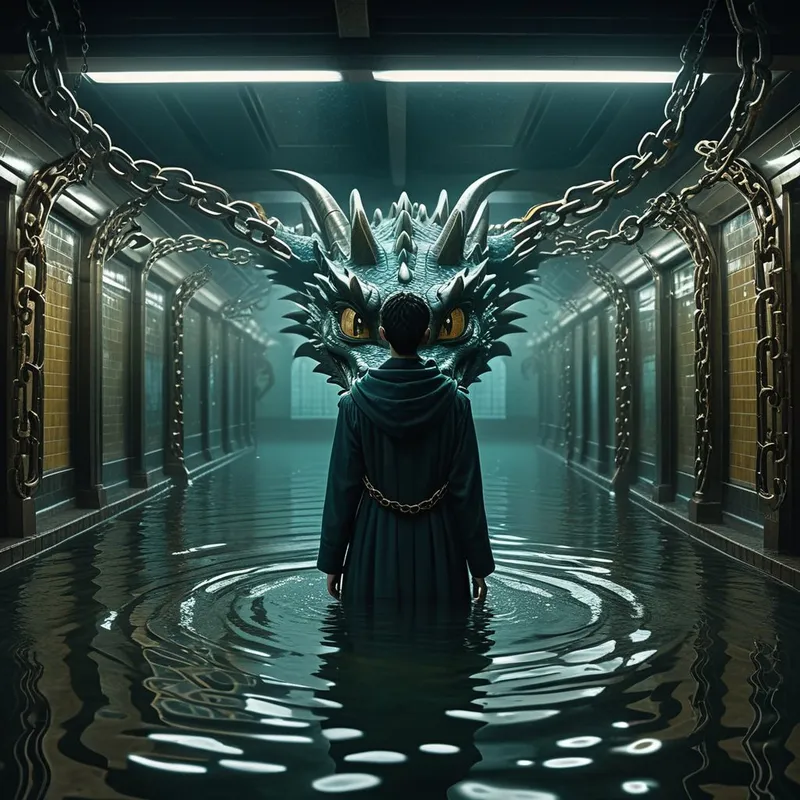
The individuation process mirrored in this myth is the alchemical opus of reconciling order and chaos within oneself. The initial state is one of imbalance: the “drought” represents a psychic condition ruled solely by dry, rigid consciousness, cut off from the vivifying waters of the unconscious. The hero’s journey is not to slay the dragon, but to petition him—to acknowledge the sovereignty of a power greater than the ego.
Individuation is not about conquering the inner dragon, but learning the proper rituals to request its rain.
The “ritual” performed by the elder is the conscious work of attention, respect, and symbolic offering. In psychological terms, this is active imagination, dream work, or artistic expression—the methods by which we respectfully engage the unconscious. The resulting “rain” is the enlivening energy that fertilizes the conscious personality, allowing what was barren to grow. The ultimate goal is not for the ego to become king, but for it to become a faithful steward in the kingdom of [the Self](/myths/the-self “Myth from Jungian culture.”/), where the Dragon King rules in harmony with the celestial mandate. One integrates the dragon’s power, becoming, in a sense, a vessel for that sovereign, balancing energy, and navigating the world with the wisdom of both depth and surface.
Associated Symbols
Explore related symbols from the CaleaDream lexicon: