Dragon bones Myth Meaning & Symbolism
A myth where a dragon's self-sacrifice forms the world's skeleton, offering a blueprint for turning chaos into enduring structure through sacred loss.
The Tale of Dragon bones
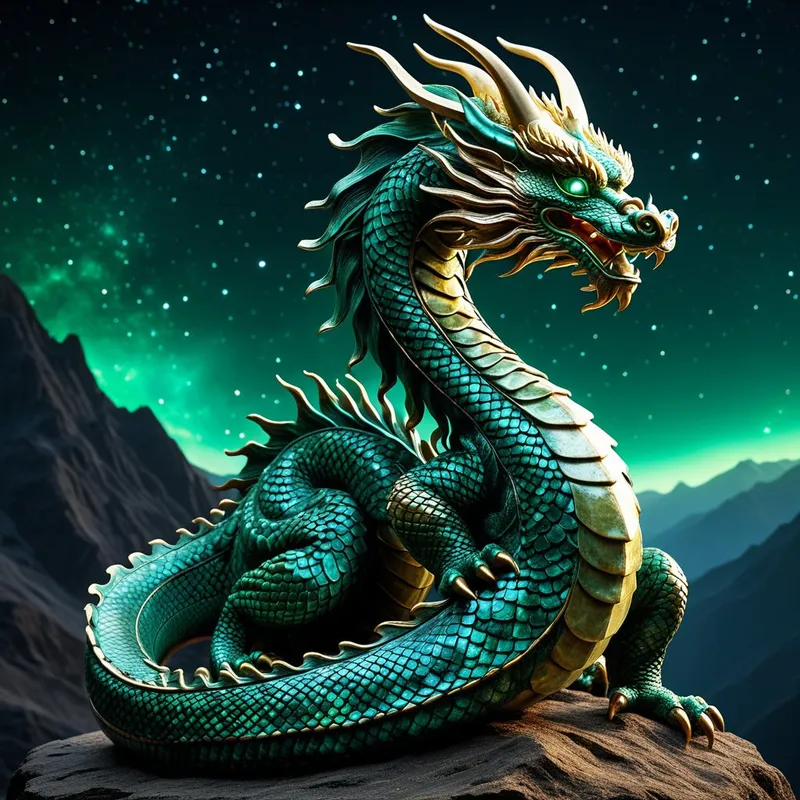
Before there was a world to walk upon, there was only the [Hundun](/myths/hundun “Myth from Chinese culture.”/)—a swirling, silent egg of mist and potential. And within it slept the [Qinglong](/myths/qinglong “Myth from Chinese culture.”/), [the Azure Dragon](/myths/the-azure-dragon “Myth from Chinese culture.”/), a being of wind and cloud, of river-course and storm. It was not a beast of flesh, but a spirit of becoming, its body a length of intention waiting to be written upon [the void](/myths/the-void “Myth from Buddhist culture.”/).
[The dragon](/myths/the-dragon “Myth from Chinese culture.”/) stirred. It felt the ache of the formless, the yearning of the Yinyang to find their shape. To its celestial senses, the Hundun was not peace, but a desperate, silent scream for order. There was no up or down, no here or there, only a ceaseless, directionless churn. [The dragon](/myths/the-dragon “Myth from Chinese culture.”/) knew a terrible truth: for a world to be born, a world must first have bones. A structure to hold the soft flesh of earth and the flowing blood of rivers. But there was no stone hard enough, no metal pure enough, to serve as the spine of creation.
So, the Qinglong made a choice that echoed through the pre-dawn of time. With a roar that was the first sound, it began to coil upon itself, tighter and tighter, compressing its vast, ethereal form. Where its spirit-flesh met its own immense pressure, it did not bruise—it petrified. Cloud-essence hardened into crystalline marrow. Storm-wind solidified into vast, curving ribs. The shimmering path of its flight calcified into a gargantuan, winding spine.
The process was an agony of becoming. Each transformation was a willing surrender of its boundless freedom for the sake of a future stability it would never inhabit. Its celestial eyes, last to harden, watched as its own body became the first ranges of mountains, the first deep riverbeds, the first arch of the vaulted sky. Finally, with a sigh that became the first wind, the last of its consciousness dissolved. The [dragon](/myths/dragon “Myth from Chinese culture.”/) was gone. In its place lay the skeleton of [the world](/myths/the-world “Myth from Tarot culture.”/): jagged peaks were its teeth, rolling hills the knobs of its vertebrae, deep valleys the spaces between its ribs. The Huang He found its course along the path of its tail. [The world](/myths/the-world “Myth from Tarot culture.”/) had its bones. Now, the soft things—the soil, the forests, the creatures—could begin to grow.

Cultural Origins & Context
The concept of Long Gu exists in a liminal space between high myth, folk geology, and early medicine. It is not a single, codified myth from one text like the Shan Hai Jing, but a pervasive, foundational idea woven into the understanding of the landscape. The tales were told by farmers who plowed fields and struck strange, giant bones with their tools, by Daoist adepts who saw the dragon’s Qi in mountain veins, and by village elders explaining why a particular ridge had such a powerful, protective presence.
Its societal function was multifaceted. It was an etiological myth, explaining the origin of China’s dramatic and varied topography. More importantly, it was a myth of sacred geography. It taught that the land itself was not inert matter, but the transformed body of a divine, self-sacrificing being. This instilled a profound sense of place and reverence—to live upon the land was to live upon a sacred relic. This belief later dovetailed with the practical use of fossilized bones (often from prehistoric mammals) in Traditional Chinese Medicine, where they were literally called “dragon bones” (Long Gu) and believed to contain residual, calming dragon-essence for treating the human spirit.
Symbolic Architecture
At its core, the myth is a master [symbol](/symbols/symbol “Symbol: A symbol can represent an idea, concept, or belief, serving as a powerful tool for communication and understanding.”/) of the necessary sacrifice that precedes all creation. The [dragon](/symbols/dragon “Symbol: Dragons are potent symbols of power, wisdom, and transformation, often embodying the duality of creation and destruction.”/) represents unbound potential, the fluid [chaos](/symbols/chaos “Symbol: In Arts & Music, chaos represents raw creative potential, uncontrolled expression, and the breakdown of order to forge new artistic forms.”/) of pure [spirit](/symbols/spirit “Symbol: Spirit symbolizes the essence of life, vitality, and the spiritual journey of the individual.”/). The bones represent [structure](/symbols/structure “Symbol: Structure in dreams often symbolizes stability, organization, and the framework of one’s life, reflecting how one perceives their environment and personal life.”/), law, and the enduring [framework](/symbols/framework “Symbol: Represents the underlying structure of one’s identity, emotions, or life. It signifies the mental or emotional scaffolding that supports or confines the self.”/) that makes manifestation possible.
The ultimate act of creation is not an explosion, but a crystallization; not an outward conquest, but an inward sacrifice of possibility for the sake of actuality.
Psychologically, the dragon is the totality of the unconscious Self in its raw, pre-personal state. Its sacrifice symbolizes the painful but essential process of [the ego](/myths/the-ego “Myth from Jungian culture.”/)‘s formation—the “hardening” of certain patterns, the setting of boundaries, the creation of a stable psychological structure (the “bones”) from which a coherent [identity](/symbols/identity “Symbol: Identity represents the sense of self, encompassing personal beliefs, cultural background, and social roles.”/) can grow. The dragon does not die; it becomes the [foundation](/symbols/foundation “Symbol: A foundation symbolizes the underlying support systems, values, and beliefs that shape one’s life, serving as the bedrock for growth and development.”/). This speaks to a worldview where divinity is not remote, but immanent, its [body](/symbols/body “Symbol: The body in dreams often symbolizes the dreamer’s self-identity, personal health, and the relationship they have with their physical existence.”/) the very ground of being. The conflict is not against an external foe, but against the unbearable [weight](/symbols/weight “Symbol: Weight symbolizes burdens, responsibilities, and emotional loads one carries in life.”/) of [infinite possibility](/symbols/infinite-possibility “Symbol: A spiritual symbol representing boundless potential, cosmic freedom, and the dissolution of limitations in consciousness.”/). The heroism is in choosing limitation.
The Dreamer’s Resonance
When this myth stirs in the modern [psyche](/myths/psyche “Myth from Greek culture.”/), it may surface in dreams of discovering massive, ancient bones in one’s backyard, of feeling one’s own skeleton transforming or growing heavy, or of witnessing a great being willingly turn to stone or crystal. These are not dreams of horror, but of profound, somber transformation.
Somatically, this can correlate with periods where one is building a new life structure—starting a family, founding a business, committing to a long-term path. There is often a felt sense of “hardening,” a loss of personal flexibility and spontaneous freedom, which can be mourned even as the new stability is desired. The dream is the psyche’s way of framing this necessary sacrifice as a sacred, cosmically significant act. It is the process of giving up the dragon’s flight so that the mountain of one’s life can exist. The psychological process is one of foundation-laying, where diffuse energy and potential are condensed into durable form, often accompanied by grief for the un-lived paths.
Alchemical Translation
The alchemical journey modeled here is not of slaying the dragon, but of becoming the dragon who performs the ultimate opus: the transmutation of spirit into foundation. For the individual seeking wholeness (individuation), this myth maps the late, crucial stage where insights gained from the unconscious must be structured into a durable way of living.
First, one must recognize the “Hundun” within—the chaotic, fertile, but unlivable swirl of potentials, complexes, and unlived lives. The “Qinglong” is the organizing, synthesizing power of [the Self](/myths/the-self “Myth from Jungian culture.”/). The “sacrifice” is the conscious, willing surrender of egoic omnipotence (“I could be anything, go anywhere”) to the demands of concrete actualization (“This is who I am, here and now”).
Individuation is the dragon building its own tomb, which becomes the palace for a conscious life.
The “dragon bones” that result are the enduring principles, values, and practices that form the skeleton of a mature personality. They are the non-negotiable truths one stands upon. This alchemy turns the lead of chaotic impulse into the gold of disciplined character. The myth assures us that this process, though it feels like a [death](/myths/death “Myth from Tarot culture.”/) of freedom, is in fact a sacred act of world-building. The dragon’s spirit does not vanish; it becomes the animating Qi within the structure, the life in the bones. Thus, the individual learns that true strength is not in remaining fluid and unbounded, but in having the courage to become the foundation for one’s own existence.
Associated Symbols
Explore related symbols from the CaleaDream lexicon: