Donn Cuailnge Myth Meaning & Symbolism
A mythic bull, a contested prize, and a cataclysmic war that reveals the deep bond between a king's sovereignty and the land's primal spirit.
The Tale of Donn Cuailnge
Hear now the tale that shook the very pillars of Ériu. It begins not with a king, but with a queen’s pride. Medb of Cruachan, she of the fierce heart and unquenchable will, lay beside her husband, Ailill. As they compared their wealth—chariots, brooches, herds—a single, glaring inequality emerged. Ailill possessed a bull of wondrous size and beauty, Finnbhennach, born of Medb’s own herd but owing allegiance to no woman. This galled the queen. Her sovereignty, her very ríastrad (warp-spasm) of spirit, demanded parity.
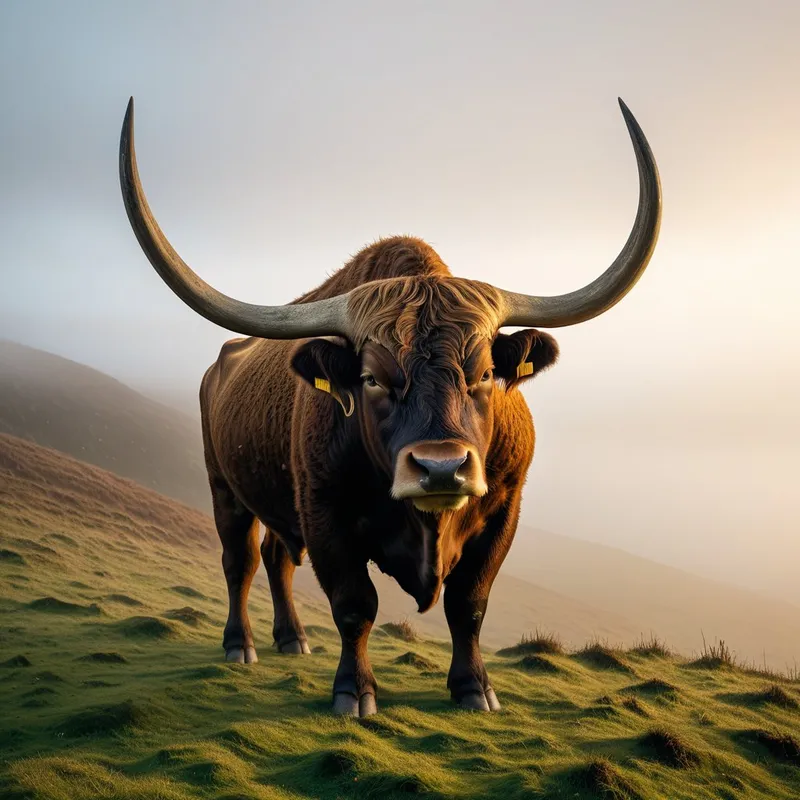
She learned of a bull to rival all bulls: Donn Cuailnge, the Dark Bull of Cooley, whose rumble was the thunder of the province of Ulster, whose hide held fifty white spots, each the size of a king’s fist. He was no mere beast. He was the incarnate fertility and martial fury of Ulster itself, owned by Dáire mac Fiachna. Medb sent envoys with lavish offers: wealth, land, her own “friendly thighs.” Dáire agreed. But in the revelry of his acceptance, a drunken envoy boasted that had Dáire refused, Medb would have taken the bull by force. Pride flared. The deal was shattered.
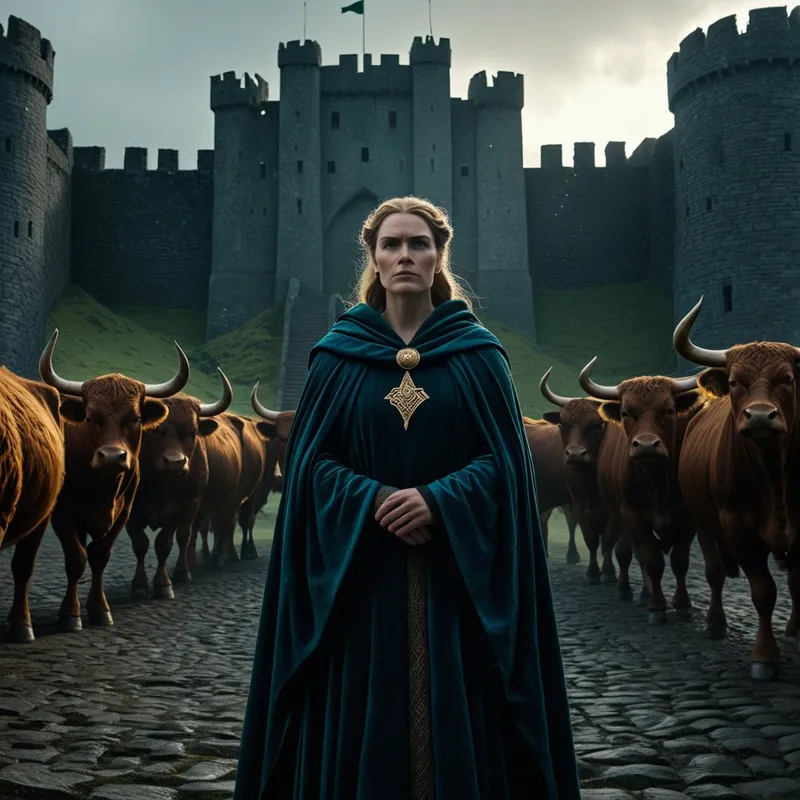
Thus did Medb muster the greatest army Ériu had ever seen, a sea of spears from every province save one—Ulster. For the men of Ulster were laid low by the Pangs of Macha, a curse of childbirth pains, leaving the province defended only by the boy-hero Cú Chulainn. Against this lone, terrifying guardian, Medb’s host hurled itself, battle after bloody battle at the fords. All for a bull.
While heroes fell and rivers ran red, Medb’s warriors finally seized Donn Cuailnge. They drove him across the land, a living prize, back to Connacht. But the tale’s heart is in the return. Brought before Finnbhennach, the two bulls did not merely fight. They enacted a geography of rage. They circled all Ériu, their hooves carving new landscapes, their bellows shaking mountains. In their final, apocalyptic clash at the ford of the Shannon, Donn Cuailnge emerged victorious, goring the white bull to pieces, scattering his remains across the land—giving places like Áth Luain their names.
But triumph was ash. Donn Cuailnge, his heart bursting with fury and sorrow, returned to his own land of Cooley. There, on the border of his home, he died. From his dying breath sprang a legend, and from his spilled life, a warning: the spirit of the land cannot be stolen without unleashing the cataclysm that consumes both thief and prize.
Cultural Origins & Context
This is the central, driving engine of the Ulster Cycle, the Táin Bó Cúailnge (The Cattle Raid of Cooley). It is not a children’s fable but a foundational epic, composed in the 7th-8th centuries CE from far older oral traditions. It was the province of the filid (the learned poet-seers), who preserved it not merely as entertainment, but as a deep map of sovereignty, territory, and social order.
In a cattle-based economy, wealth was livestock. A prize bull was a kingdom’s living bank, its genetic treasury, and a symbol of the king’s virility and right to rule. The myth functioned as a cosmic justification for landscape features and tribal relationships, explaining why one place was rich and another rocky. More profoundly, it articulated a core Celtic political concept: a true ruler (rí) must have a perfect, uncoerced union with the spirit of the land, often symbolized by a sovereignty goddess. Medb’s failure was not just greed, but a fundamental rupture in this sacred marriage. She sought the symbol to create her sovereignty, rather than having her sovereignty validated by it—a fatal inversion of the natural order.
Symbolic Architecture
At its core, Donn Cuailnge is not an animal, but an autonomous psychic complex of immense potency. He is the genius loci made flesh, the untamed, instinctual power of a specific place and people.
The bull is the embodied soul of the territory. To possess him is to hold the right to rule; to steal him is to invoke the land’s vengeful shadow.
Medb represents the conscious ego, ambitious and calculating, seeking wholeness (parity with her husband) through possession of an external object of power. Her raid is a grandiose, yet ultimately hollow, attempt at inflation. Cú Chulainn, the defender, embodies the heroic but overburdened psyche holding the boundary against overwhelming unconscious forces. The conflict reveals that the land’s spirit (the bull) has its own will and destiny. It cannot be integrated through force, only through rightful relationship. The bulls’ cataclysmic fight is the psychic civil war that erupts when a core, instinctual power is alienated from its rightful home and pitted against its counterpart (the white bull, Finnbhennach, representing a similarly unintegrated, “tamed” but prideful power).
The Dreamer's Resonance
To dream in the pattern of the Táin is to feel the ground of your being under threat of raid. It speaks to a modern condition where one’s vital energy, one’s foundational passion or creative drive (the bull), feels subject to theft—by a demanding job, a draining relationship, or the inner Medb who demands constant comparison and acquisition.
Somatically, it may manifest as a deep fatigue in the limbs (the Pangs of the Ulstermen), a feeling of being cursed into incapacity when your core resources are threatened. The dream landscape becomes a borderland (like Cooley), and the dreamer may be Cú Chulainn, exhausted but holding a ford, or Dáire, furious at a broken promise. The climax—the bull fight—in a dream is rarely witnessed directly. It is felt as seismic tremors, distant roars, or the discovery of strange, bloody trophies (the scattered remains of the white bull). It signifies an immense, autonomous process of psychic re-ordering happening at a depth the ego cannot directly access, only experience in its devastating aftermath.
Alchemical Translation
The alchemical journey here is not of the hero, but of the prima materia itself—the bull. His raid, journey, battle, and return map the process of confronting, alienating, wrestling with, and ultimately reconciling with one’s deepest instinctual nature.
The individuation process demands that our Donn Cuailnge be raided. We must lose our naive identification with our primal power to consciously win it back.
First, the separatio: The bull is taken from his home. Our instinctual self is cut off from its natural context by the demands of culture, persona, and ambition (Medb’s envy). Then, the coniunctio: not a loving union, but a violent clash of opposites in the bull-fight. This is the necessary, terrifying confrontation between our alienated deep nature and the prideful, “civilized” complexes that claim to rule it (the white bull). The mortificatio is explicit: the death of both beasts in their old forms. Finally, the reductio ad originem: Donn Cuailnge’s return to die on the border of his homeland. This is the crucial, sorrowful integration. The power does not return triumphant to the stable, but expires at the threshold. Its essence is absorbed back into the psychic soil from which it came, now sanctified by its ordeal. The ego (Medb’s army) is devastated, but the land (the total Self) is, in its terrible way, made whole again. The modern seeker learns that true sovereignty comes not from possessing one’s animal spirit, but from acknowledging its autonomy and accepting the ruins left in the wake of its sacred, untamable journey.
Associated Symbols
Explore related symbols from the CaleaDream lexicon: