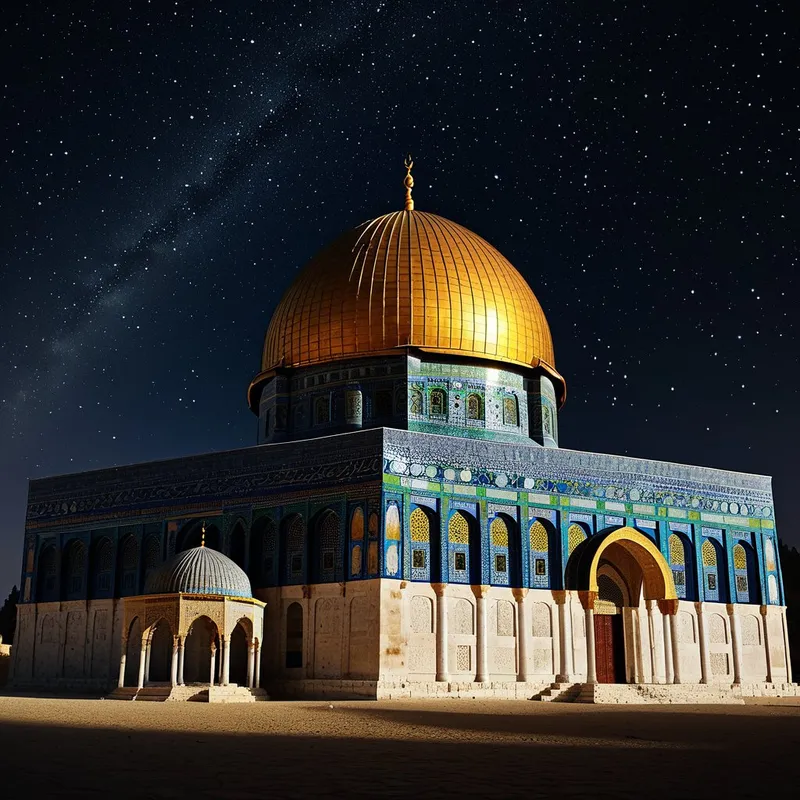
Dome of the Rock Myth Meaning & Symbolism
The celestial journey from the primordial rock, a covenant between heaven and earth, establishing the sacred center of the world.
The Tale of the Dome of the Rock
Listen, and let the veils of time grow thin. Before the first minaret pierced the sky, before the call to prayer echoed in the valleys, there was the Rock. Not merely stone, but the silent, steadfast navel of the world, the first solid thing to emerge from the primordial waters of creation. It was the axis, the fixed point around which all of existence would turn.
Upon this Rock, in a night that contained all nights, the Muhammad was brought. Not by horse or chariot, but by the celestial steed Al-Buraq, a creature woven from lightning and light, with a face of terrible beauty and a stride that spanned horizons. From the sacred sanctuary in Makkah, they ascended, leaving the sleeping world below. They traversed the seven heavens, each a realm of increasing luminescence and profound silence, meeting the prophets of old who greeted him as a brother and a seal.
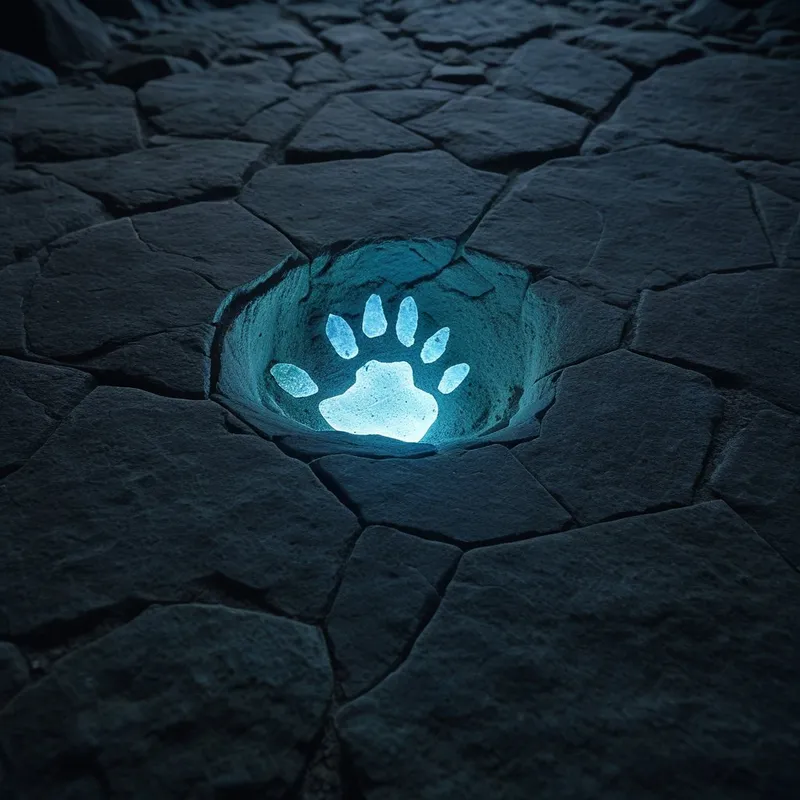
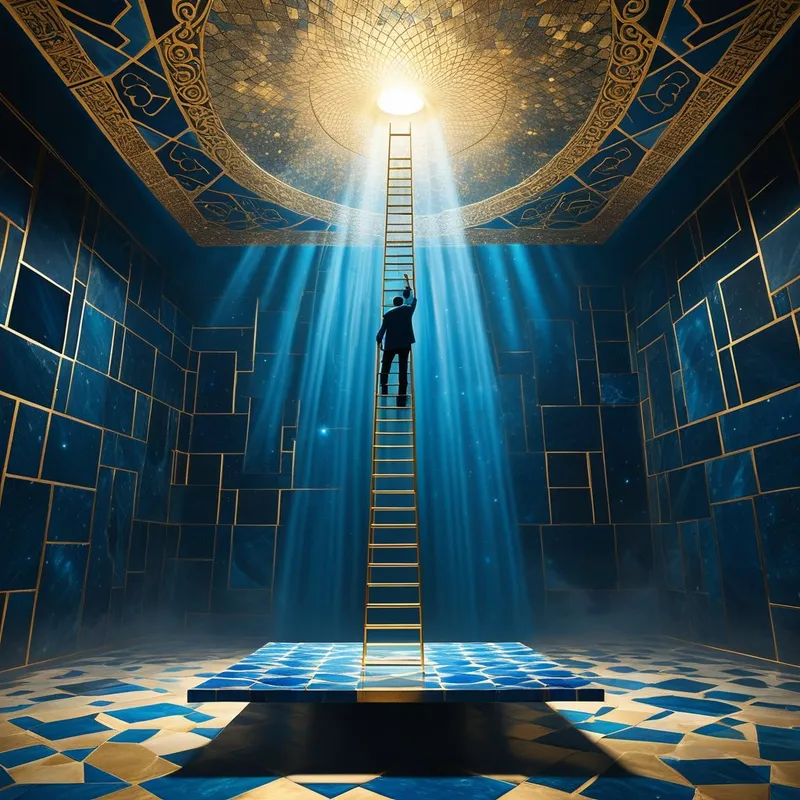
And then, from that very Rock, the ladder of light extended. The Mi'raj began. He ascended beyond the cosmos of form, into the Divine Presence. There, in a communion beyond words, a covenant was renewed. Not of law alone, but of love and witness. He was shown the signs, the inner architecture of reality, and given the gift of prayer—a direct line from the heart of the believer back to this very moment, back to this Rock. He returned, his feet touching the stone once more, imprinting it not with weight, but with witness. The Rock was now a throne, a portal, a testament. The Dome was built not to contain God, for God cannot be contained, but to mark the spot where heaven kissed the earth and left its eternal signature.
Cultural Origins & Context
This is not a myth of the distant, foggy past, but a living narrative anchored in history, scripture, and stone. Its primary sources are the Qur'an (specifically Surah Al-Isra) and the vast collections of Hadith. It is the story of the Isra and Mi'raj, commemorated annually. It was passed down not by bards in mead halls, but by scholars in mosques and mystics in cloisters, its every detail scrutinized for spiritual truth.
The societal function is multifaceted. It established Al-Quds as a sacred axis in Islamic cosmology, a spiritual sibling to Makkah and Madinah. It validated the lineage of prophecy, connecting Muhammad to Abraham, Moses, and Jesus. Most importantly, it democratized the sublime. The Salah, gifted during the Mi'raj, became every believer's personal ascension, a daily mi'raj to the divine. The Dome, built centuries later by the Umayyad Caliph Abd al-Malik, physically enshrined this metaphysical reality, a permanent marker of the world's center and a defiant symbol of a new civilization's spiritual and architectural prowess.
Symbolic Architecture
The myth is a masterclass in symbolic architecture. The Sakhrah is the axis mundi, the still point in the turning world. It represents the primordial Self, the unshakable core of being that emerges from the chaotic waters of the unconscious.
The journey begins not from a palace, but from the bedrock. Individuation starts not with the ego's achievements, but with the acknowledgment of the foundational, often overlooked, Self.
Al-Buraq is the transcendent function, the psychic vehicle that can bridge the immense gap between earthly consciousness and numinous reality. It is intuition incarnate, that sudden, luminous understanding that carries us beyond our ordinary limits. The ascent through the seven heavens is the purification and integration of the psyche's layered complexities—passions, reason, will—each level a confrontation and reconciliation with an aspect of the soul, represented by the prophets.
The Dome itself is the perfected vessel. Its octagonal base symbolizes the transition from the earthly square (the four elements, the four directions) to the celestial circle (unity, infinity). The golden dome reflects the sun, but aims to capture the supernal light of the divine. It does not house the sacred; it frames it, creating a liminal space where the finite human can stand and orient themselves toward the Infinite.
The Dreamer's Resonance
When this myth stirs in the modern dreamer, it speaks to a crisis or calling of orientation. To dream of standing on a great rock in a vast, empty space is to feel the call of the Self, the need to find one's own unshakable center amidst life's turbulence. The somatic sensation is often one of both profound grounding (the solid stone underfoot) and dizzying potential (the expanse above).
Dreaming of a magical ascent—a ladder, a sudden flight, a beam of light—mirrors the Mi'raj. It indicates a psychological process where the dreamer is receiving insight from a level of consciousness beyond the personal ego. This is not escapism, but a necessary retrieval. The "gift" brought back might manifest in the dream as a symbol, a word, or a feeling of mandate. Conversely, dreaming of a beautiful, empty dome can symbolize a prepared sacred space within the psyche, a potential for connection that awaits activation. The conflict in such dreams is often the struggle to integrate the awe of the ascent with the demands of the "return" to ordinary life.
Alchemical Translation
The alchemical process modeled here is the unio mentalis, the union of the mind, or the creation of the inner sanctuary. The prima materia is the raw, chaotic experience of life (the primordial waters). The first congealing into the Sakhrah is the initial act of self-definition, finding one's core values and truths.
The ascension is the sublimatio—the heating and elevating of base matter into spirit. It is the phase where we seek vision, purpose, and connection to the transpersonal.
But the critical, often overlooked stage is the coagulatio—the descent and fixing of the spirit back into matter. This is the Prophet's return with the gift of prayer. Psychologically, this is the embodiment of insight. The visionary experience must be grounded into daily practice, into a disciplined, recurring ritual (the Salah) that continually re-anchors the ego in the Self.
The completed work is not a static state of enlightenment, but a dynamic structure: the Dome. It represents a psyche that has built a stable, beautiful form around its central, numinous truth. The ego becomes the custodian of the sanctuary, not its master. The individual no longer seeks the center in a frantic journey outward; they learn to stand at the center, and from that grounded, golden point, engage with the world. The struggle is the continual maintenance of this sacred architecture against the erosions of forgetfulness, the triumph is the daily return to the Rock within.
Associated Symbols
Explore related symbols from the CaleaDream lexicon: