Dolphin Guides Myth Meaning & Symbolism
A lost soul, guided by dolphins through perilous seas, undertakes a journey of forgetting and remembering to reclaim their true name and purpose.
The Tale of Dolphin Guides
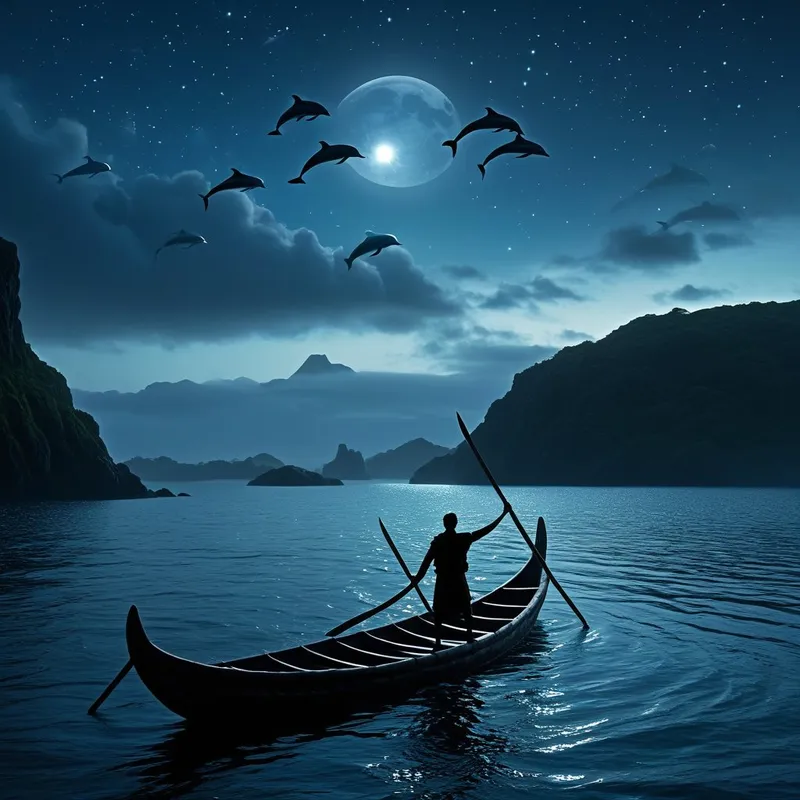
Listen now, and let the fire’s crackle become the crash of waves on a distant shore. In a time when the world was younger and the veil between realms was thin as sea-mist, there lived a soul named Fionnlagh. He was a man of the land, a warrior of the tribe, yet his dreams were not of forest or fort, but of the grey, sighing sea. A sickness of the spirit was upon him—a forgetting. He knew his name, his deeds, but not the why of his being. His heart was a hollow shell, echoing with the memory of a song he could not recall.
Driven by a longing he could not name, Fionnlagh built a coracle of willow and ox-hide. With no oar but a staff, no map but the ache in his bones, he pushed into the embrace of the western ocean. For nine days and nine nights, he drifted, a speck upon the endless, heaving breast of Manannán mac Lir. The sun bleached his resolve; the night winds whispered of despair. He forgot the language of the land, the taste of fresh water, the sound of his own voice. He was becoming a thing of the deep—nameless, purposeless, adrift.
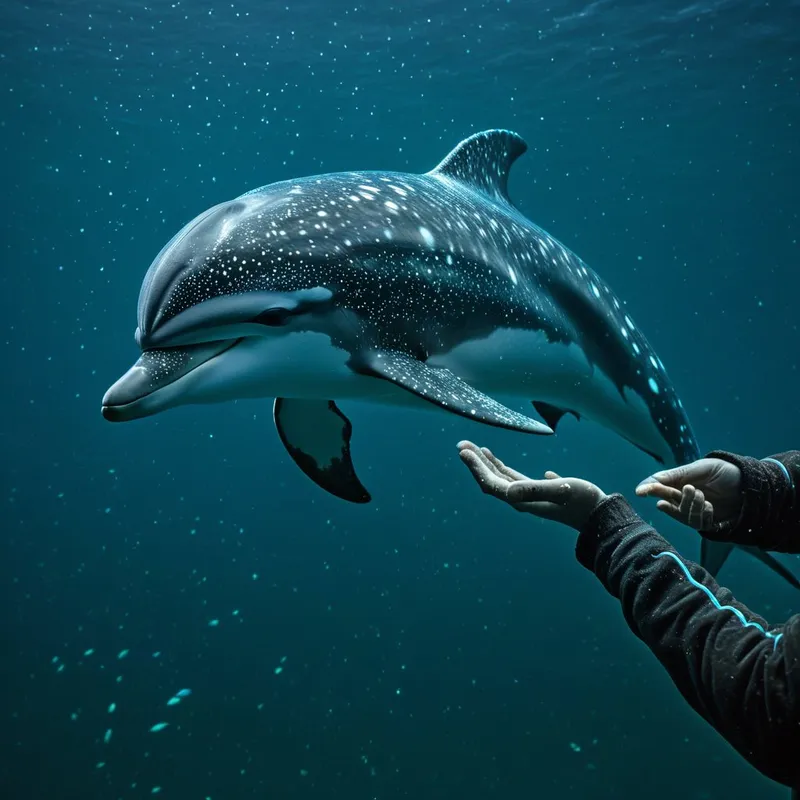
On the tenth dusk, as the sea turned the colour of a bruise and the first stars pricked the sky, the water around his fragile boat began to churn with silver light. Not one light, but many. Smooth, powerful forms broke the surface, breathing the damp air in sighs that spoke of ancient knowing. They were the Muintir na Mara, the Dolphin Guides. They did not speak in words, but in a language of movement, of sonorous clicks that vibrated in Fionnlagh’s very marrow. They circled his coracle, their eyes holding the depth of the abyss and the spark of the stars.
One, larger than the rest, with a scar like a crescent moon on its flank, nudged the boat. Then again, more insistently, turning it away from the empty west. A direction was given. Through moonless nights and fog-bound days, the pod escorted him. When storms rose, they swam before him, parting the waves into paths of lesser fury. When the thirst-madness came, they led him to hidden streams of fresh water that bubbled from submerged stones. They fed him with fish that leapt, as if offering themselves, into his boat. They were his protectors, his pilots through the physical and spiritual wilderness of the ocean.
Their journey ended at an island that was not on any chart—Emain Ablach, cloaked in perpetual mist. On a shore of black sand, the lead dolphin beached itself. In the space between one breath and the next, its form shimmered, melted, and reformed into an ancient woman with hair like sea-foam and eyes that held the same abyssal kindness. She placed a cool hand on Fionnlagh’s salt-cracked forehead.
“You forgot your song,” she said, her voice the sound of waves on a pebble beach. “To find your purpose, you had to lose everything, even the memory of what you sought. The emptiness you carried was the shape of your true self, waiting to be filled. We do not guide those who know their way. We guide the lost who are brave enough to become empty, to be remade by the journey itself.”
With her touch, the forgotten song returned—not a melody of battle or triumph, but the simple, rhythmic pulse of his own heart in tune with the tide. He remembered his true name, his purpose not as a land-warrior, but as a bridge between worlds. When he turned back to his coracle, the dolphin-pod was waiting. The return voyage was not a retreat, but a completion. He was no longer adrift. He was sailing home, the dolphin’s path now etched upon his soul, a living map of the journey from forgetting to remembering.
Cultural Origins & Context
The myth of the Dolphin Guides, while not belonging to a single, canonical text like those of Greece or Rome, is woven from the broader tapestry of Celtic, particularly Insular Celtic, cosmovision. It is a aetiological tale that emerged from the lived experience of coastal and island communities in Ireland, Scotland, Wales, and Brittany. For these peoples, the sea was not a barrier but a sacred, animistic highway, ruled by deities like Manannán mac Lir and Llyr. Dolphins, as intelligent, social creatures who rescued drowning sailors and guided ships through treacherous currents, were naturally seen as numina of this realm—messengers and agents of the sea gods.
This story would have been told by bards and Druids, not as mere entertainment, but as a functional myth. It served as a psychological and spiritual map for a culture deeply engaged with voyage, both literal and metaphorical. It explained the very real phenomenon of dolphin interaction, sanctifying it. More importantly, it modeled the process of the immram—the perilous sea-journey to the Otherworld—which was a central metaphor for the soul’s journey through life, crisis, and transformation. The myth taught that true guidance arrives not when we are strong and certain, but when we are utterly, courageously lost.
Symbolic Architecture
At its core, the myth is a profound allegory for the journey of the psyche through a state of existential disorientation toward reintegration. Fionnlagh represents the modern ego: competent in the outer world yet suffering an inner anomie, a spiritual amnesia. His hollow heart is the felt sense of a missing connection to the Self.
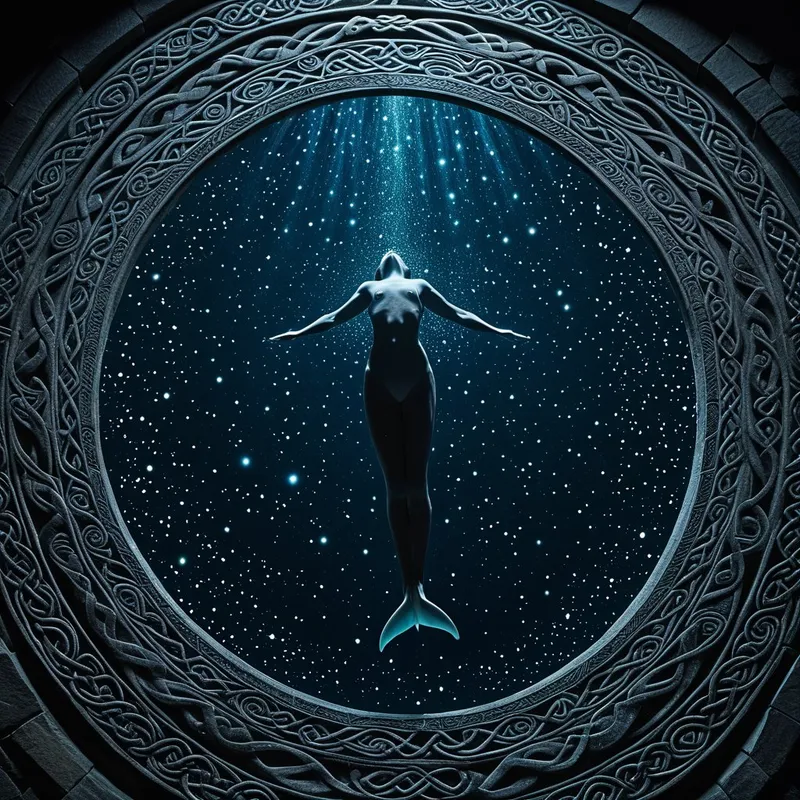
The ocean is the vast, unconscious psyche itself—teeming with life and danger, the source of all nourishment and the potential for annihilation. To set sail upon it is to willingly enter a state of not-knowing.
The coracle is the fragile vessel of consciousness, utterly inadequate for the journey yet paradoxically sufficient, symbolizing the ego’s necessary but limited resources. The Muintir na Mara are emissaries from the deeper, instinctual layers of the unconscious. They are not gods, but psychopomps—guides of the soul. Their intelligence, compassion, and mastery of the medium represent the innate, guiding wisdom of the psyche’s own structures, which activate when the ego surrenders its illusion of control.
The island, Emain Ablach, is the symbolic center, the mandala of the Self. The transformation of dolphin into crone reveals the guide’s true nature: the Great Mother in her dual aspect of creature of the deep (instinct) and ancient sage (wisdom). Her revelation—that emptiness is the shape of the true self—is the myth’s central koan.
The Dreamer's Resonance
When this myth pattern activates in the modern dreamer, it signals a profound somatic and psychological process: a navigational crisis. Dreaming of being lost at sea, or of a guiding dolphin or whale, often coincides with life transitions where old identities, careers, or relationships have dissolved, leaving a feeling of purposeless drift. The somatic experience may be one of vertigo, weightlessness, or a deep, unsettling quiet—the psychic equivalent of Fionnlagh’s hollow heart.
The dolphins in such dreams are manifestations of the dreamer’s own latent guiding intelligence. They do not appear with a printed map, but with nudges, synchronicities, and intuitive pulls. The dream is highlighting that the conscious mind, striving and planning, has lost its way. The healing process involves a descent into this oceanic state—allowing oneself to feel the loss, the emptiness, the not-knowing. It is an invitation to release the death-grip on the “oar” of willful direction and to attend, instead, to the subtle currents and intelligent presences within one’s own emotional and intuitive depths. The process is one of re-orientation not by external landmarks, but by internal, animal resonance.
Alchemical Translation
The myth of the Dolphin Guides is a perfect allegory for the individuation process, specifically the stage following a painful but necessary dissolution of the persona. Fionnlagh’s journey models the alchemical nigredo—the descent into the sea of the unconscious, the “dark night of the soul” where all light and certainty are extinguished.
The guided voyage is the albedo, where the conscious mind, in its humble vessel, learns to cooperate with the autonomous, guiding forces of the unconscious (the dolphins). This is not possession by the unconscious, but a dialogue.
For the modern individual, this translates to a practice of radical receptivity. When our life’s structure collapses—through loss, failure, or simply the weariness of a meaningless path—the instinct is to rebuild immediately, to find a new map. The myth instructs otherwise: first, one must become the coracle adrift. One must acknowledge the amnesia, the hollow feeling. This conscious acceptance of being lost is the bait that summons the inner guides—the sudden intuitive hunches, the unexpected helping hand, the dream symbol that recurs, the creative idea that surfaces from the depths.
The arrival at the island and the recovery of the “song” symbolizes the rubedo—the integration. The recovered purpose is not the old ego-goal refurbished; it is something new, born from the marriage of the disciplined, journeying ego (the sailor) and the wise, instinctual Self (the guides). One returns to the world of “land” not as the person who left, but as a translator between realms, carrying the dolphin’s wisdom within. The path home is no longer a straight line, but a living, responsive navigation, forever attuned to the deep, guiding currents of one’s own authentic being.
Associated Symbols
Explore related symbols from the CaleaDream lexicon: