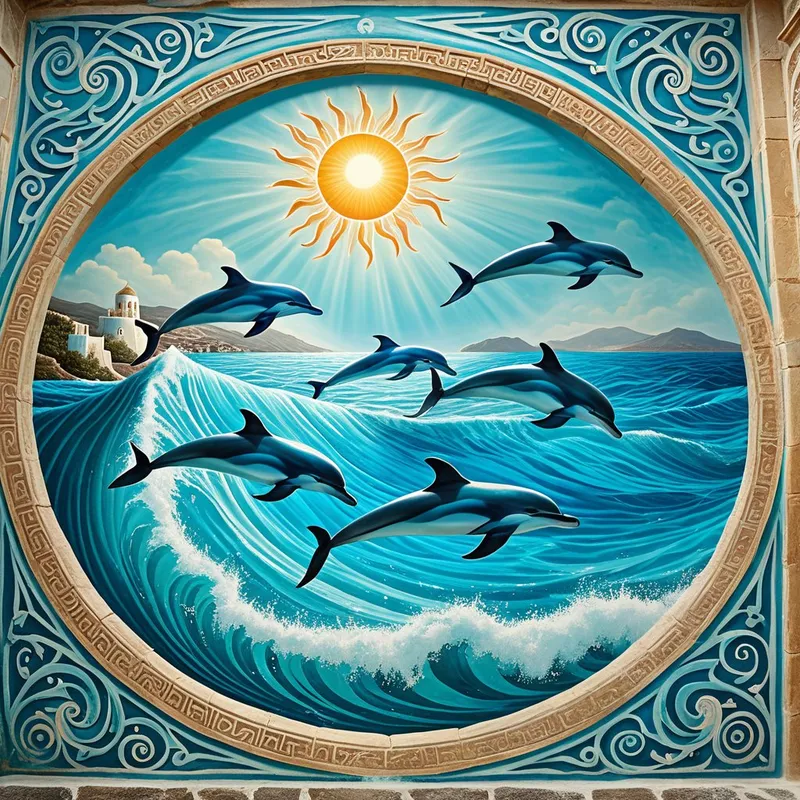
Dolphin Frescoes Myth Meaning & Symbolism
A sacred messenger guides a lost queen through labyrinthine seas to rediscover her island's heart, restoring the bond between land, sea, and soul.
The Tale of the Dolphin Frescoes
Hear now the tale whispered on salt-spray, painted in the breath of the deep. It begins not with a king, but with a queen, Potnia, whose heart had become a dry cistern. Her island, Keftiu, was lush, but a silence had fallen upon its core. The great horns of consecration stood empty of song; the labyrinth within the palace, and within her, echoed only with the shuffle of feet and the weight of rule. The sea, their great mother and father, had become a wall of blue mystery, its rhythms no longer speaking to her soul.
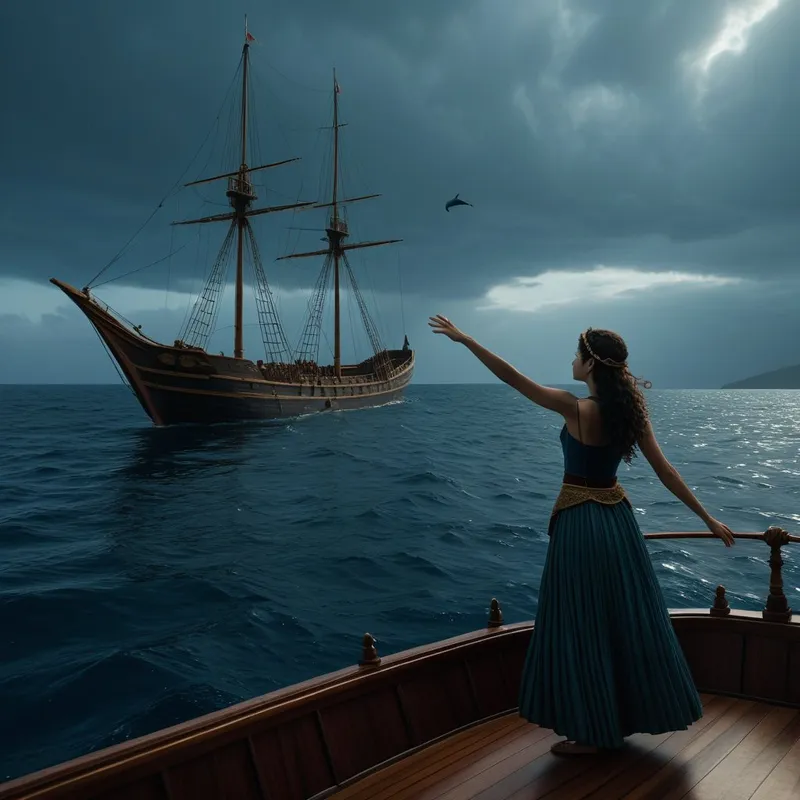
A great restlessness took her, a daimon of disquiet. She ordered her finest ship, its hull painted with octopus and spiral, and set out not for trade or war, but for a forgetting—a journey into the featureless wine-dark sea. For days, they sailed under a hollow sky, the sun a hammer, the stars cold points of indifference. The sailors grew fearful, whispering of The Sea God’s displeasure. The queen felt the threads connecting her to the land-that-is-mother stretch thin, threatening to snap.
Then, on the third day of the void, the sea changed. It began to breathe. Not with wind, but with life. A shimmering silver school of fish erupted around the ship, and with them, the dancers of the deep. They were the dolphins, the delphines. They did not merely swim; they flew through the liquid air, arcs of pure joy, their sleek bodies gleaming like polished obsidian and sunlight. One, larger than the rest, a patriarch with wise eyes, leapt before the queen’s prow. It did not flee. It turned, and looked at her.
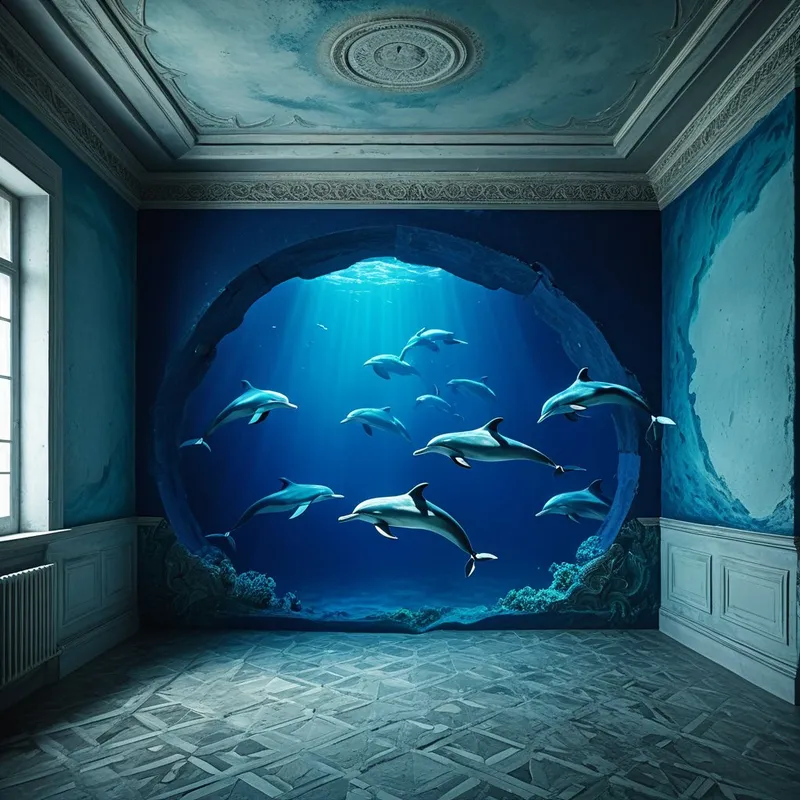
And in that look was a summons. The great dolphin dove, and the pod followed, not away, but on a path. The queen, her heart a sudden drum, cried to the helmsman, “Follow them!” The ship became a follower in a sacred procession. The dolphins led them through channels only they knew, past sleeping sea-mountains, through straits singing with currents. They led the queen back from the formless abyss, not to her own harbor, but to a small, forgotten cove on the wild side of Keftiu. There, in a sea-cave washed with aquamarine light, the water itself seemed to paint stories on the stone. And in the center of the cave, on a smooth wall, was a vision: figures of dolphins, painted with earth and shell, leaping in an eternal, graceful circle around a giant labrys.
The lead dolphin breached once more before the cave, gave a final, chattering call that was both farewell and benediction, and vanished with its kin into the blue. The queen stepped into the cave, the seawater pooling around her ankles like a blessing. She placed her hand upon the ancient fresco. And the silence broke. She heard it all—the pulse of the sea in the island’s veins, the sigh of the cypress trees, the distant laughter from the palace courtyards. The labyrinth within her had a center again. She had not been found by the dolphins. She had been remembered by them. She had been guided not to a new land, but to the oldest, most sacred map of her own soul, painted by the sea itself on the living rock of home.
Cultural Origins & Context
The so-called “Dolphin Frescoes” of Knossos and Akrotiri are not illustrations of a single, codified myth as the Greeks later would have. In the Minoan world, myth was not a linear story but a lived reality, a resonant pattern woven into ritual, art, and daily life. The frescoes themselves—found in palace chambers, likely in spaces used for ritual or elite gathering—are the primary “text.” They depict a world in harmony, where the boundary between human civilization and the vibrant, teeming sea is porous and celebratory.
This myth, as we have shaped it from the archaeological poetry of the art, would have been part of the oral tradition maintained by priestesses, bards, and sailors. Its societal function was multifaceted. For a thalassocracy, a sea-empire, it sanctified navigation; the dolphin was a protector and guide, a living manifestation of The Sea God’s benevolent aspect. On a deeper level, it reinforced the core Minoan cosmological principle of communion—not domination—with the natural world. The dolphin’s intelligence and playful freedom were seen as divine attributes, messengers (daimones) from the elemental realm. The story of the lost queen served as a narrative vessel for initiatory themes, perhaps related to the rites of passage for female nobility or priesthood, where a symbolic “loss at sea” (a dissolution of the old self) was necessary to be guided to a profound rediscovery of one’s sacred purpose and connection.
Symbolic Architecture
At its core, the myth is a profound map of the psyche’s relationship with the unconscious. The queen’s island, though prosperous, represents a conscious ego-state that has become stagnant, cut off from its life-giving source. The labyrinth is not just a physical structure but the complex, often confusing, architecture of a personality that has lost its axis mundi, its central pillar.
The sea is the great unconscious, both terrifying in its formless potential and nurturing in its depth. To be lost upon it is to experience the dissolution of ego-boundaries, a necessary prelude to renewal.
The dolphins are the ultimate symbol of guided intuition. They are creatures of the deep (the unconscious) who move with effortless grace and intelligence in their medium. They do not fight the sea; they are its embodied joy and wisdom. Their intervention represents the psyche’s innate self-regulating and healing capacity—what Jung called the transcendent function—which activates when the conscious mind admits its lostness. They guide the queen not out of the sea, but through it, transforming a voyage of despair into a sacred procession.
The sea-cave fresco is the discovered temenos, the sacred precinct within the self. It is the innate, archetypal pattern—the archetype of wholeness—that was always there, waiting to be remembered. The dolphins circling the labrys depict the integration of the dynamic, fluid, playful aspects of life (the dolphin) with the structured, decisive, and sacred authority of the center (the labrys). The queen’s touch is the moment of recognition, where the personal experience of being guided is understood as a return to a universal, eternal pattern.
The Dreamer's Resonance
When this myth stirs in the modern dreamer, it often manifests as dreams of being lost at sea, or in vast, unfamiliar spaces, accompanied by a deep somatic anxiety—a feeling of being unmoored. Then, the dolphins appear. They may appear as literal dolphins, as a sudden intuitive flash, a piece of music, or a helping figure in the dream.
This dream sequence signals a critical psychological process: the ego has ventured too far into adaptation to the outer world (the “prosperous island”) and has become desiccated, losing touch with the inner, instinctual, and spiritual life (the sea). The feeling of being lost is the psyche’s honest assessment of this state. The appearance of the dolphin-guide marks the beginning of the navigatio, the soul’s journey back to its source. The dreamer is not being rescued from the unconscious, but being taught how to move within it. The somatic shift, from anxiety to awe and flowing movement, is the body registering the re-connection to a deeper, guiding intelligence. The dream often ends not with arrival at a familiar port, but at a mysterious, beautiful place that feels profoundly like “home”—the discovery of an inner sanctum the conscious mind had forgotten.
Alchemical Translation
The alchemical journey mirrored here is the solve et coagula: dissolve and coagulate. The queen’s purposeful yet despairing voyage into the formless sea is the solve, the dissolution of the hardened, overly-structured conscious attitude. This is a voluntary descent, a nekyia, which feels like failure but is the prerequisite for transformation.
The guided return is the coagula—not a return to the old, brittle form, but a re-coagulation around a newly discovered, more authentic center. The discovered fresco is the lapis philosophorum, the philosopher’s stone of the psyche: the realized pattern of one’s unique wholeness.
For the modern individual, the myth models the process of individuation. We are all the ruler of an island that can turn stagnant. The call is to have the courage to set sail into our own disquiet, our own midlife sea, our own depression or meaning-crisis—and to cease paddling frantically. We must wait, in the stillness of that lostness, for the dolphin. That guide may be a sudden creative inspiration, a synchronicity, a therapist’s apt interpretation, or a quiet voice of intuition that says, “turn here.”
The triumph is not in conquering the sea, but in learning its currents and trusting its native guides. It is to allow the deep, playful, intelligent, and communal spirit within (the dolphin) to lead us back to the sacred, central authority of our own being (the labrys in the cave). We do not create this inner fresco; we discover that it has been there all along, painted by the very depths we feared, waiting for our touch to make it live again. We return to our daily lives not as the same ruler, but as one who has seen the map on the cave wall and now governs in conscious communion with the vast, supporting, and intelligent deep.
Associated Symbols
Explore related symbols from the CaleaDream lexicon: