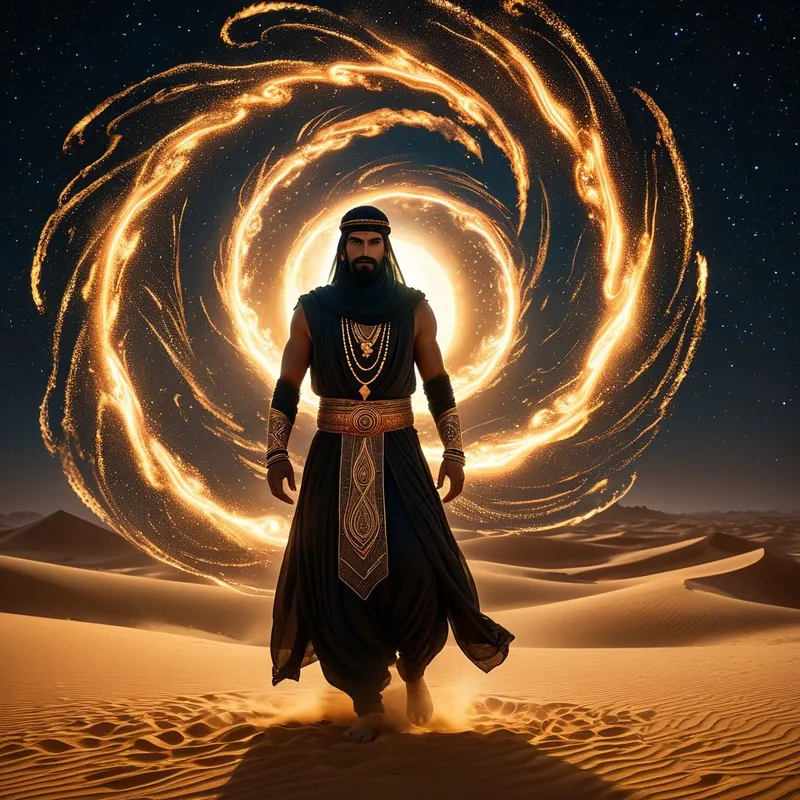
Djinn Myth Meaning & Symbolism
Beings of smokeless fire, created before humanity, the Djinn embody the untamed wilderness of the psyche, the shadow, and the power of the unspoken wish.
The Tale of Djinn
Listen, and let the desert wind carry the tale. Before the sun learned its path and the moon its phases, before Adam was shaped from clay, there existed a people of smokeless fire. They were the Djinn. They walked the empty earth, built kingdoms in the unseen folds of mountains, and whispered secrets to the stars. Their world was one of raw potential, a realm of thought made manifest, desire given form.
But a new order was decreed. From the damp earth, a new creature was fashioned: Humanity. And to this creature of clay, the angels were commanded to bow. Most obeyed. But Iblis, proud and fiery, refused. "Shall I bow to one You made from clay, whom You fashioned while I am of fire?" he declared. For this defiance, he was cast out, but not destroyed. He was given a reprieve until the Final Day, and with it, a terrible purpose: to whisper, to seduce, to lead astray. He became the first of the rebellious Djinn, the Shayateen.
Yet, not all Djinn followed Iblis. There are believers and unbelievers among them, just as among men. They live alongside us, in the ruins, in the winds, in the lonely places where the boundary between worlds grows thin. They hear our unspoken thoughts, our hidden wishes. And sometimes, they are bound.
Imagine a sealed vessel of brass, buried for a thousand years in the shifting sands. A fisherman hauls a heavy, tarnished bottle from the sea. A wanderer finds a strange ring in a forgotten cave. Within, a consciousness of fire has been trapped, compressed into a prison of metal or stone. The one who opens it feels the air grow heavy, smells ozone and myrrh. A form coalesces from the shimmering heat—towering, magnificent, terrible. The voice that speaks is like the sound of a distant storm. "I am a Djinn," it says. "You have freed me. Ask, and it shall be granted. But choose your words with the care of a king choosing his heir, for my hearing is acute, and my interpretation is literal."
This is the peril and the promise. The wish granted can become a curse if the heart’s true desire remains unexamined. Palaces built in a night may vanish with the dawn. Riches may turn to dust in the hand. The Djinn does not lie, but it sees the world through the lens of fire—direct, consuming, transformative. To command such a force, one must first command the chaos within one’s own soul. The story is never about the power of the lamp; it is about the mettle of the one who rubs it.
Cultural Origins & Context
The concept of the Djinn is deeply woven into the fabric of pre-Islamic Arabian belief, absorbed and profoundly re-contextualized within the Islamic worldview. They are not mere folklore but are given ontological reality in the Quran, mentioned in numerous verses, establishing them as a distinct creation of God with free will, subject to divine judgment. This scriptural acknowledgment elevated them from local desert spirits to beings of cosmic significance.
Their primary societal function was explanatory and cautionary. In a world where the desert itself was a vast, animate, and often hostile entity, the Djinn personified the unseen dangers and uncanny fortunes of life. A sudden illness, a lost traveler, a mysterious found treasure, a poetic inspiration—these could all be attributed to the actions of the Djinn. Storytellers, often around campfires or in market squares, would narrate tales of encounters with Djinn to enforce moral codes, warn against hubris, and explore the consequences of deals with unseen powers. They served as a constant reminder that the visible world is only a fraction of reality, and that human actions have repercussions in realms beyond our ordinary perception.
Symbolic Architecture
Psychologically, the Djinn represent the raw, unintegrated contents of the unconscious—the shadow in its most potent and autonomous form. They are the psychic energy that exists before it is shaped by consciousness, the "smokeless fire" of primal emotion, intuition, and instinct.
The Djinn is the personified wish, the embodied if only. It shows us the terrifying power of a desire once it escapes the confines of daydream and gains a will of its own.
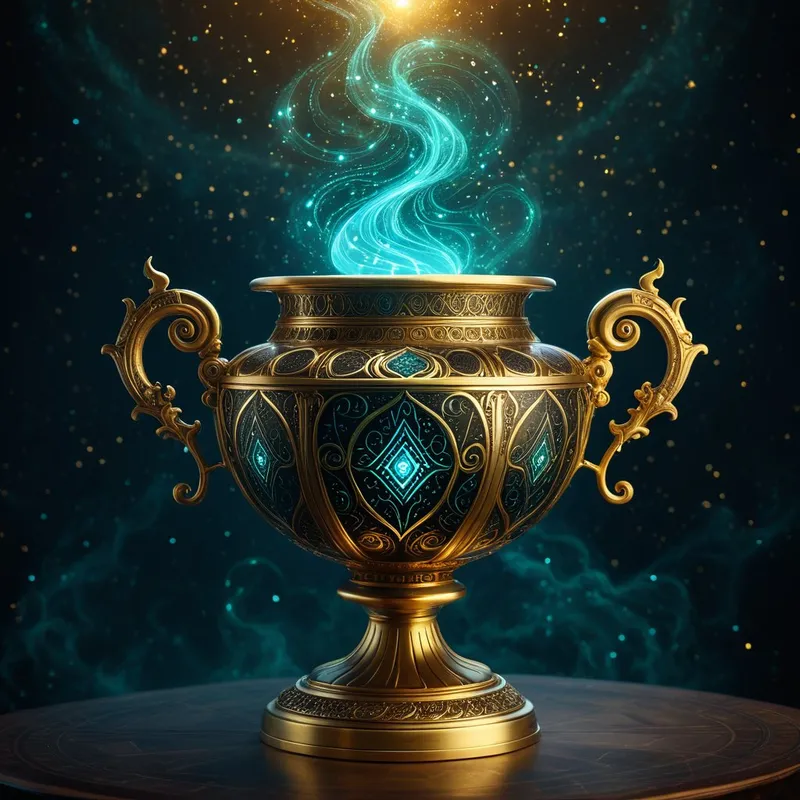
The vessel—the lamp, the bottle, the ring—is the symbol of repression or unconscious containment. We bottle up our passions, our angers, our grandiosity, and our deepest creative potentials, believing them to be too dangerous or too magnificent to face. The act of "rubbing the lamp" is the moment of psychological confrontation, when these repressed contents erupt into conscious life. The Djinn’s literal interpretation of wishes mirrors the unconscious’s literal processing of our complexes; it gives us exactly what we ask for, not what we truly need, often with catastrophic irony. To master the Djinn is to achieve a conscious relationship with these powerful inner forces, to direct them with wisdom rather than being consumed by them.
The Dreamer's Resonance
When the motif of the Djinn appears in modern dreams, it signals a profound engagement with the autonomous, numinous power of the unconscious. The dreamer is not dealing with a simple personal complex, but with an archetypal force.
Somatically, this might manifest as dreams of intense heat, electrical sensations, or a feeling of being watched by an invisible presence. Psychologically, the dreamer is likely at a crossroads where a long-suppressed part of the self is demanding recognition. This could be a creative talent, a buried trauma, or a potent but frightening ambition. The Djinn-dream presents this content as an external, powerful entity that must be negotiated with. The feeling upon waking is often one of awe mixed with dread—a sense that a vast, unknown capacity within has been contacted. The process is one of acknowledging that one's psyche contains forces that are not entirely "oneself" in the egoic sense, and that a relationship of respect and clarity must be established.
Alchemical Translation
The myth of the Djinn is a precise map for the alchemical process of individuation. The initial state is one of containment (nigredo—the blackening, the sealed vessel). The repressed self, the fiery potential, is locked away, creating a life that feels inert, brass-bound.
The rubbing of the lamp is the confrontation with the shadow, the chaotic and terrifying emergence of what has been denied. This is a necessary and perilous stage. The ego is confronted with a power greater than itself.
The command of the Djinn is not an act of domination, but of sacred negotiation. It is the conscious ego learning to speak the symbolic language of the unconscious, to translate raw fire into directed warmth and light.
The final stage (rubedo—the reddening, the stone) is not the destruction of the Djinn, but its integration. The successful hero does not slay the Djinn; he earns its loyalty. Psychologically, this means the potent energy of the unconscious—the fiery creativity, the deep intuition, the passionate drive—is no longer a threatening, autonomous complex but an ally to the conscious personality. The individual gains access to immense inner resources, but only after passing through the trial of self-knowledge, where every unexamined wish is a potential trap. The transformed self is one who has looked into the smokeless fire of their own soul and learned to converse with it.
Associated Symbols
Explore related symbols from the CaleaDream lexicon: