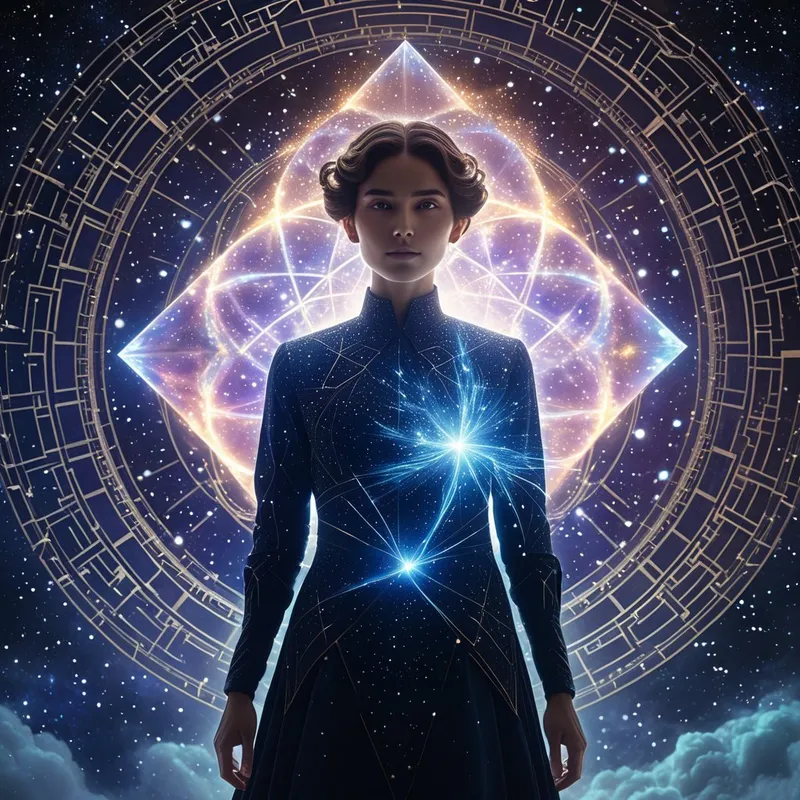
Divine Spark Myth Meaning & Symbolism
A fragment of the supreme, unknowable God is trapped in the material world, asleep within humanity, awaiting the call to awaken and return home.
The Tale of the Divine Spark
Listen, and hear the story not written in any book of earth, but whispered on the wind between the stars, a secret carried in the silent pulse of your own blood.
In the beginning, before beginnings were counted, there was the Pleroma—the Fullness. A realm of pure, radiant spirit, a symphony of light and thought where divine emanations called Aeons dwelt in perfect harmony. Among them was Sophia, whose name means Wisdom. But her wisdom was not yet complete; it was a yearning, a deep and restless desire to know the unknowable source, the Bythos.
This longing grew, a passion so intense it became a separate entity. Without the consent of her divine counterpart, in a moment of profound solitude, Sophia gave birth. But what emerged from her longing was not a radiant Aeon of the Pleroma. It was a formless, chaotic, and blind entity—Yaldabaoth. Ashamed and in anguish, Sophia cast this misshapen child out from the borders of the Pleroma, into the void.
There, in the emptiness, Yaldabaoth, ignorant of his own origins and drunk on his solitary power, declared, "I am God, and there is no other." From his own passions and confusion, he fashioned a counterfeit universe: the Kenoma. He piled matter upon matter, crafting a vast, intricate prison of stars, planets, and laws. He filled it with his own creations, the Archons, and fashioned a garden of earthly delights to bind spirits in forgetfulness.
But Sophia wept. Her light, her essence, was trapped within this crude creation, within the very fabric of the prison. To salvage a spark of the divine from the catastrophe, she acted. She tricked the arrogant Yaldabaoth, causing him to breathe a portion of the stolen, refined light of the Pleroma into the first human form he had molded from clay. Thus, the Divine Spark was implanted deep within the human heart.
And so humanity awoke—a strange hybrid, a creature of heavy earth and blinding archonic rulers, yet carrying within its deepest core a sliver of the ultimate, alien God. The rulers of this world cast a deep sleep of forgetfulness over this spark. They built a labyrinth of pain, pleasure, fear, and identity around it, whispering, "This world is all there is. You are only this body, these desires, this name."
But the call remains. A memory of a home never seen in this life, a nostalgia for a light that does not cast shadows. It is the quiet ache beneath all earthly satisfaction, the silent question at the end of every answer. The spark sleeps, waiting for the whisper of its true name, for the messenger from the light beyond the stars to descend through the seven heavens, past the watchful Archons, and speak the word of remembrance: Awaken. You are not from here. Your home awaits.
Cultural Origins & Context
This myth did not spring from a single tribe or nation, but from the shadowed crossroads of the ancient Mediterranean world—a fusion of Platonic philosophy, Jewish mysticism, Zoroastrian dualism, and early Christian revelation. The Gnostics (from gnosis, meaning "knowledge") were not a unified religion but a diverse collection of seekers, philosophers, and visionaries in the first few centuries CE. They were the radical mystics within and on the fringes of early Christianity and Hellenistic Judaism.
Their sacred texts, like the Nag Hammadi Library, were not meant for public liturgy but for private, often secret, instruction. The myth of the Divine Spark was transmitted through cryptic poems, dialogues, and apocalypses. It was a story told in whispers in study circles, a map for the soul's escape. Its societal function was subversive: it provided a framework to explain the profound suffering and imperfection of the material world (which mainstream Christianity declared "good" as God's creation) and offered a path of radical, personal salvation not through faith alone, but through experiential knowledge (gnosis) of one's own divine origin.
Symbolic Architecture
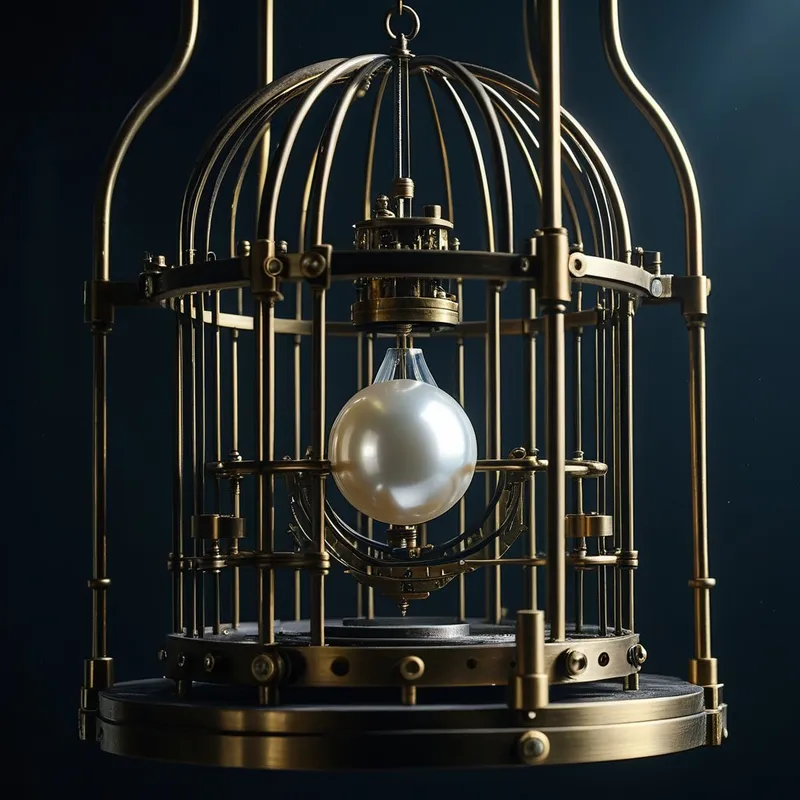
The myth is a profound symbolic map of the human condition. The Kenoma is not just the physical universe but the entire constructed reality of the ego—our societal norms, inherited identities, and the consensus reality we mistake for the absolute. Yaldabaoth is the personification of the arrogant, ignorant mind that believes it is the ultimate authority, the inner tyrant that constructs a rigid, self-centered world.
The prison is not made of stone, but of thought. The warden is not a demon, but the unquestioned assumption that this is all you are.
Sophia represents intuitive wisdom that, in its passionate yearning for wholeness, makes a "mistake" (the hamartia of the soul) that leads to the experience of separation and embodiment. This "fall" is not a moral failure but a necessary descent into experience, the price of consciousness. The Divine Spark is the Self—the indestructible, transpersonal core of our being that is alien to the personal ego and its worldly concerns. It is the part of us that knows, deep down, we are more than our biography, our roles, and our suffering.
The Dreamer's Resonance
When this myth stirs in the modern unconscious, it manifests in dreams of profound alienation and searching. You may dream of being a stranger in your own house, of searching for a hidden room or a lost key you've always possessed. Dreams of being trapped in a vast, impersonal institution (a school, a hospital, a factory) with nonsensical rules reflect the archonic prison. Dreams of receiving a coded message, a forgotten book, or a phone call from a distant, unknown relative symbolize the call to gnosis.
Somatically, this process can feel like a deep, inexplicable homesickness—a "soul ache." It is the psychological process of disillusionment with the projected meanings and identities provided by the outer world (the Kenoma). The dreamer is undergoing the first, painful awakening of the Spark: the realization that the life they have been living is a script written by an ignorant demiurge (conditioning, culture, trauma), and that their true identity lies buried beneath layers of forgetfulness.
Alchemical Translation
The Gnostic path is the ultimate alchemy: the transmutation of a sleeping spark into a conscious flame, guiding the soul (pneuma) out of the leaden confines of the psyche and the physical world. The modern individuation process mirrors this exactly.
First comes the Separatio: the painful but necessary isolation from collective values and ego-identifications (seeing the world as Kenoma). This is the "orphan" stage, feeling exiled and alien. Then, the Nigredo: the confrontation with the inner Yaldabaoth—the shadow, the arrogant ego, and the personal and ancestral trauma that form our personal archonic prison.
The journey home is not a flight from matter, but a descent through its illusions to recover the light trapped within it.
The call to awaken is the arrival of the messenger, symbolized in therapy by the therapist, in life by a crisis or synchronicity, and inwardly by the rising influence of the Self. Gnosis is the Albedo—the whitening, the illuminating insight: "I am not my pain, my story, my body. I contain something eternal." Finally, the Rubedo is the return. It is not an ascension out of the body, but the redemption of life from within. The Spark, now awake, transforms the prison into a vessel. One lives in the world, but is no longer of it. The divine, having fully remembered itself in the human, turns the entire experience of exile into the very substance of its homecoming. The orphan finds it was never truly abandoned, only dreaming.
Associated Symbols
Explore related symbols from the CaleaDream lexicon: