Divine Light Myth Meaning & Symbolism
The myth of the Divine Light descending into the world of matter, becoming flesh to illuminate the darkness and offer a path of transfiguration back to its source.
The Tale of Divine Light
In the beginning, before the shaping of mountains or the whispering of seas, there was the Word. And the Word was with God, and the Word was God. This Word was Life, and the Life was the Light of all humanity. A Light that shone in the primordial darkness, and the darkness could not overcome it.
But the world, fashioned from the dust and the deep, grew thick with shadow. The children of earth forgot the brilliance of their origin, their eyes adjusting to the gloom, mistaking the twilight for the full day. The Light, undimmed and aching with a love older than time, conceived a terrible and glorious plan. It would not simply shine upon the darkness from a safe, celestial distance. It would enter into the very heart of it.
And so, the uncontainable contracted. The infinite became infinitesimal. The Divine Light, through a mystery that hushed the cosmos, was kindled within the womb of a young woman in a forgotten corner of the empire. He was born not in a palace of gold, but in a cave used for beasts, his first cradle a feed trough. The shepherds, keeping watch in the fields, saw the sky torn open and filled with the terrifying, beautiful glory of the host, announcing the arrival of the Light in flesh.
He grew, this child of light and dust. For thirty years, the radiance was hidden, banked like a fire beneath ordinary ash. Then, in the waters of the Jordan, as he rose from the river, the heavens were rent once more. The Spirit descended like a dove, and a Voice from the cloud proclaimed, “This is my beloved Son.” The hidden Light began to shine.
He walked the dusty roads, and where the Light passed, the shadows fled. Blind eyes, long accustomed to nothingness, were seared open with color and form. Lepers, whose flesh was a living tomb, felt the warmth of the Light restore them. Those possessed by inner darkness—the chaotic, fragmenting spirits of the unclean—writhed and shrieked in its presence, for it revealed them utterly.
Yet, the Light’s purpose was not merely to dispel external shadows, but to illuminate the interior ones. He spoke in riddles of lamps and bushels, of cities on hills that cannot be hidden. “I am the light of the world,” he declared. “Whoever follows me will never walk in darkness but will have the light of life.”
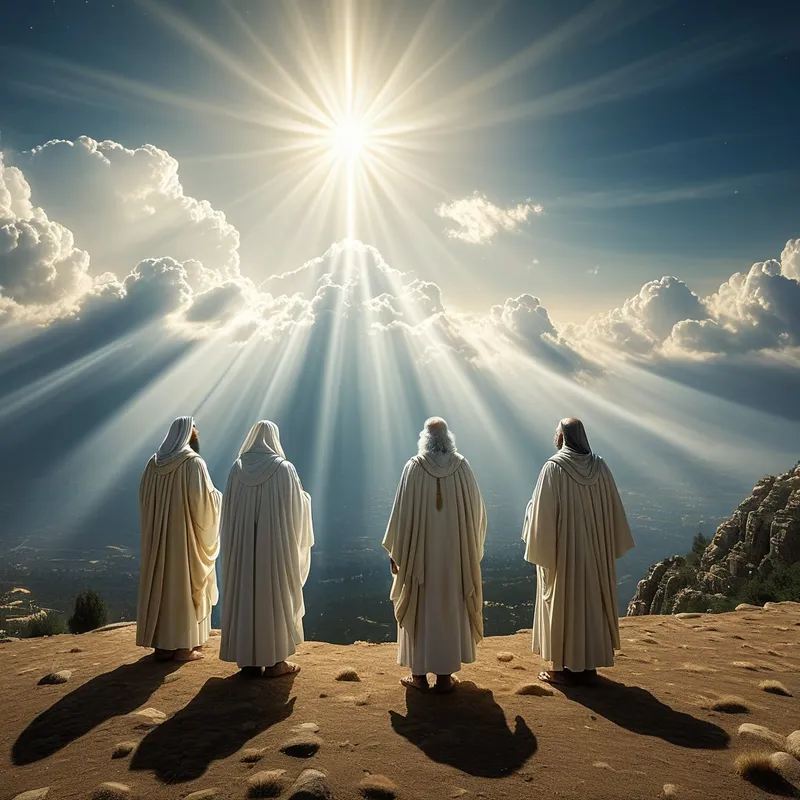
But the world, comfortable in its half-light, feared the full revelation. The shadows conspired. On a high mountain, he revealed his true nature to three trembling friends—his face shone like the sun, his clothes became whiter than any fuller on earth could bleach them. Moses and Elijah appeared, speaking of the departure he was to accomplish in Jerusalem. This was the Light unmediated, and it was terrifying in its beauty.
The culmination was a hill called Golgotha. There, at the zenith of the world’s shadow, the Light was seemingly extinguished. He was nailed to a cross of dead wood, and a darkness fell over the whole land at noon—a darkness so thick it could be felt. The source of illumination was enveloped by the very substance it came to conquer.
For three days, the world held its breath in a profound, cosmic pause. Then, in the deep watch of the night before dawn, in a tomb sealed with stone and imperial authority, the impossible happened. The Light, which no darkness can overcome, rekindled itself. It burst forth, not merely restoring what was, but transfiguring it. The man who died was alive, his body now a vessel of radiant, immortal flesh. He appeared to his followers, not as a ghost, but as a living sun at the center of their room, saying, “Peace be with you.” The Light had passed through the ultimate shadow and was now inextinguishable, offering its own nature to all who would receive it.
Cultural Origins & Context
The myth of the Divine Light is not a single story but the central, luminous thread woven through the entire tapestry of the Christian narrative. Its primary sources are the canonical Gospels—Matthew, Mark, Luke, and John—composed in the latter half of the first century CE. The Gospel of John, in particular, frames the entire biography of Jesus Christ within this cosmic light metaphysics, opening with the majestic “In the beginning was the Word…” prologue.
This myth was born in a cultural cauldron: Second Temple Judaism, with its rich imagery of God’s glory (Shekinah), the wisdom of God personified as a radiant figure, and prophetic hopes for a coming dawn; and the Hellenistic world, steeped in Platonic thought where light was a metaphor for the Good, the True, and the Real. The early Christian storytellers—evangelists, apostles, and teachers—synthesized these streams. They passed down the myth orally at first, in communal gatherings for the “breaking of bread,” where the story of the Light’s death and resurrection was ritually remembered and re-experienced.
Its societal function was multifaceted. For persecuted communities, it was a narrative of hope, asserting that the oppressive darkness of Roman power was ultimately illusory and temporary before the unconquerable Light. Doctrinally, it established the core claim of the incarnation—the paradoxical union of divine and human nature. Psychologically and spiritually, it provided a master map for the soul’s journey: a path from the darkness of ignorance and sin, through the illuminating encounter with the divine figure, toward the promised transfiguration into “children of light.”
Symbolic Architecture
At its core, the myth presents Light not as a physical phenomenon but as the supreme symbol of consciousness, truth, life, and divine presence. Darkness represents the opposite: unconsciousness, ignorance, death, and alienation.
The Divine Light is the archetype of consciousness itself descending into the unconscious matrix of the world to initiate the great work of awakening.
The central figure, Christ, embodies the Imago Dei—the perfect image of the divine source within the human frame. He is the symbol of the potential wholeness in every individual, the transcendent function made flesh. His journey is the blueprint for the process of individuation: the conscious ego (the human Jesus) must fully submit to and embody the guiding light of the Self (the Divine Word), pass through the necessary crucifixion (the death of the old, limited identity), and experience the resurrection (the birth of a new, integrated consciousness).
The supporting symbols are profound. The Mount of Transfiguration represents the peak experience of psychic integration, where the inner law (Moses) and the inspired voice of the unconscious (Elijah) converse with the central Self. The Cross is the ultimate coincidentia oppositorum—the place where light and darkness, life and death, divine and human, eternity and time intersect and are held in transformative tension. The Resurrection body is the symbol of the psychoid aspect of the Self—a consciousness that has fully integrated the material and spiritual realms, no longer subject to the laws of either alone.
The Dreamer's Resonance
When this myth activates in the modern dreamer’s psyche, it signals a critical phase of awakening or crisis. To dream of a blinding, beautiful light in a dark place—a light that feels personal, intelligent, and loving—often accompanies what Jung called an “encounter with the Self.” It is a numinous experience that can feel both exhilarating and terrifying, as it promises radical reorientation.
Dreams of being unable to find a light switch, or of a lamp flickering and dying, may reflect the dreamer’s sense of being in a period of spiritual or psychological “dark night,” where old certainties have faded and new consciousness has not yet dawned. This is the somatic experience of the via negativa—the path of purification.
Conversely, dreams where the dreamer’s own hands or chest begin to emit light suggest the early stages of what the myth calls “transfiguration.” The individual is beginning to recognize and own their inner source of authority, wisdom, and life—the inner Christ archetype. This can be accompanied by feelings of warmth, expansion, or awe in the dream, and often a sense of profound responsibility upon waking. The psyche is modeling the incarnation: the divine spark is taking up residence in the everyday “flesh” of the dreamer’s own personality and life.
Alchemical Translation
The alchemical process mirrored in this myth is the opus magnum—the great work of transforming leaden, unconscious existence into golden, conscious life. It is a precise map for psychic transmutation.
Incarnation (Nigredo & Albedo): The first, staggering step is the descent of the light into the darkness of one’s own complex, shadow-ridden humanity. This is the nigredo, the blackening. One must consent, as the myth does, to the full reality of one’s flawed, mortal, “earthy” condition. The light does not avoid this; it enters it. The psychological work here is brutal honesty—shadow work. The subsequent albedo, the whitening, begins as this incarnate light starts to illuminate the inner world. It is the dawning of self-awareness, where one’s complexes, patterns, and inner figures are seen clearly for the first time in its glare.
Crucifixion (Citrinitas): This is the stage of suffering and paradox, the yellowing. The emerging conscious ego, now aligned with the Self (the inner light), faces the inevitable conflict with the entrenched structures of the personal and collective psyche—the “law” of one’s upbringing, the “prophets” of internalized voices, the “empire” of societal expectations. This is the crucifixion: the feeling of being torn apart by opposing demands. The alchemical key here is holding the tension. One must stay on the cross, in the conflict, without resorting to one-sidedness. This suffering is not meaningless; it is the fire that separates the essential from the dross.
Transfiguration is not the avoidance of suffering, but the radiant consciousness that emerges from having consciously endured it.
Resurrection (Rubedo): The final stage is the reddening, the production of the Philosopher’s Stone. This is the resurrection body—a new, integrated personality. The light is no longer an external visitor or a temporary experience; it has become the very substance of the being. The individual operates from a united center. They have “died” to their old, ego-dominated life and are “reborn” to a life animated by the Self. This is the promise of the myth made personal: “It is no longer I who live, but the Light that lives in me.” The work is to make one’s daily life—one’s relationships, work, and creativity—a transparent vessel for that indwelling radiance, thus completing the alchemical circuit of descent and return.
Associated Symbols
Explore related symbols from the CaleaDream lexicon: