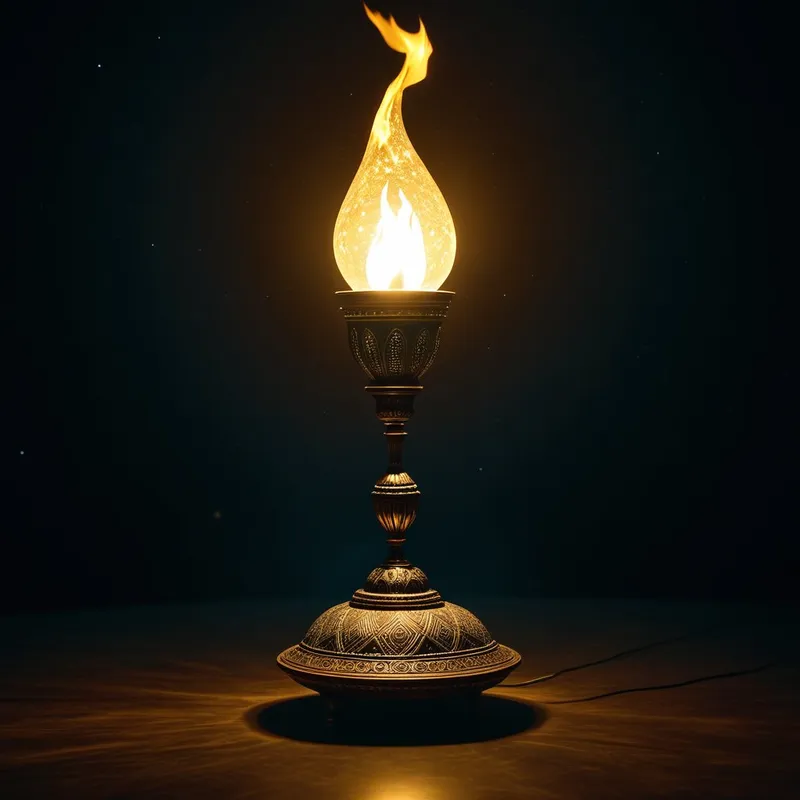
Dipa Myth Meaning & Symbolism
A myth of a lamp that burns its own oil to dispel darkness, symbolizing the ultimate sacrifice of the self to become a vessel for liberating wisdom.
The Tale of Dipa
Listen. In the deep, silent hours before the world remembers the sun, there is a kingdom of shadow. It is not the gentle dark of rest, but a clinging, suffocating obscurity that settles on the mind like a heavy cloak, smothering memory, hope, and the very knowledge of the path. In this realm, beings wandered, not knowing they were lost, their inner sight turned utterly inward upon itself, seeing nothing.
But in the heart of this profound night, a vow was made. It was not a shout, but a whisper in the fabric of reality. A presence, an essence of compassion that had witnessed the endless, blind stumbling, resolved to become a beacon. It would not command the sun to rise, for that light was outside of the lost ones. It would become a light from within their very world of shadow.
Thus, the essence poured itself into a form both humble and profound: a lamp. They called it Dipa. Its body was crafted of steadfast resolve, its reservoir filled not with common oil, but with the very essence of selfless intention. Its wick was the focused mind, pure and upright.
The Dipa was placed on the threshold between the known darkness and the unseen path. With a breath of ultimate commitment, its wick was touched, and a flame was born—a single, fragile, golden tongue of fire. It did not roar. It did not blaze. It simply was. And in its simple being, a miracle unfolded.
The clinging darkness, which had seemed absolute, recoiled. Not in fear, but in revelation. The light of the Dipa did not attack the dark; it revealed that the dark had no substance of its own. It was merely an absence. With each steady moment the flame burned, it consumed a drop of its own oil, its own life, its own self. This was its nature: to give of its very substance to make space for clarity.
Where the light fell, the lost ones saw their own feet. They saw the rough stones of the path, the gentle incline leading upward. They saw the faces of their fellow wanderers, no longer strangers but companions in the journey. The Dipa asked for nothing. It gave no sermons. It only burned, offering its light freely, its purpose fulfilled in its own gradual emptying.
It burned through the long watch of the night. Its flame remained constant, even as its reservoir grew shallow. It illuminated fears as mere shapes, and obstacles as steps. It showed that the path was always there, waiting only for the light to fall upon it. And when the first true hint of dawn finally began to blush at the edge of the sky, the Dipa’s task was complete. Its oil spent, its wick turned to a whisper of ash, its light gently merged with the growing radiance of the new day, having held the line against oblivion until the greater light could return.
Cultural Origins & Context
The symbol of the Dipa is not confined to a single, canonical mythic narrative like those of gods and heroes. Instead, it is a pervasive, living metaphor woven into the very fabric of Buddhist teaching and practice. Its origins are in the foundational sermons of the Buddha, who used the imagery of light and lamps to describe the nature of wisdom and the path. In the Pali Canon, he famously urged his disciples to be "islands unto yourselves, lamps unto yourselves," taking refuge in the Dhamma as their light.
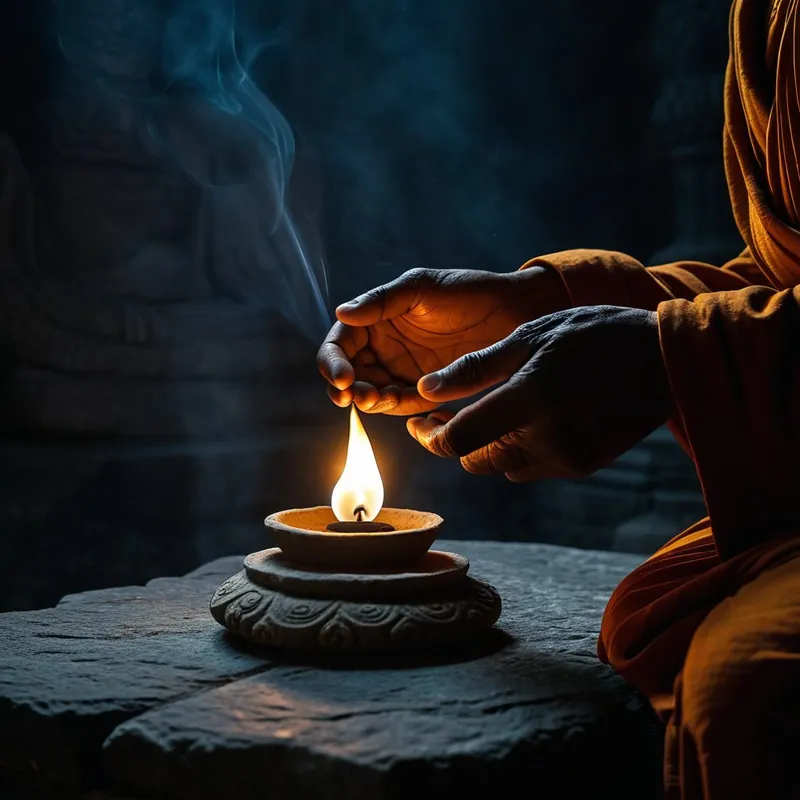
This metaphor was passed down not only through scripture but through ritual and art. In temples across Asia, the physical lighting of lamps (dipa or butter lamps) became a core devotional act. Each lamp lit before an image of the Buddha or a Bodhisattva is a re-enactment of the myth: the devotee offers fuel (oil, butter) and ignites a light, symbolizing the offering of their own resources—their effort, their faith, their intention—to sustain the wisdom that dispels ignorance. The lamp’s societal function was thus both pedagogical and participatory. It taught the doctrine of self-reliance and inner illumination through a simple, sensory act that anyone could perform, making the profound intimately accessible.
Symbolic Architecture
The Dipa is a perfect symbolic vessel for the central paradox of the Buddhist path. It represents the enlightened mind, the Buddha, or the Dhamma itself.
The lamp does not illuminate itself; it illuminates the space around it. In the same way, wisdom is known not by introspection upon the self, but by the clarity it brings to all phenomena.
Its oil is the fuel of practice: virtue (sila), concentration (samadhi), and the accumulated merit of selfless action. This fuel is finite and must be consumed. The wick is the focused, disciplined mind, trained through meditation to be steady and receptive. The flame is the wisdom (panna) that arises when the prepared mind engages with the fuel of experience. It is luminous, transformative, and inherently sacrificial—it exists by consuming what feeds it.
Most critically, the Dipa’s light dispels darkness without conflict. It does not wage war on ignorance; it reveals ignorance’s insubstantial nature. The darkness was never a thing to be defeated, only a condition of not-knowing. The light, therefore, symbolizes a non-violent, revelatory power. The ultimate emptying of the lamp—the burning of all its oil—symbolizes the culmination of the path: the total expenditure of the conditioned self, the "fuel" of karma and craving, to reveal the unconditioned, deathless state (Nirvana).
The Dreamer's Resonance
When the archetype of the Dipa flames in the modern dreamscape, it often signals a critical phase of inner work where one’s personal resources are being dedicated to a process of clarification. To dream of a lone, steadfast lamp in a vast darkness suggests the dreamer is in a period of isolation or confusion, yet has accessed a point of inner guidance. The dream-ego may be the lamp-bearer, struggling to keep the flame alive against winds of doubt or adversity.
Somatically, this can feel like a burning focus in the chest or mind—a "light bulb moment" sustained under pressure. Psychologically, it mirrors the process of "holding the tension" in somatic or depth work. The dreamer is burning their own psychic "oil"—their old coping strategies, emotional reserves, or identifications—to maintain awareness (the flame) through a dark night of the soul. The dream may test this: the oil runs low, the wick smokes, the flame gutters. These images do not signify failure, but the authentic cost of illumination. The psyche is demonstrating the law of psychic metabolism: to create light, something must be given up.
Alchemical Translation
For the individual on the path of individuation, the Dipa models the alchemy of consciousness itself. The ego, initially identified as the solid "lamp," must learn its true role as the vessel and fuel for a transpersonal flame.
The individuated Self is not the lamp that holds the light, but the light that consumes the lamp.
The modern seeker begins by filling their lamp with the oils of knowledge, therapy, and experience. They trim the wick through discipline and introspection. They ignite the flame through a commitment to truth. This is the first alchemical stage. But the myth demands a second, more profound operation: the willing sacrifice of the vessel itself.
The core psychic transmutation occurs when one realizes that the light of awareness is primary, and the personal identity that carries it is secondary and combustible. To become a "lamp unto oneself" is to undertake the gradual, courageous burning away of the very structures of the conditioned personality—the fears, desires, and narratives we mistake for ourselves—to serve a purpose greater than self-preservation: the illumination of reality as it is.
This is the ultimate alchemical translation: the lead of the ego-complex is not turned into the gold of a better, shinier ego. It is consumed as fuel so that the gold of pure, objective consciousness can shine forth unobstructed. One moves from being a person who has insights to becoming a temporary, gracious host for the light of insight itself. In the end, as in the myth, the individual vessel is empty, its task complete, its essence having merged with the dawn of a broader, impersonal awareness. The struggle is not to keep the self alive, but to allow the self to be spent wisely in the service of a light that belongs to no one, and thus, to everyone.
Associated Symbols
Explore related symbols from the CaleaDream lexicon: