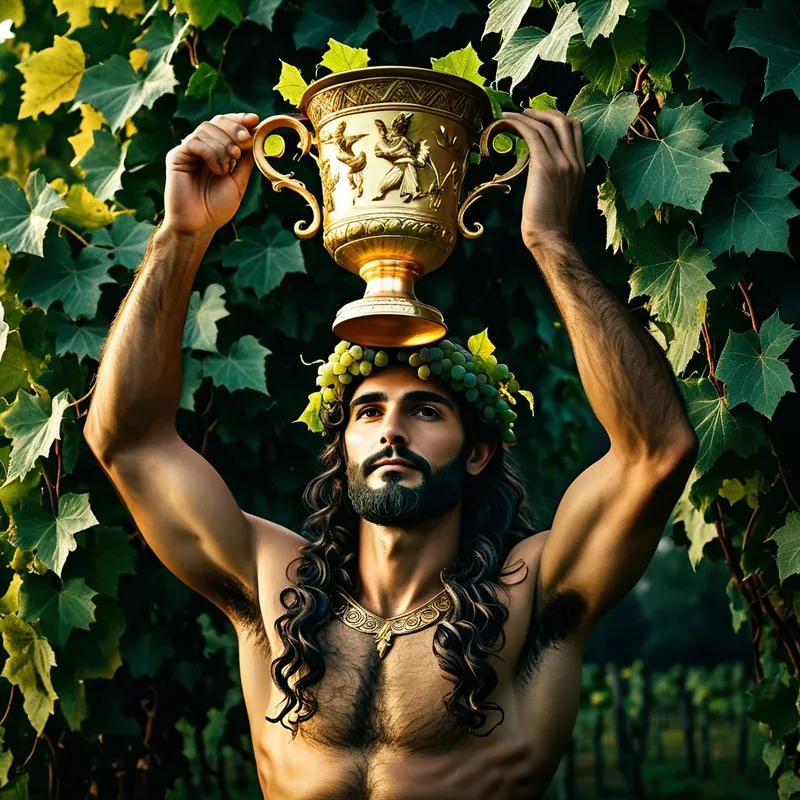
Dionysus's Kantharos Myth Meaning & Symbolism
The story of the god's sacred cup, a vessel of divine madness that dissolves boundaries and reveals the raw, creative chaos at the heart of being.
The Tale of Dionysus's Kantharos
Hear now the tale not of a hero’s sword, but of a god’s cup. In the deep, resin-scented forests where sunlight fractures into emerald shards, a presence stirs. It is the rustle of leopard skin, the sigh of wind through vine, the low laugh that echoes from the mountain’s hollow heart. This is the realm of Dionysus, the twice-born, the stranger-god who walks the boundary between civilization and the wild.
He carries no thunderbolt, no trident. His scepter is the thyrsus, and his true weapon, his sacred trust, is the Kantharos. Forged not in Hephaestus’s smoky forge but born from the earth’s own dreaming, it is a vessel of dark clay and gleaming promise. Its twin handles are like raised arms in ecstatic dance, its bowl a waiting womb for the liquid sun of the grape.
The story unfolds not in a single battle, but in a thousand revels. See him in the torch-lit clearing, the Maenads circling like flames. He raises the Kantharos. It is not water he pours, but the essence of the summer sun trapped and fermented, the blood of the earth itself. The first sip is sweet, a promise of joy. The second is a fire that melts the wax of the mortal mind. The careful walls of the self—the “I” and the “you,” the king and the slave, the man and the beast—begin to soften, to blur.
This is the conflict: not against a monster, but against the tyranny of rigid form. A proud king, like Pentheus, sees only drunken chaos. He tries to shackle the god, to imprison the wild vintage in the jar of law. But the god smiles, and the Kantharos is always full. The wine seeps through stone, it climbs the palace walls as ivy, it whispers in the dreams of the guards until the very foundations of order are drunk on its fumes.
The rising action is the sparagmos—the rending. Under the god’s influence, fueled by the draught from the sacred cup, the world is torn apart so it may be remade. The Maenads, their senses opened by the Kantharos’s gift, perceive the divine pulse in all things. The resolution is not a return to normal, but a transformation. Where the wine from the cup spills, vines erupt. Where tears of ecstasy fall, new springs bubble forth. The one who drinks deeply does not conquer the wild; they become it, and in that becoming, touch the god. The Kantharos is never empty, for its true content is the boundless, terrifying, and creative life force that civilization strives to bottle, and which Dionysus, with a toast and a wild grin, eternally pours out.
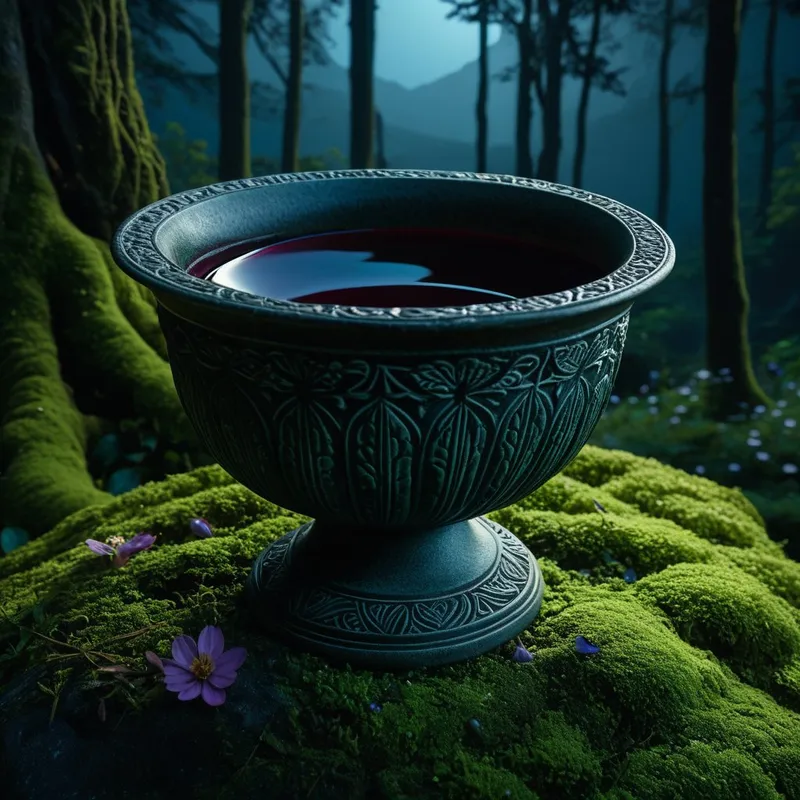
Cultural Origins & Context
The myth of Dionysus and his Kantharos is not a single, codified narrative from a text like Hesiod’s Theogony. It is a living pattern woven through the entire tapestry of Greek cult practice, theater, and vase painting. The stories emerged from the ecstatic rites of the Dionysian Mysteries, practiced from the archaic period onward, particularly in places like Thebes and at the City Dionysia in Athens.
It was passed down not just by poets, but by the thiasos (the ecstatic retinue) themselves—the Maenads, Satyrs, and initiates who experienced the god’s presence directly in their mountain revels (oreibasia). On the stage, in the tragedies of Euripides (most notably The Bacchae), the civic function of the myth was performed and interrogated. The Kantharos was a ubiquitous symbol on red-figure pottery, forever in the god’s hand, a visual shorthand for his power and the central act of his worship: the communal, transformative drink.
Societally, the myth served as a crucial pressure valve and a profound challenge. In the ordered, Apollonian world of the polis, the Dionysian with his Kantharos represented the necessary, annual return of chaos. It was a sanctioned eruption of the irrational, the feminine, the animalistic, and the ecstatic—forces that, if completely repressed, would threaten the city with a far more destructive madness. The cup, therefore, was both a vessel of holy communion and a container for society’s own shadow.
Symbolic Architecture
The Kantharos is far more than a drinking vessel; it is the symbolic architecture of a psychological revolution. It represents the container for the uncontainable.
The Kantharos is the shaped void that makes the formless potent. It is the individual ego, a fragile cup, daring to hold the oceanic wine of the unconscious.
Its twin handles symbolize the dual nature of the Dionysian experience: one handle for ecstasy (ekstasis—standing outside oneself), the other for agony, for the sparagmos of the psyche. The bowl is the receptive, feminine principle, the womb of transformation where the raw juice of experience (the grape) is fermented into the intoxicating wisdom of the soul (the wine).
Psychologically, the god Dionysus represents the totality of the life force, the libido in its rawest, most undifferentiated form. He is the drive behind creation and destruction, joy and rage, love and madness. The mortal who encounters him—the Pentheus in each of us—is the rigid ego, the persona that says “I am this and not that.” The wine from the Kantharos is the agent of dissolution. It does not destroy the self; it dissolves the artificial boundaries of the self, forcing an encounter with all we have excluded: our wildness, our primal emotions, our creative chaos, and our connection to the non-human world.
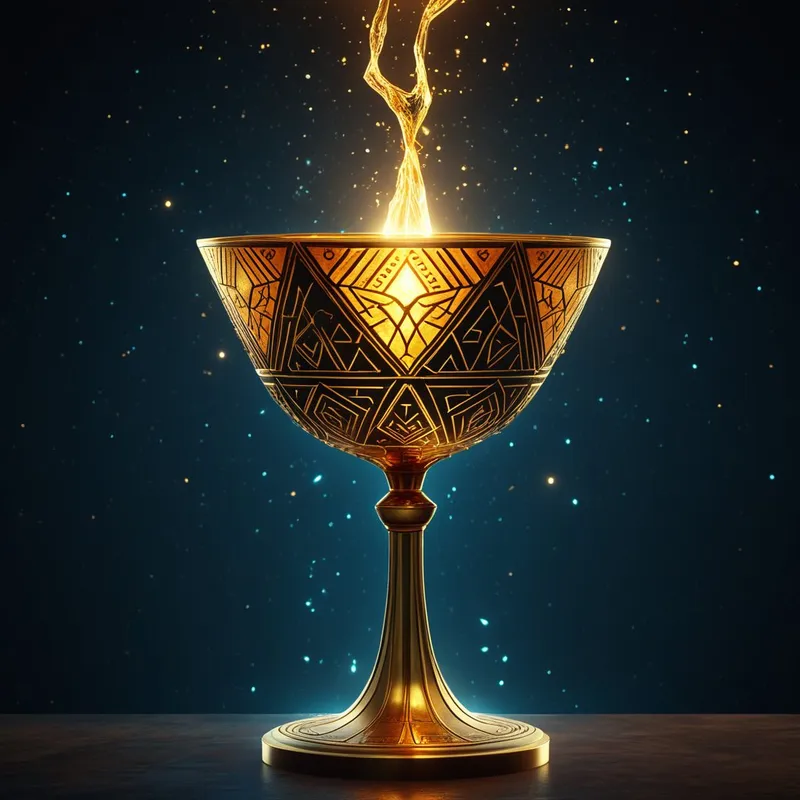
The Dreamer's Resonance
When the Kantharos appears in a modern dream, it rarely manifests as a literal Greek cup. It may be a cherished coffee mug that suddenly overflows with an impossible liquid, a ceremonial bowl in a strange ritual, or even a feeling of being a vessel that is filling to the point of breaking.
This dream image signals a somatic and psychological process of intoxication by the unconscious. The dreamer is likely at a point of sterile order or emotional drought. The psyche, in its Dionysian wisdom, is introducing the catalyst. The overflowing cup suggests that contents from the deep psyche—long-repressed emotions, creative impulses, or instinctual energies—are rising and can no longer be contained by the dreamer’s current conscious attitude.
The experience is often one of both allure and terror. To drink from the dream-Kantharos is to accept a necessary dissolution. The somatic resonance can feel like heat, pressure, or a liquefying sensation—the “melting” of ego defenses. This dream is an invitation to a sacred madness: to temporarily let go of rigid control and allow a more authentic, if chaotic, state of being to emerge. It is the psyche’s ritual, offering its own wine of transformation.

Alchemical Translation
The myth of the Kantharos is a perfect map for the alchemical process of psychic transmutation, or individuation. The core struggle is the ego’s resistance to being dissolved in the aqua permanens—the permanent water, which here is the divine wine.
The first stage, nigredo (the blackening), is represented by the crushing of the grape. It is the suffering, the frustration, the feeling of being pressed by life circumstances. The grape (our identified self) must be rendered into juice (undifferentiated psychic material). The fermentation within the jar is the albedo (the whitening), a hidden, transformative process in the dark of the unconscious, often experienced as depression or confusion.
The Kantharos itself is the vas hermeticum, the sealed vessel where the great work takes place. The ego is not the alchemist; it is the cup that must hold the process.
The raising of the cup by Dionysus is the citrinitas (the yellowing), the first glimpse of enlightened understanding—the realization that this dissolution is sacred. Finally, the ecstatic communion, the shared drink that reveals the unity of all things, is the rubedo (the reddening), the culmination. The wine is the aurum potabile—the drinkable gold, the supreme realization of the Self.
For the modern individual, the myth models the necessity of creating a sacred container (through therapy, art, ritual, or relationship) strong enough to hold the intoxicating, chaotic contents of our own depths. We are invited to move from being Pentheus, the king who denies the god, to being an initiate who willingly drinks from the cup, allowing our old identity to be fermented into something richer, more complex, and more wholly alive. The goal is not to become perpetually drunk, but to integrate the vintage, to carry the wisdom of the vine into the clear light of day, transformed.
Associated Symbols
Explore related symbols from the CaleaDream lexicon: