Dionysus's Cradle Myth Meaning & Symbolism
The infant god Dionysus, born from Zeus's thigh, is hidden in a cradle from Hera's wrath, a myth of primal vulnerability and ecstatic return.
The Tale of Dionysus's Cradle
Hear now a tale not of Olympus’s gleaming heights, but of the secret, fertile dark. It begins with a scream—the scream of Semele, consumed by the unveiled glory of her lover, Zeus. From her ashes, Zeus plucked the unborn seed of his son. His own flesh became the womb; he sewed the divine child into his mighty thigh. Thus, in a second birth, Dionysus was born—the twice-born god.
But a shadow hung over this miraculous birth. Hera</ab title>, ever-watchful, ever-furious at her husband’s infidelities, saw this new son as a living insult. Her jealousy was a cold fire that sought to extinguish the infant’s flickering flame. To save him, Zeus acted with desperate cunning. He commanded Hermes to spirit the child away, far from the divine court’s piercing eyes.
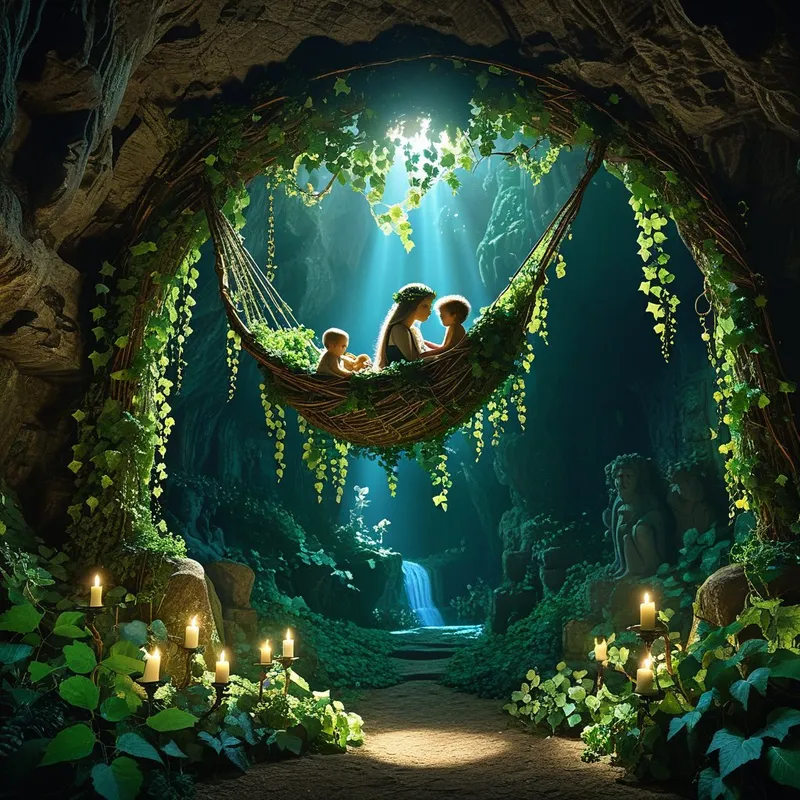
Hermes, with the infant cradled in his arms, flew to the wild, hidden slopes of Mount Nysa. There, in a cave veiled by waterfalls and twisting vines, he delivered the god-child to the Oreads and the gentle, goat-legged Satyrs. They fashioned a cradle not of gold or ivory, but of living nature—a basket woven from the tendrils of the wild ivy and the nascent grapevine, lined with soft moss and petals. This was Dionysus’s cradle: a nest of primal, burgeoning life, hidden in the earth’s dark heart. The nymphs sang lullabies that were the whispers of growing things, and the satyrs danced quiet, cloven-footed jigs to guard his sleep.
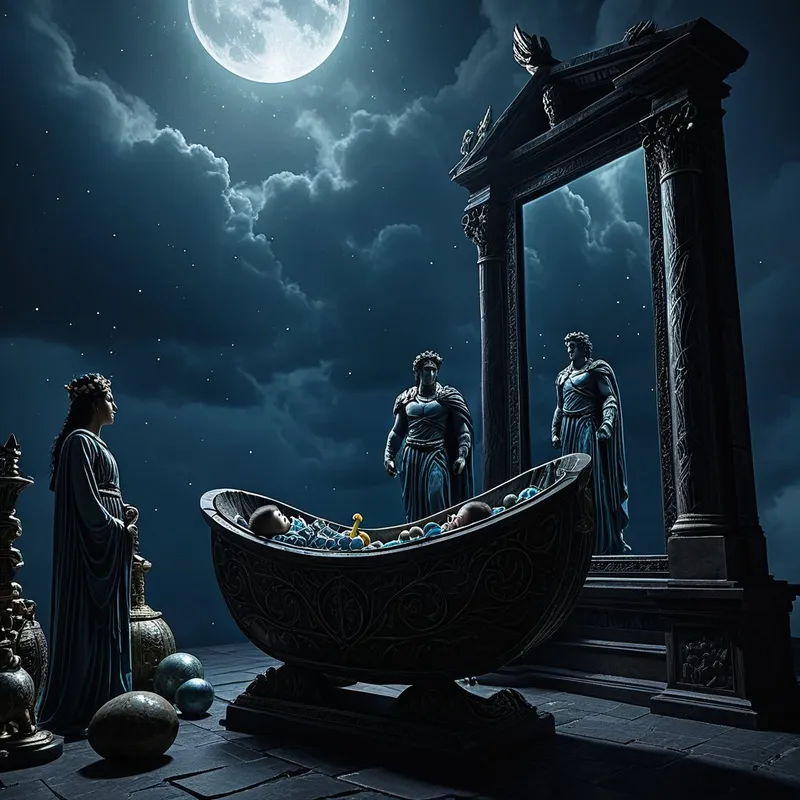
Yet, Hera’s gaze was relentless. She could not find the hidden grotto, so she summoned the ancient, raw powers of the world—the Titans. She filled them with her own maddened rage and sent them to Nysa. With cunning darker than any beast’s, the Titans approached. They did not come with roars, but with whispers. They distracted the nymphs with shimmering phantoms. Then, they presented themselves to the infant god. They offered toys—a spinning top, a polished mirror that caught the cave’s dim light. Enchanted, the child reached out from his cradle of vines.
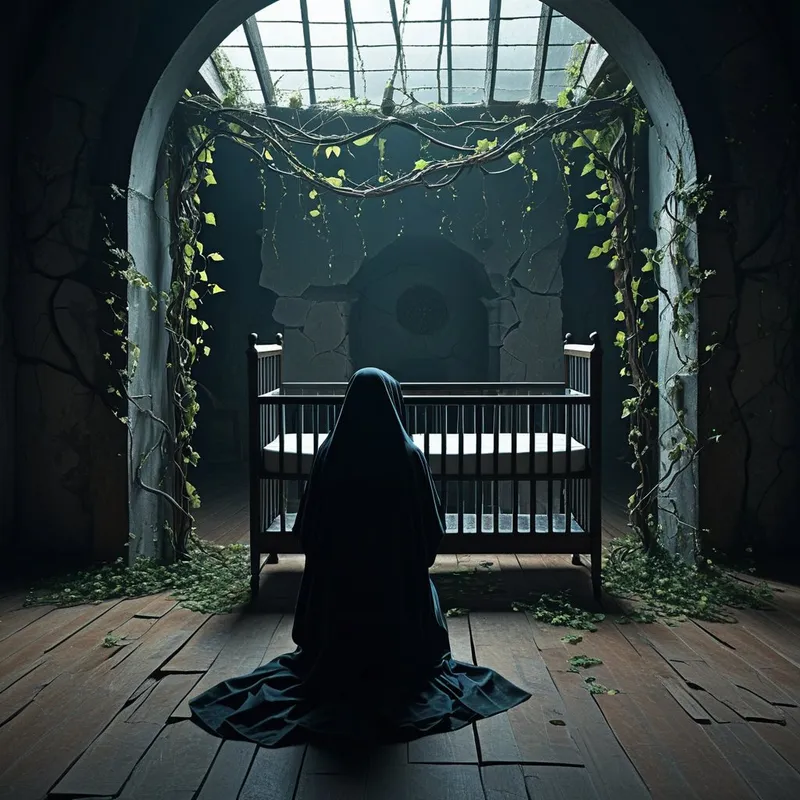
In that moment of innocent fascination, the Titans struck. They seized the twice-born god. What followed was an act of unspeakable sparagmos—a rending apart. The cradle was left empty, stained and shattered. But the story does not end in the dark. For from the remains, from the fragments scattered on the earth, a greater power was invoked. Some say his grandmother, Rhea, gathered the pieces. Others say Zeus’s thunder roared in lament and resurrection. The essence of Dionysus, unquenchable, was reborn. He rose whole, but changed—no longer just the hidden infant, but the god of the tearing ecstasy that follows dissolution, the lord of the vine that must be crushed to give its sacred wine.
Cultural Origins & Context
This haunting narrative is not the product of a single poet, but a tapestry woven from threads of ancient cultic practice and late poetic compilation. The most detailed account comes from the Bibliotheca of Pseudo-Apollodorus, a source that synthesizes older, often Orphic, traditions. The Orphic mysteries, a profound and secretive religious movement, held this myth at their core. For them, the death and rebirth of the infant Dionysus, often called Zagreus, was the central sacred story (hieros logos).
Told not in public theaters but in the hushed tones of initiation rites, this myth served a critical societal and psychological function. It explained the presence of suffering, chaos, and ecstasy in the ordered world. It was a myth for the margins—for women (Maenads), for outsiders, for those who felt the strictures of civic, Apollonian order as a cage. The cradle, hidden away, represents the sanctioned, secret space where the untamed and irrational—the Dionysian force—was nurtured until it could no longer be contained. It was a cultural acknowledgment that civilization is built upon, and must periodically make room for, the raw, creative, and destructive powers of nature and the psyche.
Symbolic Architecture
The cradle is the central symbol, and it is profoundly paradoxical. It is a vessel of safety that becomes a site of catastrophe; a womb that precedes a tomb. It represents the fragile, nascent stage of any profound psychic content—an inspiration, a trauma, a new sense of self—that must be protected in the unconscious (Mount Nysa as the inner world) before it can face the light of day.
The cradle is the temporary sanctuary for that which is not yet ready for the world, and its shattering is the inevitable price of coming into being.
The Titans represent more than mere monsters. They are the archaic, fragmented, and chaotic forces of the primal psyche—the raw, unintegrated complexes and instinctual drives that can dismantle a nascent consciousness. Their use of toys and a mirror is deeply psychological: they lure the emerging self with fascination for its own image and with trivial distractions, only to dismantle it. This is the psyche’s own self-sabotage, the destructive urge that arises when a new, vulnerable identity begins to form.
Dionysus’s double birth—from Semele and from Zeus’s thigh—signifies his dual nature: fully mortal and fully divine, of the earth and of the spirit. His rending and reconstitution model a fundamental truth: that wholeness is not a state of pristine, untouched integrity, but is often achieved through fragmentation and reassembly. The self that returns is greater for having been broken.
The Dreamer's Resonance
When this myth stirs in the modern dreamer, it often signals a profound process of psychic death and rebirth. To dream of a hidden, nurturing place (a secret room, a protected garden) that is suddenly invaded and violated speaks to the vulnerability of a new psychological development. This could be the early, tender stages of healing from a past wound, the first inklings of a creative project, or the fragile beginning of self-love.
The somatic experience might be one of acute vulnerability—a feeling of exposure, of being “torn apart” by circumstances or internal conflicts. The dreamer may feel like the infant in the tale: fascinated by something shiny (a new obsession, a narcissistic reflection) that ultimately leads to a sense of disintegration. The aftermath of such dreams is not always despair; often, it is a strange, hollow calm—the empty cradle. This is the necessary void, the temenos or sacred cutting, where the old form has been shattered to make way for a reconstitution. The dream is the psyche performing its own sparagmos, not as a punishment, but as a brutal, necessary alchemy.
Alchemical Translation
The myth of Dionysus’s Cradle is a perfect map for the alchemical process of individuation—the Jungian journey toward psychic wholeness. The alchemical vessel, the vas, is the cradle. Into it goes the prima materia, the raw, divine spark of the potential self (the infant god). This material must be hidden away (the nigredo, the blackening, the descent to Nysa) and protected in the unconscious.
The attack of the Titans represents the mortificatio or separatio—the essential stage of dissolution, where the ego’s rigid structures and identifications are torn apart. This is a painful but necessary destruction of the old, infantile state to prevent it from remaining merely a hidden, powerless secret.
Individuation does not proceed by building higher walls around the cradle, but by having the courage to let the Titans in, to be dismantled, and to trust the deeper, archetypal process of reassembly.
Finally, the rebirth of Dionysus is the albedo (whitening) and rubedo (reddening)—the emergence of a new, conscious awareness that has integrated the primal, chaotic forces. The reborn god is not a naive infant, but the master of ecstasy and transformation. For the modern individual, this translates to the hard-won realization that our deepest wounds, our most fragmenting experiences, are not merely scars. They are the very sites where a more resilient, complex, and authentic self is forged. We are all, in a sense, twice-born: first into the family and culture that cradles us, and second into the self we must reclaim from our own personal Titans, rising from the shattered pieces not in spite of the breaking, but because of it.
Associated Symbols
Explore related symbols from the CaleaDream lexicon: