Dionysus & the Maenads Myth Meaning & Symbolism
The god of ecstasy leads women into the wild, dissolving identity in sacred madness, revealing the untamed psyche beneath social order.
The Tale of Dionysus & the Maenads
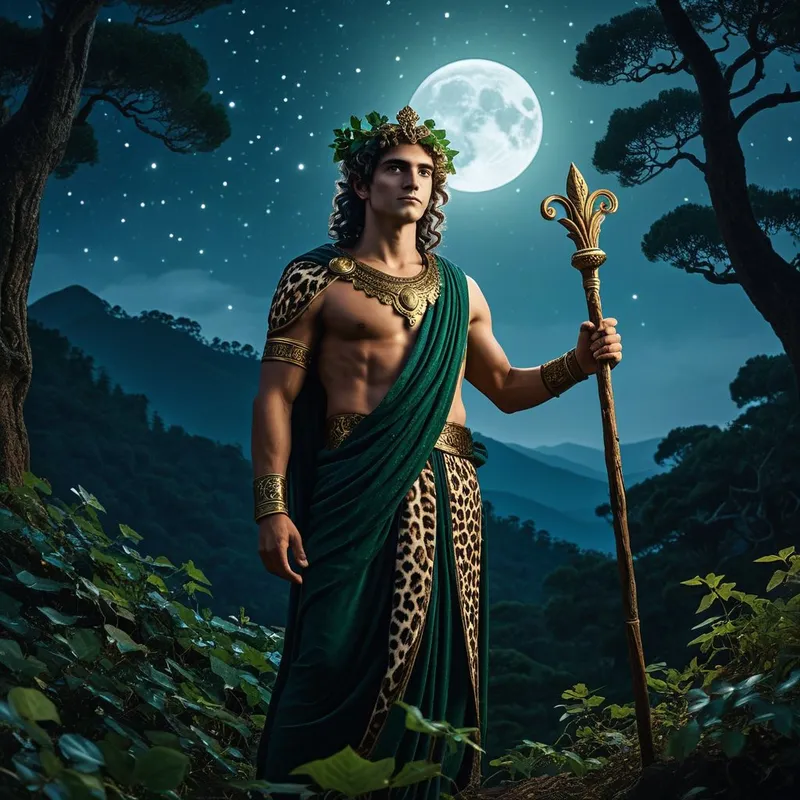
Hear now the sound that breaks the silence of the ordered world. It is not a song of the lyre, but the thrum of the deep earth, the pulse of the untamed vine. It is the call of [Dionysus](/myths/dionysus “Myth from Global/Universal culture.”/), the god who arrives not with thunder, but with the scent of crushed grapes and the whisper of ivy through stone.
He was born twice: once from a mortal mother, Semele, consumed by the glory of his father Zeus, and again from the thigh of the king of gods himself. Thus, he is [the stranger](/myths/the-stranger “Myth from Biblical culture.”/), the outsider-god who is also of the highest lineage. He walks the roads of mortal lands, a beautiful, long-haired youth, often smiling, always unsettling. In his hand, he carries the thyrsus, a fennel stalk that is both a gentle wand and a fearsome weapon. Where he walks, wine flows from the soil and milk from the rock. Animals lose their fear. And the women hear him.
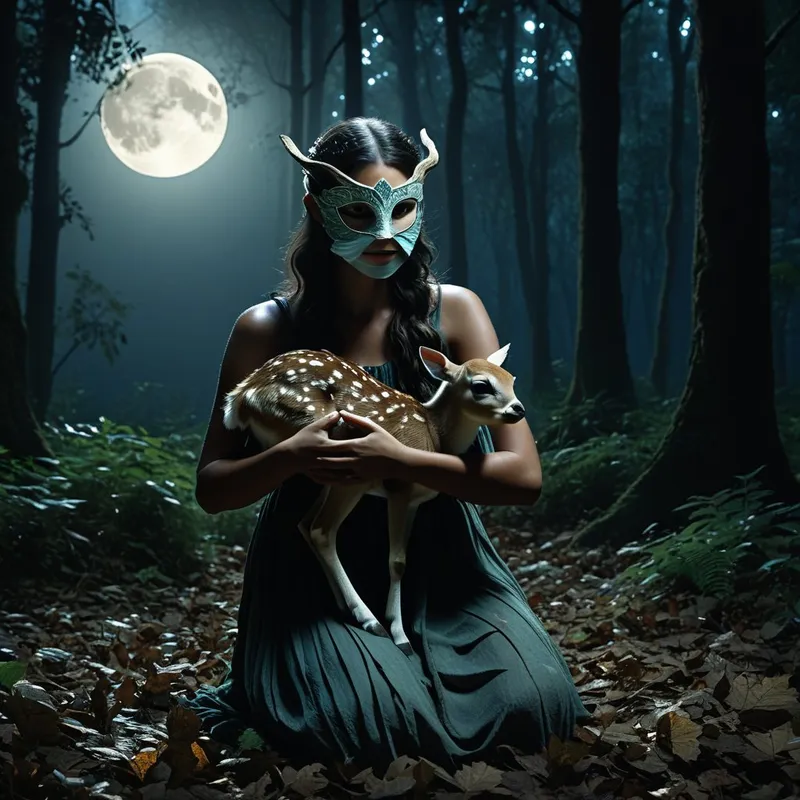
They are the women of Thebes, of Corinth, of every polis that believes its walls are high enough to keep out the wild. They are mothers, wives, daughters, weavers at the loom—the very foundation of the civilized household, the oikos. They hear the god’s call—the skirl of pipes, the rhythm of the tympanon drum—and it speaks to a part of them deeper than duty, older than law. One by one, then in a flood, they drop their shuttles, leave their children at [the hearth](/myths/the-hearth “Myth from Norse culture.”/), and stream out of the city gates. Their eyes, once downcast, are now wide and shining. They let their hair loose, gird themselves with fawnskins, and take up the thyrsus. They become the [Maenads](/myths/maenads “Myth from Greek culture.”/), the raving ones.
They follow him into the mountains, to the places untouched by the plow. This is the oros, the wild. Here, under the sun and the piercing stars, civilization dissolves. They dance with a fury that is also grace, their bodies moving not to a human tune but to the heartbeat of [the world](/myths/the-world “Myth from Tarot culture.”/). They become one with the god, entheos. With their bare hands, they tear goats and bulls limb from limb—the sparagmos. This is no mere butchery; it is a holy act. They drink the blood, eat the raw flesh, and in this primal communion, they are filled with the god’s power. Milk and honey spring from [the earth](/myths/the-earth “Myth from Hindu culture.”/) for them. They can charm snakes and nurse wild wolf cubs. Their thyrsus strikes the rock, and a fountain of wine erupts.
But woe to the man who spies on these mysteries, who tries to impose the logic of the marketplace upon the logic of the soul. Such was the fate of Pentheus, the rigid king who saw only madness and disorder. Disguised as a woman on the god’s mocking advice, he climbed a pine tree to watch the sacred rites. [The Maenads](/myths/the-maenads “Myth from Greek culture.”/), their senses supernaturally heightened, spied him. Led by Pentheus’s own mother, Agave, in her god-struck state seeing only a mountain lion, they surrounded the tree. With a collective roar that was the voice of the god himself, they pulled the tree down. And in a frenzy of ecstatic violence, they performed the sparagmos upon the king. Agave, triumphant, carried her son’s head back to the city on her thyrsus, boasting of her hunt, only to slowly, horrifyingly, return to her senses and see what she held. The god’s [justice](/myths/justice “Myth from Tarot culture.”/) is terrible, and it is complete. The wall between the civilized self and the wild soul, once breached, cannot be rebuilt without a sacrifice.
Cultural Origins & Context
This myth was not a fringe tale but central to the religious life of ancient Greece. Its most powerful telling comes from the Athenian tragedian Euripides in his late play, [The Bacchae](/myths/the-bacchae “Myth from Greek culture.”/), performed in the late 5th century BCE. This was an era of intense intellectualism, philosophical questioning, and social anxiety—the very soil in which a myth about the return of the repressed would flourish. The cult of Dionysus was real, with documented rituals for women (and some men) involving nighttime mountain rites (oreibasia), ecstatic dancing, and likely the ritual consumption of wine and possibly psychoactive substances.
The myth served a critical societal function. It acted as a controlled, narrative pressure valve. By channeling the potentially disruptive forces of ecstasy, altered states, and female agency into a specific, god-sanctioned ritual space and time (often outside the city), [the polis](/myths/the-polis “Myth from Greek culture.”/) acknowledged these forces while attempting to contain them. It was a profound reminder that the order of the city was a fragile construct, built upon and forever threatened by the chaotic, fertile, and amoral power of nature, which included human nature. The storytellers, from village bards to master playwrights, were not just entertainers but cultural therapists, staging the community’s deepest conflicts between law and instinct, male and female, self and other.
Symbolic Architecture
At its core, this myth maps the geography of the [human](/symbols/human “Symbol: The symbol of a human represents individuality, complexity of emotions, and social relationships.”/) [psyche](/myths/psyche “Myth from Greek culture.”/), where the conscious, structured ego (the polis, Pentheus) confronts the unconscious, instinctual Self (the wild, Dionysus).
Dionysus represents the undifferentiated, primal [life](/symbols/life “Symbol: The symbol of ‘Life’ represents a journey of growth, interconnectedness, and existential meaning, encompassing both the joys and challenges that define human experience.”/) force itself—the libidinal [energy](/symbols/energy “Symbol: Energy symbolizes vitality, motivation, and the drive that fuels actions and ambitions.”/) that fuels creativity, joy, communion, and also destruction. He is not evil, but amoral; he is the process of [life](/symbols/life “Symbol: The symbol of ‘Life’ represents a journey of growth, interconnectedness, and existential meaning, encompassing both the joys and challenges that define human experience.”/), [death](/symbols/death “Symbol: Symbolizes transformation, endings, and new beginnings; often associated with fear of the unknown.”/), and [rebirth](/symbols/rebirth “Symbol: A profound transformation where old aspects of self or life die, making way for new beginnings, growth, and renewal.”/) made divine. The Maenads symbolize those aspects of the psyche—particularly those culturally assigned as “feminine”: [intuition](/symbols/intuition “Symbol: The immediate, non-rational understanding of truth or insight, often described as a ‘gut feeling’ or inner knowing that bypasses conscious reasoning.”/), [emotion](/symbols/emotion “Symbol: Emotion symbolizes our inner feelings and responses to experiences, often guiding our actions and choices.”/), [connection](/symbols/connection “Symbol: Connection symbolizes relationships, communication, and bonds among individuals.”/) to the [body](/symbols/body “Symbol: The body in dreams often symbolizes the dreamer’s self-identity, personal health, and the relationship they have with their physical existence.”/) and [nature](/symbols/nature “Symbol: Nature symbolizes growth, connectivity, and the primal forces of existence.”/), creative [frenzy](/symbols/frenzy “Symbol: A state of uncontrolled excitement, agitation, or wild activity, often indicating overwhelming emotions or loss of rational control.”/)—that are repressed by the dominant, “masculine” ordering principle of [consciousness](/symbols/consciousness “Symbol: Consciousness represents the state of awareness and perception, encompassing thoughts, feelings, and experiences.”/) ([logos](/myths/logos “Myth from Christian culture.”/), law, [hierarchy](/symbols/hierarchy “Symbol: A structured system of ranking or authority, often representing social order, power dynamics, and one’s position within groups or institutions.”/)).
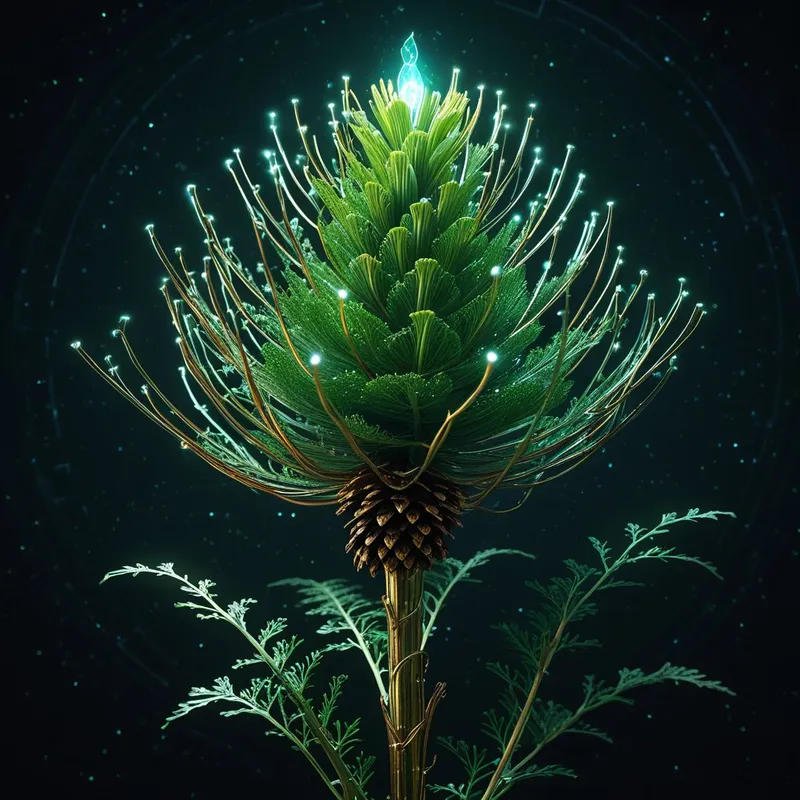
The thyrsus is the perfect symbol of this duality: a plant stalk (natural, growing) wound with ivy (binding, intoxicating) and topped with a pine cone (a seed of immense potential, but also a rigid, spiked form). It is the weaponized potential of life itself.
The sparagmos, the [ritual](/symbols/ritual “Symbol: Rituals signify structured, meaningful actions carried out regularly, reflecting cultural beliefs and emotional needs.”/) tearing apart, is the most potent [symbol](/symbols/symbol “Symbol: A symbol can represent an idea, concept, or belief, serving as a powerful tool for communication and understanding.”/). Psychologically, it represents the necessary, often violent, deconstruction of a rigid, inflated ego [identity](/symbols/identity “Symbol: Identity represents the sense of self, encompassing personal beliefs, cultural background, and social roles.”/) (Pentheus) that refuses to acknowledge the greater [reality](/symbols/reality “Symbol: Reality signifies the state of existence and perception, often reflecting one’s understanding of truth and life experiences.”/) of [the Self](/myths/the-self “Myth from Jungian culture.”/). It is the [breakdown](/symbols/breakdown “Symbol: A sudden failure or collapse of a system, structure, or mental state, often signaling a need for fundamental change or repair.”/) that must precede renewal. The wild feast (omophagia) that follows is the reintegration of that raw, instinctual energy into the individual and the [community](/symbols/community “Symbol: Community in dreams symbolizes connection, support, and the need for belonging.”/).
The Dreamer’s Resonance
When this myth stirs in modern dreams, it signals a profound uprising from the depths of the psyche. To dream of joining a wild, ecstatic dance, of feeling an irresistible pull into a forest or away from one’s daily life, speaks to a soul-deep hunger for liberation from an overly constrained identity. The dreamer may be living a “Penthean” life: all order, control, and duty, but feeling spiritually desiccated.
Dreams of vines growing through one’s house, of wild animals appearing as familiars, or of a powerful, androgynous guide are visitations from the Dionysian current. More unsettlingly, dreams of losing control, of one’s hands becoming claws, or of a terrifying yet exhilarating frenzy point to the “Maenad” complex breaking through—the raw, emotional, instinctual self that has been caged too long. This is not a call to literal madness, but a somatic signal from the unconscious that the balance has tipped too far toward control, and a vital, life-giving chaos is demanding recognition. The body itself may feel this as restlessness, unexplainable anxiety, or a powerful creative urge that feels almost violent in its intensity.

Alchemical Translation
The individuation process modeled here is not one of gentle growth, but of revolutionary, ecstatic dissolution and reconstitution. The first alchemical stage, [nigredo](/myths/nigredo “Myth from Alchemical culture.”/) (the blackening), is embodied by Pentheus’s refusal and the ensuing chaos—[the dark night of the soul](/myths/the-dark-night-of-the-soul “Myth from Christian Mysticism culture.”/) where old structures crumble. The call of Dionysus is the call to this necessary darkness, to the [solutio](/myths/solutio “Myth from Alchemical culture.”/)—the dissolving of the hardened [persona](/myths/persona “Myth from Greek culture.”/) in the “wine” of the unconscious.
To become whole, one must first consent to be taken apart. The rigid ego, like the city wall, must be breached by the god from within.
The Maenad’s journey into the wild is the albedo (the whitening)—a purification not through denial, but through full, embodied immersion in the instinctual realm. It is reclaiming one’s “wild intelligence,” the knowledge of the body and the heart. The terrifying sparagmos becomes, in the alchemical vessel of the psyche, a [separatio](/myths/separatio “Myth from Alchemical culture.”/)—the careful distinguishing of what in one’s identity is truly essential Self from what is merely societal scaffolding (Pentheus) that must die.
The final stage, the [rubedo](/myths/rubedo “Myth from Alchemical culture.”/) (the reddening), is not depicted in the tragic end of The Bacchae, but is implied in the enduring cult of the god. It is the integration. The returned Maenad, or the initiated follower, does not remain forever in the frenzy on the mountain. She returns to the city, but she is changed. She has tasted the raw flesh of her own instinct and drunk the wine of divine connection. She carries the thyrsus within. The goal is not to live in perpetual chaos, but to allow the wild, creative, ecstatic Dionysian spirit to inform the ordered life, to make the polis of the self more fertile, more joyful, and more truly alive. The god demands acknowledgment, and the price of denial is disintegration; the reward for sacred surrender is a more profound, terrifying, and complete humanity.
Associated Symbols
Explore related symbols from the CaleaDream lexicon: