Dionysus' Mysteries Myth Meaning & Symbolism
A myth of the god who arrives from the wilderness, shattering order with ecstatic rites to reveal the raw, transformative power of the unconscious.
The Tale of Dionysus' Mysteries
Listen. The story does not begin in the sun-drenched agora or the marble halls of Olympus. It begins on the edge, in the whispering spaces between the cultivated field and the untamed wood. It is the hour when the torch is lit, not the sun.
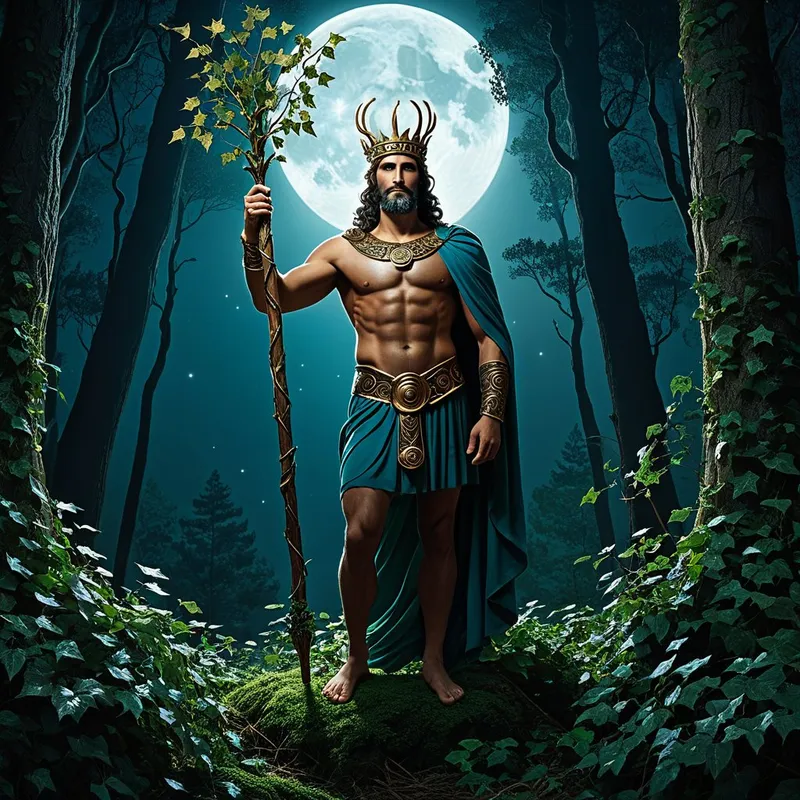
He arrives not with a herald’s cry, but with the scent of crushed grape and damp earth, with the distant, haunting cry of the flute. He is Dionysus, the Stranger-God. His hair is dark as wine, crowned with ivy and vine. In his hand, the thyrsus—a staff that is both a king’s scepter and a weapon of the wild. He walks into Thebes, the city of order and law, and his presence is a quiet tremor beneath the stones.
The king, Pentheus, sees only a corrupting influence, a pretty youth leading the women of the city—his own mother, Agave, among them—into the mountains. "They abandon their looms," he rages, "their children, their reason! For what? For drunkenness and debauchery in the night!" He orders the Stranger bound and imprisoned.
But in the dark of the cell, the earth itself groans. Ivy bursts through the mortar, stone turns to soft, fragrant vine. The shackles fall away like dry leaves. Dionysus stands, free, and his smile holds the patience of the forest that reclaims all things. He offers Pentheus one final chance: come, see the mysteries for yourself. Cloaked in a fawn-skin, hidden in the branches of a tall pine, the king ascends to the mountain, Cithaeron.
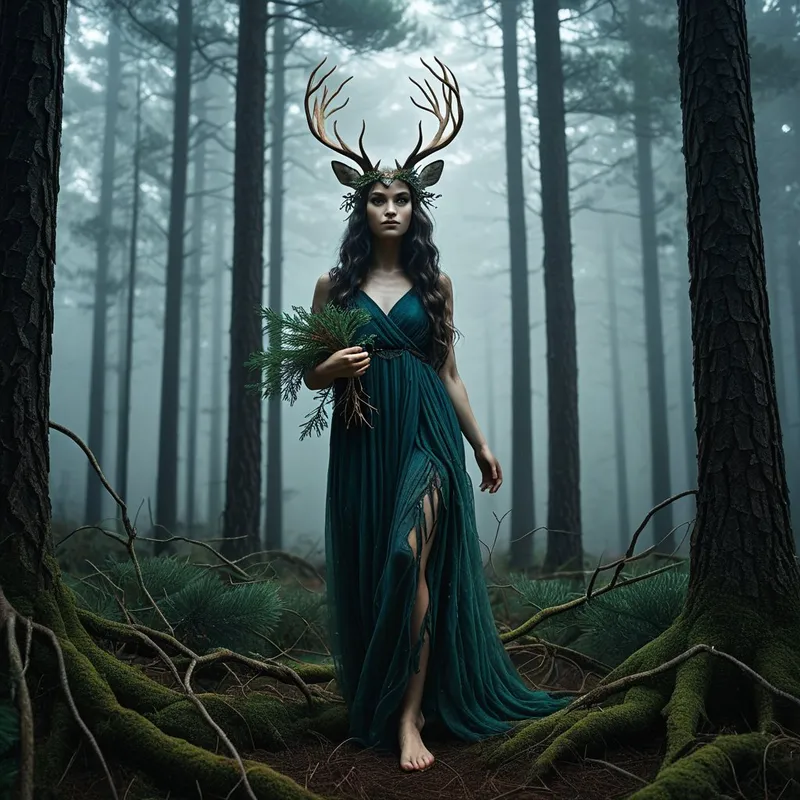
What he sees there is not debauchery. It is terror and beauty fused into one. The Maenads move in a whirling circle, their feet bare on the cold moss, their hair loose and tangled with leaves. The air is thick with the smell of pine and crushed fir, with the sweet-rot scent of wine and the metallic tang of something older. They are not drunk on wine alone, but on the god himself. They call, and milk and honey spring from the rock. They strike the earth with their thyrsoi, and fountains of wine erupt. They seize a wild bull and, with hands made impossibly strong by divine mania, rend it apart, sparagmos.
And then they see him. A spy in the sacred grove. A profane eye upon the mystery. The god’s whisper stirs the frenzy to a fever pitch. "There! A beast!" The Maenads become a single, roaring wave of fury. They tear the pine tree from the earth. Pentheus falls. His own mother, Agave, eyes wide with a holy and terrible madness, is the first to lay hands upon him. She does not see her son. She sees a mountain lion, a threat to the sacred band. The rending begins.
Later, in the cold dawn, the mania recedes like a tide. Agave staggers back to Thebes, cradling her grisly trophy—the head of her son. The ecstasy curdles into horror, the divine union into ultimate loss. Dionysus looks upon the scene, his face an unreadable mask of the god who gives the ecstasy and exacts the price. He is the liberator and the destroyer, the vine that gives the wine and the winter that kills the branch. The mystery is complete.
Cultural Origins & Context
The mysteries of Dionysus were not a single, unified doctrine but a sprawling, living network of cultic practices that pulsed at the margins of the Greek world. While the Olympian gods presided over the civic, political, and domestic spheres, Dionysus was the god of the liminal: the edges of the city, the wild mountains, the threshold between sanity and madness, life and death. His worship was often rooted in the earth, older than the marble pantheon, with probable origins in Thrace and Phrygia.
These rites were primarily experiential, not dogmatic. They were passed down not through texts, but through initiation (teletai) and participation. The most famous were the Eleusinian Mysteries, where Dionysus played a role, and the more exclusive City Dionysia which formalized his chaotic essence into the structured catharsis of theatre. But the core, primal practice was the private, often secretive, all-night rites (orgia) of the Maenads.
Societally, these mysteries functioned as a vital pressure valve. In the highly structured, patriarchal world of the Greek city-state, the Dionysian ritual provided a sanctioned, sacred space for elements otherwise suppressed: female collective power, emotional abandon, and a direct, visceral connection to the natural and divine world that bypassed civic and familial hierarchies. It was a temporary dissolution of the self into the greater, chaotic whole of life—a terrifying but necessary reminder that civilization is a thin veneer over a much wilder reality.
Symbolic Architecture
At its heart, the myth of Dionysus’s mysteries is a confrontation with the Shadow and the dissolution of the rigid ego. Pentheus represents the hyper-rational, controlling, and repressive consciousness. He is the fortress of "I," built to keep out the chaotic, instinctual, and emotional depths of the psyche—the realm of Dionysus.
The thyrsus is the symbol of this paradox: a cultivated fennel stalk (order) crowned with the wild, fertile pinecone (chaos). It signifies that true power and vitality arise not from suppressing the wild, but from channeling it.
The sparagmos (the rending) and omophagia (the eating of raw flesh) are not mere barbarism. They are profound symbols of deconstruction. The ego-structure (Pentheus/the bull) must be torn apart so that its raw, vital energy can be assimilated. It is the death of the old, isolated identity. The Maenads, in their frenzy, embody the unconscious itself—the collective, instinctual force that, when denied, turns destructive, but when engaged with ritually, becomes a source of supernatural creativity and connection.
Dionysus himself is the archetype of the psychopomp who leads the soul into this terrifying, fertile underworld of the self. He is the spirit of undifferentiated life-force, of the sap in the vine and the blood in the vein, which cares nothing for individual boundaries but is the essence of connection and transformation.
The Dreamer's Resonance
When this mythic pattern stirs in the modern dreamer, it often signals a profound psychological pressure. The conscious ego-structure is being challenged by a surge from the unconscious. Dreams may feature:
- Wild, Uncontrollable Nature: Vines breaking through walls, animals invading domestic spaces, sudden storms. This is the Dionysian force encroaching on the Penthean order of the dreamer’s life.
- Frenzied Gatherings or Rituals: Being caught in a swirling, emotional crowd where individual will is lost; participating in a strange, compelling, but frightening ceremony.
- Dismemberment Imagery: Not necessarily graphic, but a sense of being pulled apart, fragmented, or having one’s established identity dismantled.
Somatically, the dreamer may be experiencing this as anxiety, a feeling of "losing control," or a powerful, inexplicable creative or emotional urge that feels alien to their self-concept. It is the body-soul’s rebellion against an overly rigid way of being. The psychological process is one of enantiodromia—the emergence of the unconscious opposite. The more one has championed control, rationality, and order (a Pentheus life), the more violently and irrationally the Dionysian element may demand recognition.
Alchemical Translation
The alchemical journey modeled by the Mysteries is the nigredo—the blackening, the dissolution, the descent into the primal matter. For the modern individual seeking individuation, the myth maps the necessary, painful death of the provisional personality.
The initiation into the mystery is not about gaining a secret, but about surrendering the illusion of separateness. One does not possess the god; one is possessed by the god to be remade.
The first step is the invitation from the Stranger—an inner call to acknowledge the wild, irrational, passionate, or creative energies we have exiled. This is often met with the Pentheus-like resistance of the ego: denial, ridicule, or an attempt to imprison and control the impulse. The myth warns that this resistance leads only to a more catastrophic, involuntary shattering.
The conscious path of initiation involves a willing ekstasis—a "stepping outside" of oneself. This is the modern equivalent of engaging with art, dance, deep therapy, or any practice that allows the controlled, ritualized expression of the unconscious. It is the sacred orgia: not hedonism, but the deliberate, contained space where the ego’s boundaries can soften.
The rending (sparagmos) is then reframed as a deconstruction of outworn identities, beliefs, and self-images. The raw, instinctual energy released (symbolized by the raw flesh) must be integrated (omophagia). Agave’s horror is the inevitable moment of realization when the ego comprehends the cost of its own transformation. The triumph of the mystery is not in avoiding this horror, but in passing through it. One returns from the mountain not with the old, rigid self, but with a new, more fluid consciousness that has tasted both the ecstasy and the terror of being truly, vulnerably alive. The individual is reborn, having made a pact with the chaos that is also the source of all creation.
Associated Symbols
Explore related symbols from the CaleaDream lexicon: