Dionysus & His Maenads Myth Meaning & Symbolism
The god of ecstasy leads his wild female followers into the mountains, shattering rigid order to reveal the raw, creative, and terrifying power of nature and psyche.
The Tale of Dionysus & His Maenads
Hear now the tale that the pines whisper and the rivers remember, the story not of a god who rules from a high throne, but one who rises from the damp earth and the fermenting grape. He is [Dionysus](/myths/dionysus “Myth from Global/Universal culture.”/), the twice-born, [the stranger](/myths/the-stranger “Myth from Biblical culture.”/)-god. He arrives not with thunder, but with the scent of wine and the sound of unseen flutes.
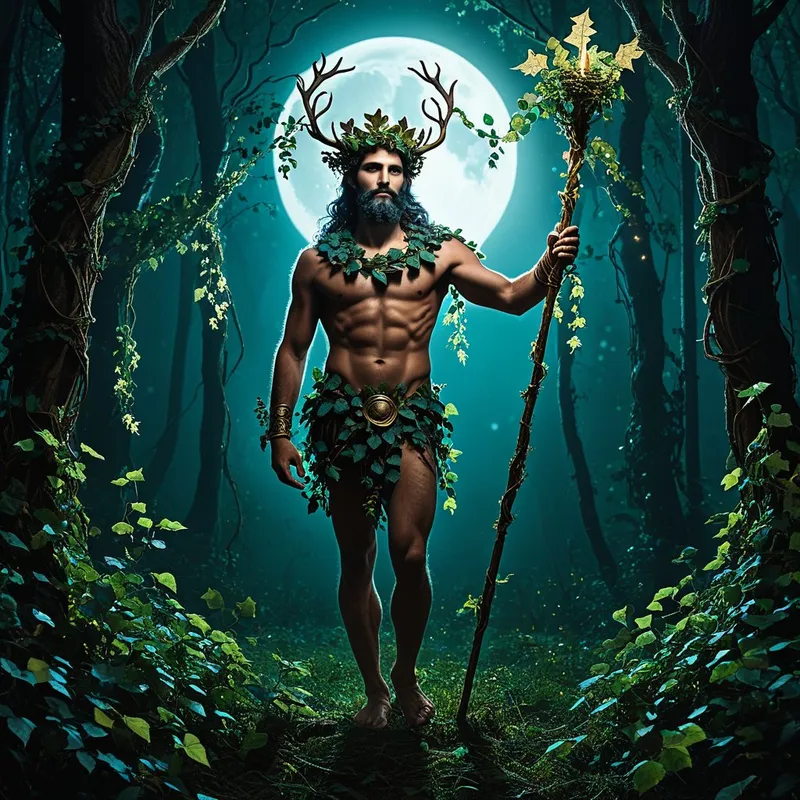
He walked the roads of [the world](/myths/the-world “Myth from Tarot culture.”/), this beautiful, long-haired youth with eyes like deep pools, a crown of ivy upon his brow, and in his hand, the thyrsus. Where he walked, the rigid order of men softened. Walls seemed less solid. The wine he offered did not merely intoxicate; it revealed. It dissolved the careful masks of civilization, showing the raw, pulsing life beneath.
And to him came the women. Not the dutiful wives and daughters of [the hearth](/myths/the-hearth “Myth from Norse culture.”/), but their secret, sleeping selves. They heard his call in the beating of their own hearts, a rhythm older than cities. They left their looms, their children, their defined lives—the Pentheus of their world—and fled to the mountains. They became the [Maenads](/myths/maenads “Myth from Greek culture.”/), the “raving ones.”
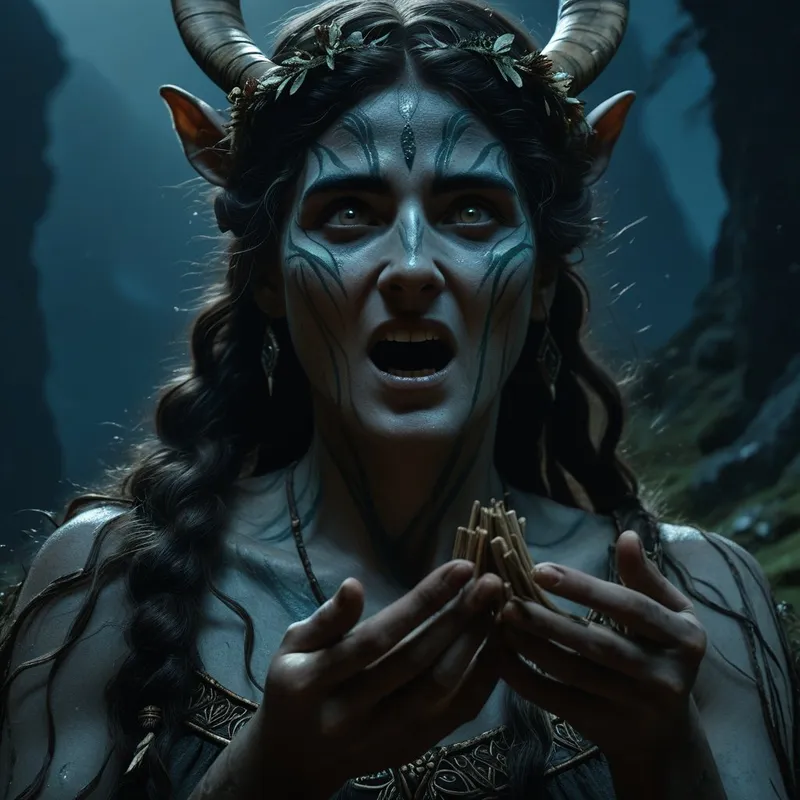
On the slopes of [Mount Cithaeron](/myths/mount-cithaeron “Myth from Greek culture.”/), under the cold eye of [the moon](/myths/the-moon “Myth from Tarot culture.”/) and the dappled light of the sun, a different law held sway. Clad in fawnskins, hair loose and tangled with leaves, they moved to a music only they could hear. With a cry, they could make milk or wine spring from [the earth](/myths/the-earth “Myth from Hindu culture.”/). With their bare hands, they could tear a bull apart. They nursed wolf cubs and serpents coiled peacefully in their hair. This was not violence for its own sake, but a terrifying, direct communion. They did not eat the sacred animal; they became it, consuming the god’s essence in a frenzy of unity, their individual selves dissolved in the roaring, singular life of the group.
But the world of walls and kings could not abide such a sight. In Thebes, Pentheus, the king of order and denial, heard of the women—his own mother, Agave, among them—running wild. He saw only chaos, a threat to his sovereignty. He tried to bind the god, to shackle the ecstasy. Dionysus, the gentle stranger, allowed himself to be captured, a smile playing on his lips. He offered Pentheus a chance to see, to witness the mysteries not as a ruler, but as a participant.
Guided by the god, Pentheus climbed the mountain, hiding in a tree to spy on the sacred rites. But the god’s vision is a gift that shatters. [The Maenads](/myths/the-maenads “Myth from Greek culture.”/), their senses supernaturally heightened, spied the interloper. In their god-filled madness, they did not see a king, but a mountain lion, a beast to be rent in the sacred hunt. Led by Agave, they descended. There was no battle, only a swift, horrific act of nature. Pentheus was torn limb from limb. Agave, triumphant, carried her son’s head back to Thebes, believing it the prize of a glorious hunt, only for the god’s power to recede and leave her cradling the truth in her blood-stained hands.
The flute-song faded. The vines receded. The women returned, hollow-eyed and trembling, to a city forever changed. The god had come, and the price of denying him was written not in fire, but in the unbearable clarity of a mother’s grief and a kingdom’s shattered certainty.
Cultural Origins & Context
This myth was not a singular story but a living, breathing force woven into the fabric of Greek society, primarily through the rituals of the [Dionysian Mysteries](/myths/dionysian-mysteries “Myth from Greek culture.”/) and the explosive civic event of theater. Unlike [the Olympian gods](/myths/the-olympian-gods “Myth from Greek culture.”/) who governed cosmic and social order, Dionysus was the god of the exception, the crack in the system. His worship was often unofficial, led by women and outsiders, flourishing in the wild margins—the mountains and forests—outside the polis.
The myth was passed down in the tragic plays of Euripides, most powerfully in [The Bacchae](/myths/the-bacchae “Myth from Greek culture.”/). Here, it was performed for the entire city during the City Dionysia. Its societal function was profoundly cathartic and regulatory. It served as a controlled, annual release valve. By watching the horrific fate of Pentheus, the citizenry—especially its male rulers—were warned of the dangers of excessive rigidity, hubris, and the repression of nature’s forces, both in the land and in the human [psyche](/myths/psyche “Myth from Greek culture.”/). It acknowledged a power greater than human law, a divine madness that, if denied, would erupt destructively, but if given its proper, ritualized space (in theater, in festivals), could renew the community.
Symbolic Architecture
At its core, this myth is an archetypal [drama](/symbols/drama “Symbol: Drama signifies narratives, emotional expression, and the exploration of human experiences.”/) between [the Ego](/myths/the-ego “Myth from Jungian culture.”/) (Pentheus) and the Unconscious (Dionysus and his Maenads). Dionysus represents the untamable, instinctual [life](/symbols/life “Symbol: The symbol of ‘Life’ represents a journey of growth, interconnectedness, and existential meaning, encompassing both the joys and challenges that define human experience.”/) force—the libido in its rawest, most creative and destructive form. He is the [spirit](/symbols/spirit “Symbol: Spirit symbolizes the essence of life, vitality, and the spiritual journey of the individual.”/) of fermentation, of decay that leads to new growth, of [ecstasy](/symbols/ecstasy “Symbol: A state of overwhelming joy, rapture, or intense emotional/spiritual transcendence, often involving a loss of self-awareness.”/) that obliterates the isolated self.
The Maenads are not merely followers; they are the embodied, awakened feminine principle—not as mother or lover, but as the untamed, intuitive, and ecstatic force of nature itself, the anima unleashed from patriarchal constraint.
Pentheus symbolizes the hyper-rational, controlling, and repressive [consciousness](/symbols/consciousness “Symbol: Consciousness represents the state of awareness and perception, encompassing thoughts, feelings, and experiences.”/). His spyhole in the [tree](/symbols/tree “Symbol: In dreams, the tree often symbolizes growth, stability, and the interconnectedness of life.”/) is the ego’s attempt to observe the unconscious from a safe, detached [distance](/symbols/distance “Symbol: Distance in dreams often symbolizes emotional separation, unattainable goals, or the need for personal space and reflection.”/). It is a fatal [error](/symbols/error “Symbol: A dream symbol representing internal conflict, perceived failure, or a mismatch between expectations and reality.”/). The unconscious cannot be safely observed; it must be experienced. His dismemberment is the symbolic, inevitable shattering of a psyche that has walled itself off from its own [depths](/symbols/depths “Symbol: Represents the subconscious, hidden emotions, or foundational aspects of the self, often linked to primal fears or profound truths.”/). The [mountain](/symbols/mountain “Symbol: Mountains often symbolize challenges, aspirations, and the journey toward self-discovery and enlightenment.”/) setting is the [temenos](/myths/temenos “Myth from Greek culture.”/), the sacred [space](/symbols/space “Symbol: Dreaming of ‘Space’ often symbolizes the vastness of potential, personal freedom, or feelings of isolation and exploration in one’s life.”/) of transformation, where the ordinary rules of [identity](/symbols/identity “Symbol: Identity represents the sense of self, encompassing personal beliefs, cultural background, and social roles.”/) are suspended.
The Dreamer’s Resonance
When this myth pattern stirs in modern dreams, it signals a profound somatic and psychological uprising. To dream of being pursued by a wild, ecstatic group, or of tearing something (or someone) apart with bare hands, or of a beautiful, compelling stranger who disrupts your orderly life, is to feel the Dionysian current breaking through the dam of a too-ordered psyche.
The somatic process is one of intense energy—restlessness, agitation, a feeling of being “pent up.” Psychologically, the dreamer is likely facing a rigid, “Penthean” structure in their life: a deadening job, a suffocating relationship with duty, a denial of their own creative or instinctual needs. The Maenad in the dream represents the part of [the self](/myths/the-self “Myth from Jungian culture.”/) that is ready to break free, to reconnect with wild intuition and passionate embodiment, even if that process feels terrifyingly destructive to the current life structure. It is the psyche’s demand for an ecstatic reunion with what has been neglected.

Alchemical Translation
The alchemical journey modeled here is the [nigredo](/myths/nigredo “Myth from Alchemical culture.”/)—the blackening, the dissolution of the old, rigid [persona](/myths/persona “Myth from Greek culture.”/). For the modern individual, the path of individuation is not one of building a stronger, more impressive ego-fortress. It is, in part, a Dionysian process of allowing that fortress to be dissolved by the truths we have denied.
The triumph is not in defeating the wild god, but in surrendering to his rite. Individuation requires a sacred madness—a willing entry into the irrational, creative, and terrifying depths of one’s own nature.
The “alchemical translation” asks: Where is your inner Pentheus? What strict order are you imposing that is causing a deeper, wilder part of you to plot its escape? The goal is not to become a raving Maenad in the streets, but to create a temenos—a sacred, bounded space (therapy, art, dance, nature immersion) where that energy can be safely invoked and integrated. One must, in a sense, become both the Maenad and the god who orchestrates the rite. We must allow the old, controlling identity to be torn apart (the end of a career, the collapse of an old self-image) so that, like the scattered pieces of the god [Osiris](/myths/osiris “Myth from Global/Universal culture.”/), a more authentic, fluid, and whole being can be reconstituted. The ecstatic dance of the Maenads, in the end, is the psyche’s violent, beautiful method of breaking [the vessel](/myths/the-vessel “Myth from Alchemical culture.”/) so a new wine can be poured.
Associated Symbols
Explore related symbols from the CaleaDream lexicon: