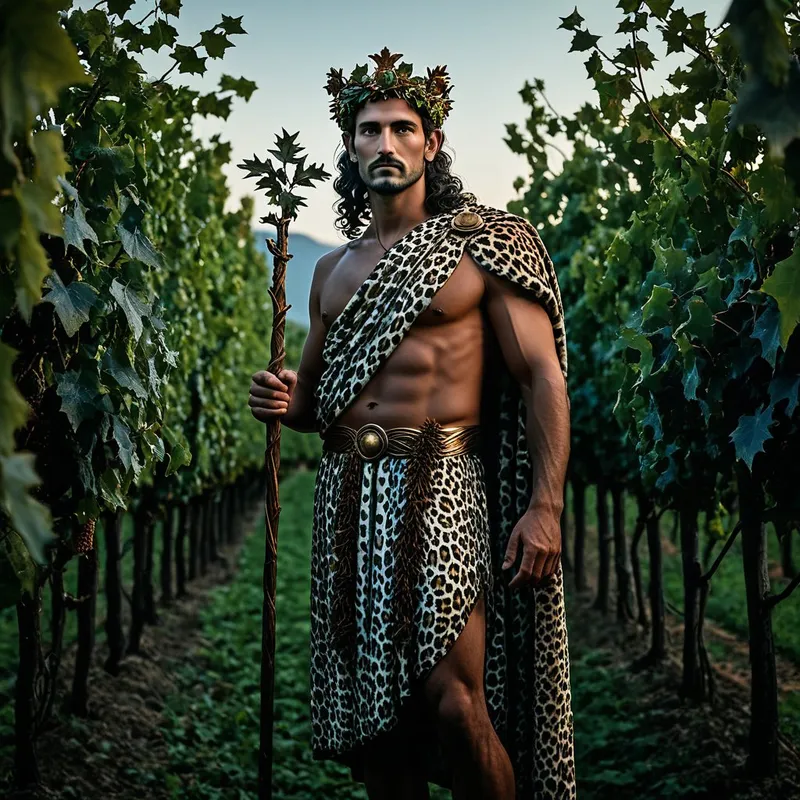
Dionysus from Greek mythology Myth Meaning & Symbolism
The twice-born god of wine, ecstasy, and madness, whose myth charts a journey from persecution to divine acceptance through the power of transformative chaos.
The Tale of Dionysus from Greek mythology
Listen, and I will tell you of the god who arrives not with thunder, but with the scent of crushed grapes and damp earth. He is [the Stranger](/myths/the-stranger “Myth from Biblical culture.”/), the Roaring One, the god who is born twice.
His story begins in fire and secrecy. His mother, the mortal princess Semele, loved by the great Zeus, was tricked by a jealous Hera into asking her divine lover to reveal his true, Olympian form. No mortal eye could bear it. Semele was consumed in a blaze of celestial glory. But Zeus, in his grief, snatched the unborn child from her ashes and sewed him into his own thigh—a womb of flesh and lightning. From there, the god was born a second time: [Dionysus](/myths/dionysus “Myth from Global/Universal culture.”/).
Cast out from Olympus as an infant, disguised as a girl to hide from Hera’s wrath, he wandered [the world](/myths/the-world “Myth from Tarot culture.”/). His madness was not his own, but a curse from the relentless queen of heaven. Yet in his madness was a seed. Where others saw a raving youth, the wild earth recognized its lord. As he traveled to the east, to Phrygia and beyond, the mysteries of the vine revealed themselves to him. He learned to press the blood of [the earth](/myths/the-earth “Myth from Hindu culture.”/), to distill joy and terror from the purple fruit.
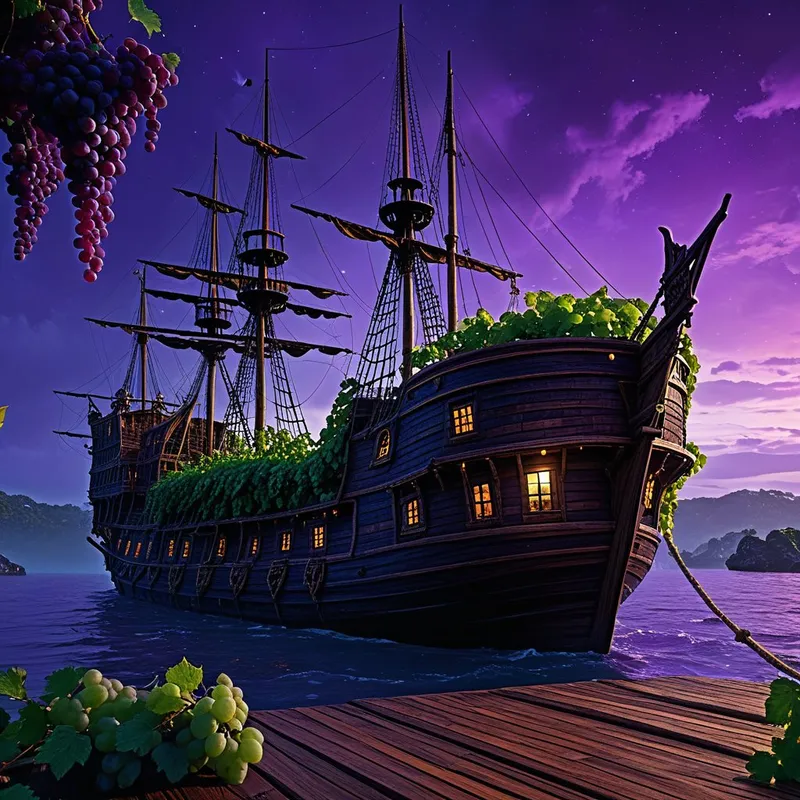
His return to Greece was not a [triumph](/myths/triumph “Myth from Roman culture.”/), but an invasion of an alien grace. He came as a beautiful, long-haired stranger, leading a thiasos—a riotous procession of [maenads](/myths/maenads “Myth from Greek culture.”/) and satyrs, their hands bearing the thyrsus, their heads wreathed in ivy and fir. He sailed on a pirate ship, and when the ignorant crew tried to bind him, their ropes fell away like dust. Vines surged up the mast, grapes swelled and burst, and the air filled with the scent of wine. The pirates, maddened, leapt into [the sea](/myths/the-sea “Myth from Greek culture.”/) and were transformed into dolphins.
He walked into cities that denied him. In Thebes, his own cousin, King Pentheus, tried to chain the god and imprison his worshippers. Pentheus, the man of reason and rigid order, spied on [the maenads](/myths/the-maenads “Myth from Greek culture.”/) dancing on the mountain. But Dionysus had gifted the women divine frenzy. In their ecstatic state, seeing not their king but a wild beast, they fell upon him. His own mother, Agave, led the attack, and Pentheus was torn apart, limb from limb. Only in the bloody aftermath, as the madness lifted, did Agave realize she held the head of her son. The god’s [justice](/myths/justice “Myth from Tarot culture.”/) was terrible, complete. It was not [death](/myths/death “Myth from Tarot culture.”/) he brought, but a truth so devastating it shattered the world that refused him. From that recognition, from that profound and awful grief, a new understanding was born. The Stranger was welcomed. The god had come home.
Cultural Origins & Context
The myths of Dionysus are not a single, coherent biography but a tapestry of local cult stories, ritual practices, and dramatic poetry woven together over centuries. His worship was fundamentally different from the state-sanctioned cults of Athena or Zeus. It was ecstatic, often nocturnal, and centered outside the city walls—on the mountain, in [the wilderness](/myths/the-wilderness “Myth from Biblical culture.”/). The primary bearers of his myths were not just poets like [Homer](/myths/homer “Myth from Greek culture.”/) or Hesiod, but the participants in the [Dionysian Mysteries](/myths/dionysian-mysteries “Myth from Greek culture.”/) and the playwrights of Athenian tragedy, such as Euripides, whose Bacchae remains the definitive literary testament.
His societal function was deeply paradoxical. He was both a god of uncontrollable nature and the patron of the highly structured art of theater. The City Dionysia festival in Athens, where tragedies and comedies were performed, was a state-sponsored container for exploring the very chaos Dionysus represented. The myth served as a necessary cultural pressure valve. It reminded [the polis](/myths/the-polis “Myth from Greek culture.”/) of what lay beyond its walls and within its own citizens: the untamed, instinctual, and creative forces that civilization must both acknowledge and ritualize to remain whole.
Symbolic Architecture
Dionysus is the archetypal [symbol](/symbols/symbol “Symbol: A symbol can represent an idea, concept, or belief, serving as a powerful tool for communication and understanding.”/) of the other—that which is foreign, irrational, ecstatic, and terrifyingly alive, breaking into the well-ordered [psyche](/myths/psyche “Myth from Greek culture.”/) (or society). He represents the undifferentiated [life](/symbols/life “Symbol: The symbol of ‘Life’ represents a journey of growth, interconnectedness, and existential meaning, encompassing both the joys and challenges that define human experience.”/) force itself, the libido or psychic [energy](/symbols/energy “Symbol: Energy symbolizes vitality, motivation, and the drive that fuels actions and ambitions.”/) that precedes form.
The vine must be crushed to yield the wine; the self must be dismantled to encounter the soul.
His dual [birth](/symbols/birth “Symbol: Birth symbolizes new beginnings, transformation, and the potential for growth and development.”/) signifies a [consciousness](/symbols/consciousness “Symbol: Consciousness represents the state of awareness and perception, encompassing thoughts, feelings, and experiences.”/) that transcends ordinary mortal or divine categories. He is the “twice-born,” a model for initiatory experiences where one’s old [identity](/symbols/identity “Symbol: Identity represents the sense of self, encompassing personal beliefs, cultural background, and social roles.”/) is destroyed (Semele’s [death](/symbols/death “Symbol: Symbolizes transformation, endings, and new beginnings; often associated with fear of the unknown.”/)) and a new, more complex consciousness is gestated in a paradoxical [space](/symbols/space “Symbol: Dreaming of ‘Space’ often symbolizes the vastness of potential, personal freedom, or feelings of isolation and exploration in one’s life.”/) (Zeus’s thigh). His thyrsus—a fennel stalk topped with a [pine cone](/symbols/pine-cone “Symbol: Pine cones symbolize potential, fertility, and the promise of regeneration.”/)—is a profound symbol of this union: the rigid, phallic stalk of [structure](/symbols/structure “Symbol: Structure in dreams often symbolizes stability, organization, and the framework of one’s life, reflecting how one perceives their environment and personal life.”/) penetrated and crowned by the fertile, seed-bearing [cone](/symbols/cone “Symbol: The cone symbolizes potential and transformation, often representing a journey towards achieving goals or enlightenment.”/) of wild [nature](/symbols/nature “Symbol: Nature symbolizes growth, connectivity, and the primal forces of existence.”/).
The [resistance](/symbols/resistance “Symbol: An object or tool representing opposition, struggle, or the act of pushing back against external forces or internal changes.”/) of figures like Pentheus symbolizes [the ego](/myths/the-ego “Myth from Jungian culture.”/)’s tyrannical attempt to suppress the unconscious, instinctual layers of the psyche. The maenads represent those suppressed energies in their raw, autonomous power. Their destruction of Pentheus is not mere brutality, but the inevitable, catastrophic return of the repressed when it is denied [integration](/symbols/integration “Symbol: The process of unifying disparate parts of the self or experience into a cohesive whole, often representing psychological wholeness or resolution of internal conflict.”/). Dionysus does not kill Pentheus; Pentheus’s own rigid refusal to acknowledge the god’s [presence](/symbols/presence “Symbol: Presence in dreams often signifies awareness or acknowledgment of something significant in one’s life.”/) orchestrates his doom.
The Dreamer’s Resonance
To dream in a Dionysian pattern is to experience the psyche in a state of fermentation. Common motifs include: chaotic, joyful, or frightening festivals; unruly vegetation overgrowing a familiar space; the sensation of being an outsider or stranger in one’s own life; scenes of tearing apart or dismemberment; or the sudden, intoxicating taste of an unknown fruit or drink.
Somatically, the dreamer may awaken with a sense of expansion, agitation, or creative urgency, or conversely, with a hangover-like depletion. Psychologically, these dreams signal that a long-contained aspect of the personality—often related to instinct, creativity, passion, or grief—is demanding recognition. The ego’s structured “city” is being besieged by the wildness of the “mountain.” The process is one of enantiodromia: the unconscious is producing the opposite of the conscious attitude to force a movement toward wholeness. The dream is an invitation to a ritual, a sacred space where this energy can be met consciously, lest it break in destructively.

Alchemical Translation
The alchemical journey of Dionysus is a map for psychic transmutation, where the base material of a one-sided, rigid consciousness is dissolved in the aqua vitae of ecstatic experience to produce the gold of a more fluid, resilient self.
[The first stage](/myths/the-first-stage “Myth from Alchemical culture.”/) is mortificatio: the death of Semele, the burning away of the old, naive container. For the individual, this is any profound loss, crisis, or “breakdown” that shatters previous identifications. The second is the [coniunctio](/myths/coniunctio “Myth from Alchemical culture.”/) in the thigh of Zeus: a paradoxical, hermetic incubation. This is the period of withdrawal, depression, or introversion where the new consciousness is secretly formed in the dark, not by will, but by a process beyond ego control.
The god is not integrated by being made tame, but by the ego learning to dance in his wild procession.
The return and confrontation with the Pentheus-figure is the crucial [rubedo](/myths/rubedo “Myth from Alchemical culture.”/), the reddening. It is the fiery, often painful, conflict between the newly emergent self (the Stranger-god) and the entrenched, authoritarian structures of the personality. Victory is not the annihilation of order, but its humbling and expansion. The final stage is individuation symbolized by the god’s acceptance into Olympus. The chaotic, creative, irrational force is granted a throne among the other gods. For the modern individual, this is the stable capacity to host one’s own creative madness, deep grief, and ecstatic joy without being identified with or destroyed by them. The thyrsus is held upright: structure and wild fertility exist in one staff, one psyche. The individual becomes a vessel capable of holding the intoxicating wine of the full human experience without shattering.
Associated Symbols
Explore related symbols from the CaleaDream lexicon: