Dionysian Festivals Myth Meaning & Symbolism
The myth of sacred festivals where the god of wine and ecstasy dissolves boundaries, unleashing primal chaos and divine madness to shatter rigid order.
The Tale of Dionysian Festivals
Hear now the tale not of stone and law, but of sap and song. It begins not at dawn, but at twilight, in the liminal hour when the world holds its breath. The air, thick with the scent of crushed pine and ripe grape, hums with a promise of madness. From the wild mountains, a sound—first a whisper, then a roar. It is the cry of the Maenads, their feet bare and bleeding on the sharp earth, their hair unbound and writhing like serpents. They are answering a call that bypasses the ears and speaks directly to the blood.
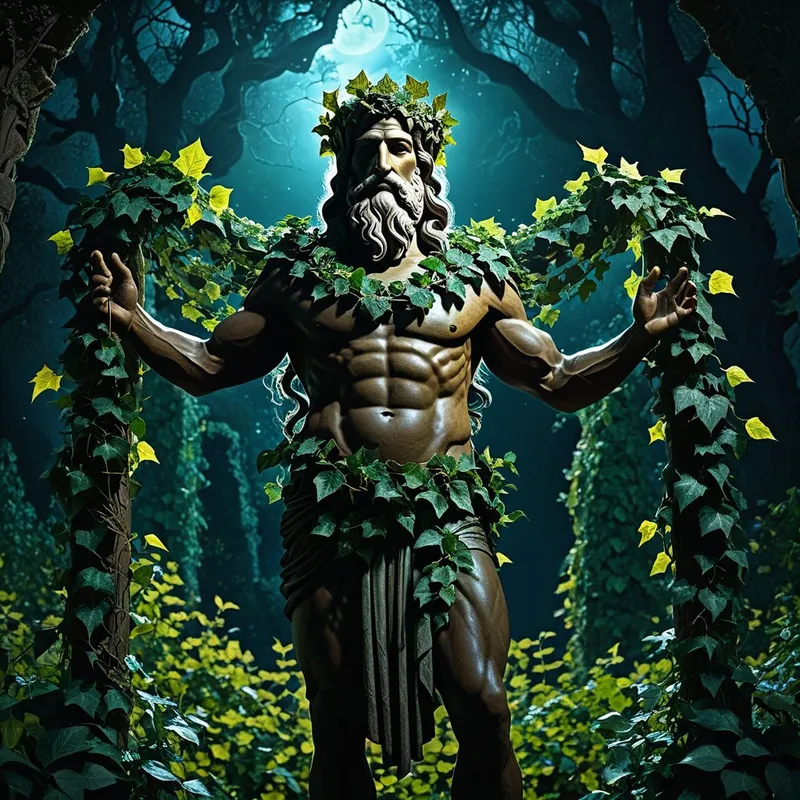
Their lord approaches. He is Dionysus, the twice-born, the stranger-god. He wears a crown of ivy and a smile that is both beautiful and terrible. In his hand, the thyrsus—a fennel stalk wound with ivy, a weapon that brings not wounds but revelations. He moves not with the measured pace of the Olympians but with the unpredictable flow of wine. Where he walks, the rigid lines of the city blur. Stone walls seem to soften; the strict rhythms of the loom and the plow are forgotten.
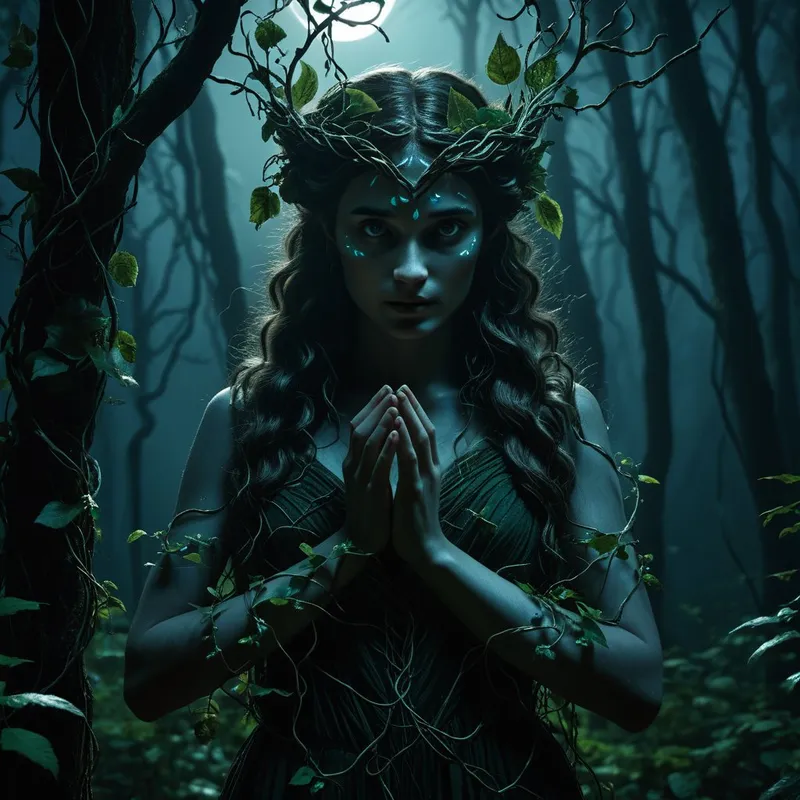
The festival is not a spectator’s event; it is a vortex. Women of all stations—queen and slave, matron and maiden—cast aside their wool and their duties. They flee to the mountains, the oreibasia. There, under the cold eye of the moon, the civilized self is stripped away. They become sparagmos—the rending. With bare hands, they tear apart living animals, consuming the raw flesh, omophagia, to ingest the god’s wild essence. Their cries are not human; they are the shriek of the hawk, the bellow of the bull. They wield the thyrsus, and with a touch, it causes springs of wine or milk to burst from the earth. The very forest dances with them; beasts lay down their ferocity, and snakes, cool and gleaming, twine in their hair like living jewelry.
But this divine madness has a dark twin: resistance. The king who bars his gates, the city that denies the god—they are the conflict. Think of Pentheus, peering from a tree to spy on the sacred rites, his rational mind trying to categorize the uncategorizable. The Maenads, in their ecstatic trance, see not a king but a mountain lion, a beast to be destroyed. The mother leads the rending. Order, in its arrogance, is torn limb from limb by the chaos it refused to acknowledge.
The resolution is not a return to normal. It is a transformation. The frenzy subsides like a tide, leaving the participants exhausted, hollowed out, and strangely whole. They return to the city, not as they left, but carrying a secret knowledge in their bones. The world has been unmade and remade. The god withdraws, but the memory of the vine remains—the promise that beneath the polished surface of civilization, the wild, creative, terrifying, and liberating pulse of life still beats, waiting for its festival.
Cultural Origins & Context
The Dionysian festivals were not mere stories; they were lived, annual realities woven into the fabric of Greek society, most famously in the City Dionysia of Athens and the rural Anthesteria. These rites served a critical societal function in a culture deeply invested in order (cosmos) and reason (logos). They were the sanctioned pressure valve, the institutionalized return of the repressed.
The myths were passed down not just by poets like Homer or Hesiod, who often treated Dionysus with ambivalence, but more powerfully through the ritual practices themselves and the explosive medium of theatre, which was born from the choral hymns (dithyrambs) sung to Dionysus. The playwrights—Aeschylus, Sophocles, Euripides—were not merely entertainers; they were theologians of the irrational, staging the god’s mysteries before the entire polis. The festival was the context, and the myth was the script for a collective psychological event. It was told by the state to itself, a necessary confrontation with everything the state was built to control.
Symbolic Architecture
At its core, the Dionysian mythos is an elaborate symbolic system mapping the geography of the human psyche. Dionysus himself is the archetype of the unintegrated other—the fluid, ambiguous, non-rational force that exists outside the ego’s citadel.
The thyrsus is the ultimate paradox: a weapon of peace, a wand of destruction. It symbolizes the transformative power that dismantles the psyche in order to rebuild it on a more authentic foundation.
The sparagmos and omophagia are not mere barbarism. They symbolize the violent, necessary deconstruction of the rigid, "civilized" personality (the persona). To ingest the raw flesh is to assimilate the raw, instinctual life force—the libido in its pure, unadulterated form—that has been denied and projected onto the "wild animal" within. The Maenad’s ecstasy represents a state of unio mystica, a divine madness where the boundary between self and other, human and nature, individual and god, completely dissolves. This is the symbolic annihilation of the ego, a terrifying yet potentially liberating encounter with the non-ego, the shadow and the collective unconscious.
The Dreamer's Resonance
When this mythic pattern stirs in the modern dreamer, it signals a profound somatic and psychological uprising. It is the psyche’s own Dionysian festival, breaking through the repression of a life too ordered, too sterile, too tightly controlled.
Dreams of chaotic, uncontrollable celebrations; of being in a wild, ecstatic crowd where one’s identity is lost; of nature violently reclaiming built spaces; or of consuming strange, raw substances—all these are manifestations. The somatic process is one of pressure and release: a build-up of instinctual energy (creative, sexual, aggressive) that the conscious attitude has dammed up. The psychological process is the ego’s confrontation with its own disowned vitality. The dream-Maenad is not an external figure; she is the dreamer’s own repressed capacity for abandon, fury, and primal joy, now demanding recognition. To dream of being Pentheus, the spy torn apart, is to experience the catastrophic failure of a purely observing, rational consciousness when faced with the full force of the unconscious.

Alchemical Translation
The alchemical journey modeled by the Dionysian festival is the nigredo—the blackening, the dissolution, the solve (to dissolve). In the vessel of the individual psyche, this is the painful but necessary stage of de-individuation, where the acquired structures of the personality are broken down.
The festival is the alchemical crucible where the leaden weight of the persona is dissolved in the sharp wine of the unconscious, not to destroy the self, but to liberate the gold of the authentic individual from its rigid ore.
The modern individual’s "rigid order" may be a suffocating career, a stagnant identity, or a life of pure adaptation. The Dionysian impulse is the call to the mountain, the invitation to let the inner Maenad run free. This is not a literal prescription for chaos, but a psychic ritual. One must consciously engage with what has been repressed—the wild creativity, the justified rage, the untamed grief. This is the sparagmos of one’s own outdated self-image. The "omophagia" is the difficult, often ugly process of re-owning these projected parts, of ingesting one’s own shadow material.
The triumph is not in the frenzy itself, but in the return. The goal of this psychic transmutation is individuation: to reintegrate that wild, divine vitality back into a more expansive, fluid, and whole consciousness. One returns from the inner festival not as a permanent Maenad, but as a person who has tasted the god and knows that the vine grows within. The ego is not destroyed but humbled and enlarged, now capable of holding both logos and mythos, both order and the creative, life-giving chaos from which all order must periodically be renewed.
Associated Symbols
Explore related symbols from the CaleaDream lexicon: