Diogenes Myth Meaning & Symbolism
The story of Diogenes of Sinope, who lived in a barrel, owned nothing, and sought truth with a lantern in daylight, challenging all societal conventions.
The Tale of Diogenes
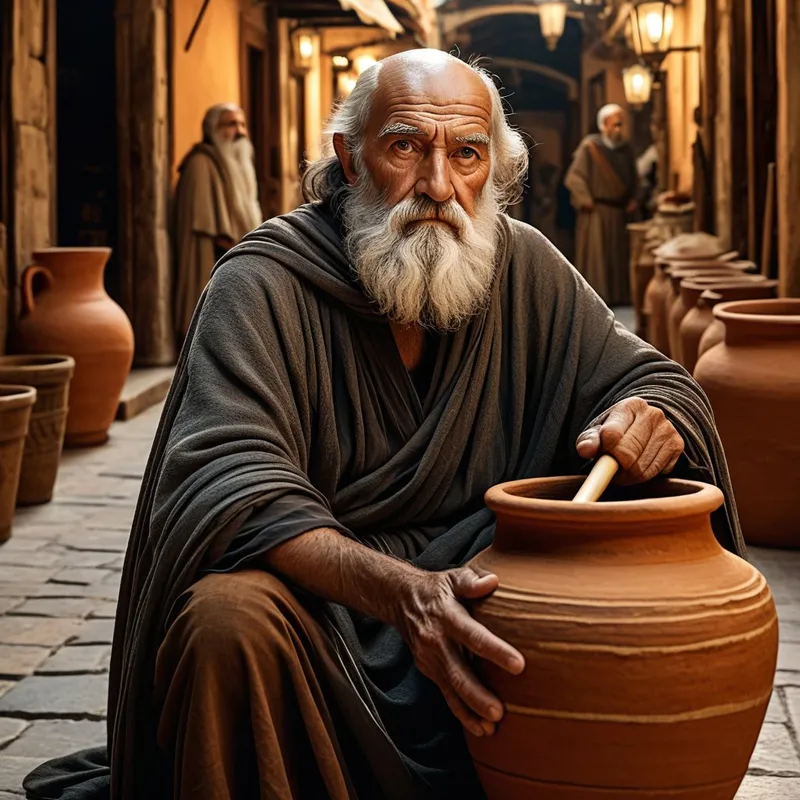
Let me tell you of a man who was not a king, nor a warrior, nor a god, but whose shadow stretched longer than any palace wall. In the heart of Athens, where marble gleamed and voices argued over truth and power, there moved a different kind of creature. His name was Diogenes of Sinope, and his palace was a large, discarded pithos.
He wore a single, threadbare cloak, slept in his jar, and owned a wooden bowl—until he saw a child drink from his hands. He threw the bowl away, laughing at his own foolishness. He performed all the acts of life in the open marketplace, a living rebuke to the hidden shame of the city. When men called him a dog for his shamelessness, he wore the name Kynikos as a badge of honor.
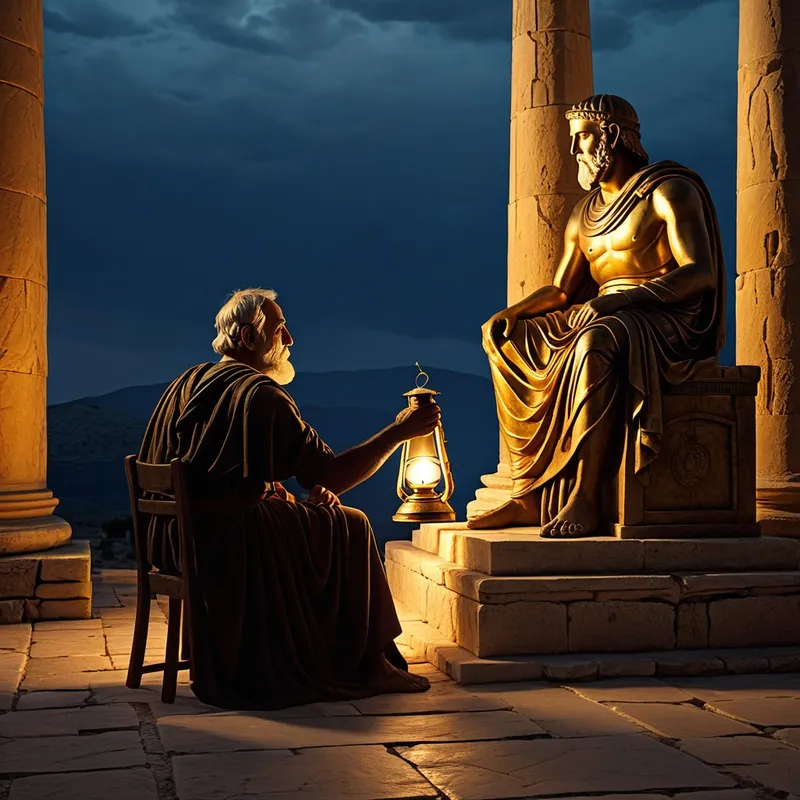
His most famous hunt was not for game, but for a man. In the bright light of noon, he would stalk the agora, his lit lamp held high. "I am looking for an honest man," he would declare to the puzzled crowds, the flame revealing only faces painted with ambition, greed, and pretense. He found none.
The climax of his tale came not in battle, but in a moment of profound stillness. Alexander the Great, the most powerful man on earth, sought out the philosopher. He found Diogenes basking in the sun by his jar. Standing over him, Alexander offered, "Ask of me any boon." Diogenes, barely opening his eyes, replied, "Stand out of my sunlight." It is said Alexander walked away, murmuring that if he were not Alexander, he would wish to be Diogenes.
Cultural Origins & Context
Diogenes is not a figure from the age of Zeus</ab title="The supreme god of the Greek pantheon">Zeus and Poseidon, but from the 4th century BCE, a time of profound transition in the Greek world. The city-state was in crisis, and philosophy was moving from cosmic speculation to questions of how to live. Diogenes was the most radical practitioner of the Cynic school, which traced its intellectual lineage to Antisthenes, a pupil of Socrates.
His "myth" was passed down not through epic poetry, but through chreiai—pithy anecdotes and biting remarks collected by later writers like Diogenes Laërtius. These stories functioned as philosophical grenades. They were told in symposia and streets to shock, amuse, and provoke. Diogenes was a living performance art piece, and his societal function was that of a holy fool—to use extreme, often offensive behavior to expose the hypocrisy of social conventions (nomos) and point toward a life according to nature (physis).
Symbolic Architecture
Diogenes is the archetype of the deconstructed self. His myth is not about building an identity, but about stripping one away.
The lantern in daylight is the symbol of a search conducted in the wrong place, or for something that does not exist in the realm you are searching.
His jar is not merely a home; it is the ultimate boundary. It separates him from the world of possessions and status, creating a vessel of the self so small that only the essential can remain. His shamelessness—eating, sleeping, and performing bodily functions in public—is a brutal act of psychic integration. He drags the repressed, shadow aspects of life into the light of the agora, refusing to split the human animal into "civilized" and "base."
The encounter with Alexander represents the ultimate confrontation between two forms of power: external, worldly dominion and internal, unassailable sovereignty. Diogenes’s request, "Stand out of my sunlight," asserts that the most fundamental goods—warmth, light, peace—cannot be given or taken by any king. They are the birthright of a being aligned with nature.

The Dreamer's Resonance
To dream of Diogenes is to dream of radical simplification and confrontational honesty. It often arises when the dreamer’s life has become cluttered with obligations, masks, and unexamined "shoulds."
You may dream of living in a small, confined, but secure space like a barrel or a closet within a vast mansion, representing a longing to shed a cumbersome identity. You might dream of holding a light in a brightly lit room, feeling a frantic, urgent need to find something everyone else insists is not lost. This speaks to a search for authenticity in a world that feels plastic and performative. A dream of defiantly rejecting a figure of immense authority—a boss, a parent, a celebrity—mirrors the somatic process of reclaiming personal sovereignty. The body, in such dreams, often feels both exposed and incredibly strong, vibrating with the tension and release of setting a boundary that is terrifyingly simple.
Alchemical Translation
The alchemical process modeled by Diogenes is the solve without an immediate coagula. It is the stage of nigredo—the blackening, the dissolution of all that is false.
The goal is not to become a beggar in a jar, but to pass through the jar to discover what, if anything, remains when everything society told you to be is taken away.
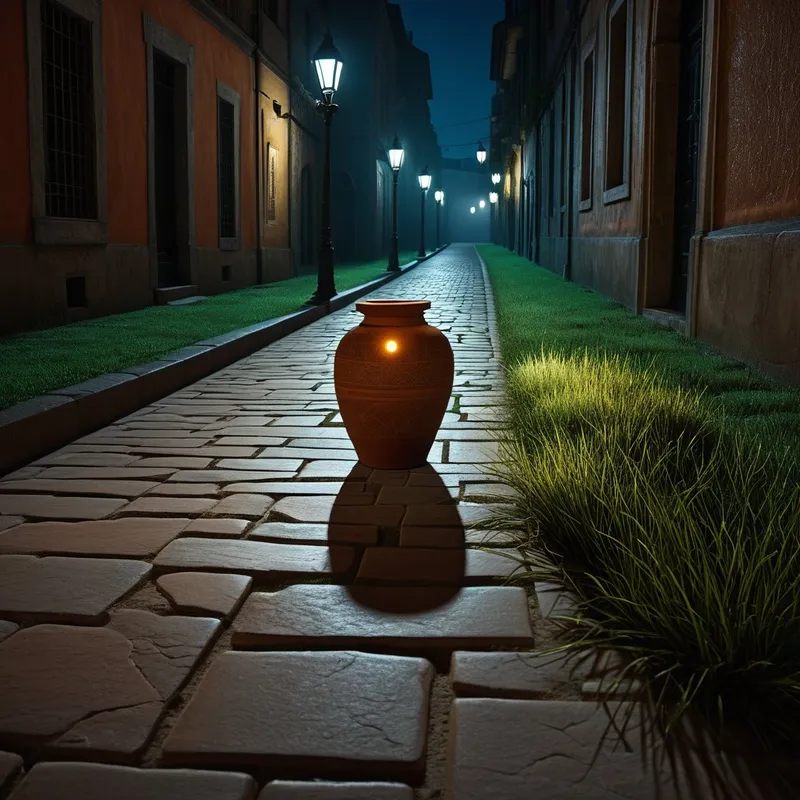
For the modern psyche, this is the work of shadow integration and value inversion. It asks: What conventions are you obeying that have no root in your nature? What luxuries have become necessities that enslave you? The "alchemical jar" is the container of the therapeutic process or the disciplined practice of self-inquiry where one consciously renounces a conditioned behavior or belief to observe the anxiety and freedom that follows.
Diogenes does not offer a new, polished philosophy to live by. He offers the wrecking ball. The triumph is not in construction, but in the clear, sunlit space left after the demolition. The psychic gold he offers is autarkeia—self-sufficiency—and parrhesia—fearless speech. It is the realization that your core, when stripped of its gilding, cannot be harmed by the opinions of the marketplace or the edicts of kings. Your sunlight is your own.
Associated Symbols
Explore related symbols from the CaleaDream lexicon: