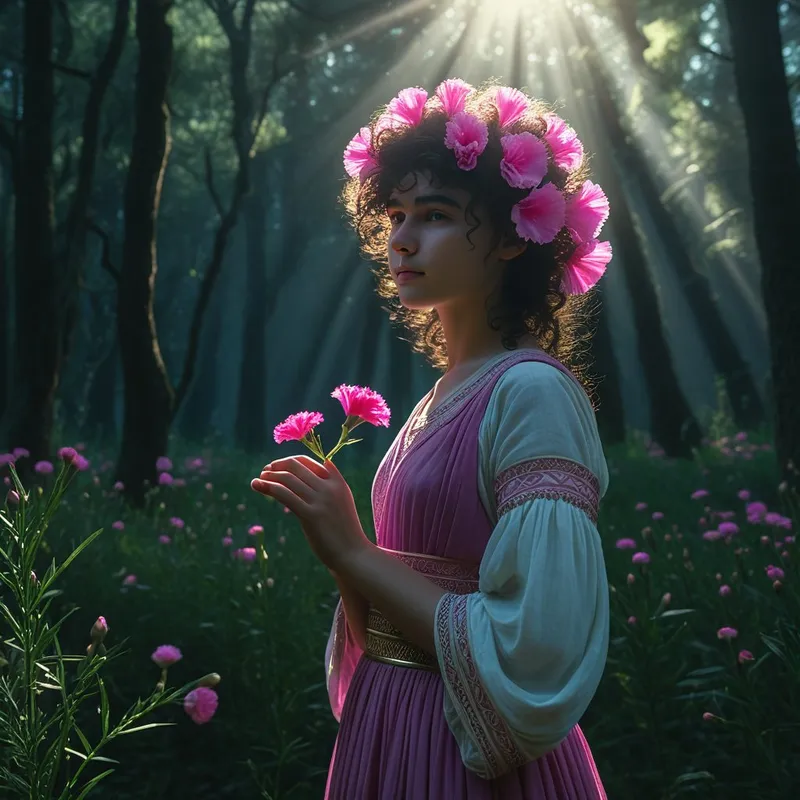
Dianthus Myth Meaning & Symbolism
A flower born from the spilled blood of a youth, transformed by Artemis's grief into a symbol of divine love and eternal remembrance.
The Tale of Dianthus
Hear now a tale not of thunderous gods on high Olympus, but of the quiet earth and the fierce, fleeting beauty that springs from it. It begins in the deep, green silence of the Arcadian woods, where the sun pierced the canopy in shafts of dusty gold and the only sounds were the rustle of a deer and the distant laugh of a stream.
There lived a youth named Dianthus. He was not a hero who sought glory, nor a king who craved dominion. His soul was tuned to a different frequency—the whisper of leaves, the secret language of tracks in the moss, the solemn grace of the wild things. His greatest devotion was to Artemis, not with grand temples or loud prayers, but with the purity of his presence in her domain. He moved through her forests as a part of them, a respectful shadow, his heart echoing the steady, untamed rhythm of the wild.
But the human heart is a complex grove, and within Dianthus grew another, softer devotion. It was for a nymph of the meadows, a creature of sunlight and open fields. When he was with her, the forest’s solemnity lifted, replaced by a lighter, sweeter joy. He believed, in his innocence, that one devotion need not betray the other; that the heart could honor the fierce independence of the huntress and the tender connection of the lover.
He was wrong.
Artemis, whose gaze misses nothing in her realm, saw the shift in him. She saw the way his thoughts would wander from the stalking path to a sunlit meadow, the way the set of his shoulders softened. To her, this was not an expansion of the heart, but a fragmentation of loyalty. A dilution of the sacred, singular focus her wildness demanded. A cold fury, sharper than any winter wind, settled in her divine breast. It was not the hot rage of Ares, but the silent, lethal frost of betrayal.
She found him at the edge of the woods, where the trees thinned and the meadow began. He was not with the nymph, but simply looking toward the light, a faint smile on his lips—a smile for a memory, a hope. It was that smile that was his undoing. Without a word, without a shouted accusation, Artemis acted. Some say a silver arrow, fletched with moonbeams, flew true and silent. Others say the very shadows of the trees reached out like claws. The tales agree only on the result: Dianthus fell, his lifeblood, warm and crimson, soaking into the dark, receptive soil of the forest floor.
As the last light left his eyes, a different emotion pierced Artemis’s icy wrath. It was a pang—a recognition of the beauty she had extinguished, the pure, wild spirit she herself had cherished. It was grief, stark and surprising. She looked upon his fallen form, and then at the blood staining the earth. Her divine will, which could destroy, could also transform. She breathed upon the bloody ground, and her breath was not frost, but a sigh of regret and power.
Where each drop of his blood had fallen, the earth stirred. Not with decay, but with creation. Green shoots, fierce and urgent, pushed upward. They unfurled into slender stems, clad in grey-green leaves like armour, and from their tips burst flowers of the most astonishing hue—a vibrant, living pink, edged with the deep crimson of his blood, and with a scent, spicy and sweet, that held the memory of the forest and the promise of the meadow. The Flower of Dianthus was born, a permanent, blooming testament to a mortal’s devotion and a goddess’s remorse, forever rooted in the moment where love and wrath met.

Cultural Origins & Context
The myth of Dianthus belongs not to the grand epic cycles of Homer, but to the rich, localized soil of aetiological folklore. It is a "just-so" story from the Greek world, told to explain the origin of a specific flower—the carnation or "pink" (genus Dianthus). These tales were the province of farmers, herbalists, and mothers, passed down not by rhapsodes in royal courts but through oral tradition in villages and across hillsides.
Its primary societal function was explanatory and pedagogical. It answered a simple, daily wonder: "Why does this beautiful, fragrant flower have this color and scent?" The answer rooted the natural world directly in the drama of the divine, making the landscape a living scripture. Furthermore, it reinforced cultural values. The story served as a subtle warning about the dangers of divided loyalties, especially regarding the capricious and exacting gods. It illustrated that even a goddess of nature could embody a punishing, possessive aspect of the wild that demanded absolute, undivided allegiance. The myth also offered a narrative of consolation, showing how beauty and remembrance can arise from tragedy, weaving mortality into the eternal cycle of nature's rebirth.
Symbolic Architecture
At its core, the myth of Dianthus is an alchemical narrative of transmutation. The central symbol is the flower itself: a living paradox born from a moment of destruction. It represents the soul's capacity to create meaning from suffering, to produce beauty from the raw material of pain and loss.
The flower is the psyche's answer to the wound: not a scar to hide the injury, but a bloom that integrates it into a new form of life.
Dianthus, the youth, symbolizes the innocent, undifferentiated consciousness that seeks to harmonize conflicting inner forces—here, the archetypal pull of the Independent Spirit (Artemis) and the Yearning for Connection (the nymph). His fate illustrates the peril of this naive unification before a conscious reconciliation has been achieved. Artemis represents a specific aspect of the Great Mother archetype: not the nurturing mother, but the Terrible Mother, the demanding, possessive force of nature that requires sacrifice and singular devotion. Her transformation from destroyer to creator in the myth's climax is crucial. It shows that the very power that can shatter the ego (the youthful identity) is also the power that facilitates its rebirth into a more symbolic, eternal form (the flower).
The Dreamer's Resonance
When this myth pattern stirs in the modern dreamer, it often signals a profound inner conflict between autonomy and intimacy, or between a cherished personal identity and the demands of a relationship or vocation. To dream of a beautiful, vibrant flower growing from a wound, from blood, or from a place of decay is to encounter the Dianthus process directly in the unconscious.
The somatic experience might be one of poignant ache mixed with a strange, burgeoning hope—a tightness in the chest that also feels like the unfurling of a petal. Psychologically, the dreamer is in the midst of a psychic death-and-rebirth sequence. The "blood" in the dream represents a vital life energy—passion, love, vitality—that feels spilled, wasted, or sacrificed. The dream is the psyche's first assertion that this loss is not an end, but the necessary fertilizer for a new phase of growth. The dreamer may be processing grief, betrayal, or the painful end of a life chapter, with the unconscious insisting that the core essence of that experience will be preserved and transformed, not lost.

Alchemical Translation
For the individual on the path of individuation, the myth of Dianthus models the stage where a conscious attitude or identification (the youth) must be sacrificed to a greater, unconscious power (the archetypal demand of Artemis). This is not a failure, but a necessary mortificatio—a symbolic death.
The ego's plan to have it all—to keep its wild independence while embracing deep connection—is found to be naive. The archetypal force, in its terrible majesty, shatters this ego-position. The alchemical work begins in the aftermath, in the "blood-soaked earth" of the psyche. This is the nigredo, the dark night of the soul, where all seems lost.
The transmutation occurs not in spite of the wound, but through it. The goddess's grief—the recognition by the very archetype that destroyed the old form—is the catalyst. It represents a moment of reflexive consciousness within the unconscious itself.
The blooming of the flower is the albedo and rubedo—the whitening and reddening. It signifies the birth of a symbolic attitude. The individual no longer is the naive youth Dianthus; instead, they carry the Flower of Dianthus. Their devotion, their passion, their essential character is no longer a fragile, mortal identity but has become a perennial principle. It is rooted in the earth of lived experience (including pain), yet reaches toward the light of meaning. The integrated self can now hold the memory of the sacrifice (the crimson edge) within the enduring beauty of its bloom, achieving a devotion that is both rooted and resilient, personal and mythic.
Associated Symbols
Explore related symbols from the CaleaDream lexicon: