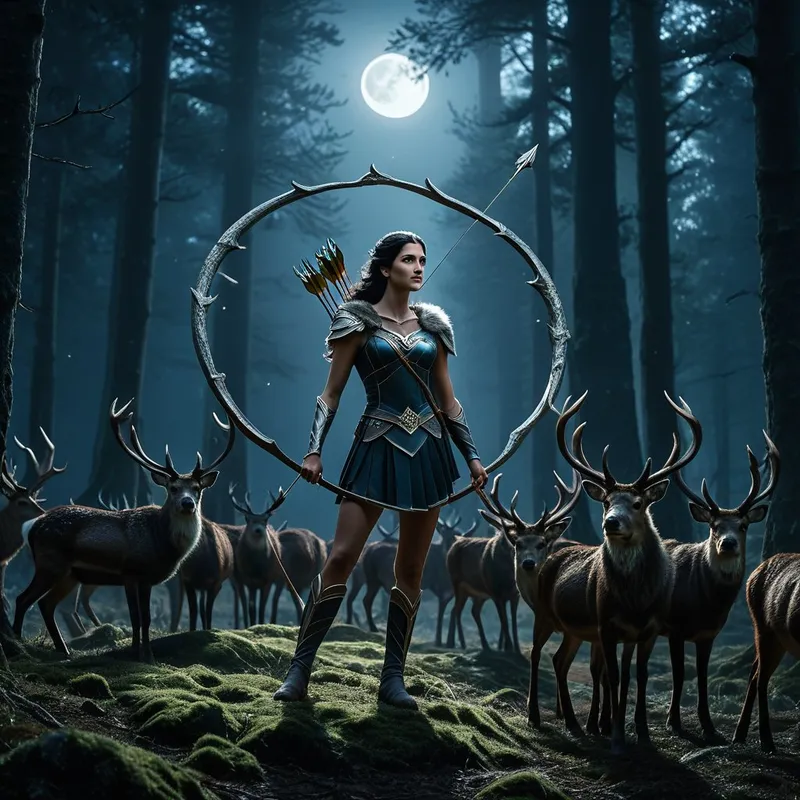
Diana Myth Meaning & Symbolism
The myth of Diana, goddess of the hunt and moon, embodies the untamed feminine, the sovereignty of nature, and the sacred boundary between wilderness and civilization.
The Tale of Diana
Breathe the air of the primeval forest, where the sun’s rule ends and the moon’s dominion begins. Here, in the deep, uncharted woods of Latium, shadows are not mere absences of light, but living things. The only law is the swift, silent law of the hunt. And she is its sovereign.
From her first cry, which was not a cry but the sound of an arrow cleaving the air, she was different. Juno did not suffer her mother’s pain; Latona bore her easily, and the child sprang forth fully formed, a girl with eyes like polished flint and a spirit as untamed as the wind in the high crags. To her father Jupiter, she asked for no palace of marble, no dominion over love or war. "Grant me," she said, her voice the whisper of leaves, "the eternal forest. Grant me the mountains where the clouds sleep and the valleys where the rivers are born. Grant me a bow, a quiver of arrows, and the company of nymphs who choose freedom over fate. And grant me that I may never be bound by the chains of marriage, that my light may be my own."
And so it was. Diana became the lady of the wild things. Her footsteps did not break the twig; her passage was known only by the sudden stillness of the birds, a reverence. By day, she ranged with her band of huntress-nymphs, their laughter like falling water, their arrows true. The stag knew her as the final, merciful shadow. The wolf knew her as sister. But when the sun bled away, she underwent her great transformation. She would ascend to the heavens, and her silver chariot would draw the moon across the star-strewn vault, bathing the sleeping world in a cool, watchful light. She was the huntress of the day and the luminous pearl of the night, a perfect, self-contained cycle.
But the world of men, with its desires and disruptions, could not forever respect the sacred boundary of the grove. One fateful evening, as Diana and her nymphs bathed in the secret, spring-fed pool of Nemorensis, a mortal hunter named Actaeon, strayed from his path. The air was thick with the scent of damp earth and wild mint, the goddess’s sacred hounds resting at the water’s edge. Through the parting ferns, Actaeon saw what no mortal eyes were meant to see: the divine form unveiled, the terrifying beauty of absolute sovereignty.
A silence colder than the mountain snow fell. Diana, met not with fear but with a wrath as pure and sudden as lightning, did not reach for a weapon. She flicked water from her fingertips. "Go now," she uttered, her voice the cracking of ice, "and tell, if you can, of what you have seen."
Where the water droplets fell upon him, change erupted. Antlers, heavy and branching, burst from his brow. His neck elongated, his hands and feet hardened into cloven hooves. The hunter’s mind screamed inside the skull of a great stag. His own hounds, catching the scent of unfamiliar prey, raised their heads. With a bay that shattered the sacred silence, they gave chase. Actaeon fled, his new legs clumsy, through the very woods he once commanded, until he stumbled and fell at the bank of the stream. His own loyal companions, eyes clouded with instinct, did not know him. The forest, which had been his home, became his tomb, fulfilling the law he had broken: to look upon the untamed divine without permission is to become part of the untamed, to be consumed by the very nature you sought to possess.
And Diana, having re-established the inviolable boundary, turned back to her nymphs. The moon continued its silent journey. The forest held its secret, and the pool’s waters, once disturbed, grew still once more, reflecting only the cold, distant face of the goddess.
Cultural Origins & Context
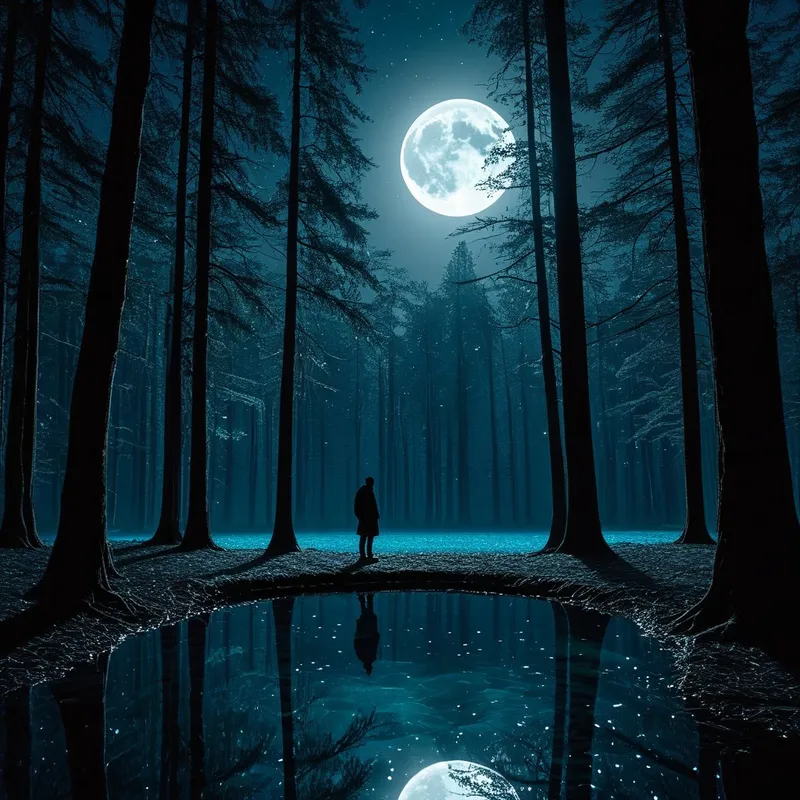
The figure of Diana is a profound palimpsest in the Roman spiritual landscape. She was not originally a figure of lofty Olympian myth, but a deeply indigenous Italic spirit. Her most ancient and revered sanctuary was at Lake Nemi, in the Alban Hills. Here, she was worshipped as Diana Nemorensis, in a dark grove where a strange and savage rite took place: her priest, the Rex Nemorensis (King of the Grove), was always a runaway slave who gained his position by murdering his predecessor in single combat. This ritual, echoing the fate of Actaeon, framed Diana not as a gentle nature sprite, but as a goddess of lethal sovereignty and cyclical violence, where the hunter could instantly become the hunted.
Her worship was particularly potent among the common people, slaves, and women. She was a goddess of the margins—of the physical margin between town and wilderness, and the social margins. As a protector of slaves and a goddess who answered the prayers of women in childbirth (a role inherited from her identification with the Greek Artemis), she represented a power structure outside the patriarchal, state-sanctioned cults of Jupiter and Mars. Her myths were not codified by poets like Vergil to serve nationalistic ends, but lived in the local cults, the whispered stories at crossroads, and the communal rituals under the full moon. She was the people’s goddess, an embodiment of a world that existed before and beyond the rigid order of the Roman state.
Symbolic Architecture
Psychologically, Diana represents the archetype of the Self-contained Feminine. She is not defined by relationship to a male consort or by motherhood in its conventional sense. Her virginity (virgo) is not a physical state but a symbol of psychological autonomy—she is one-in-herself.
The wild is not a place, but a state of soul—a psychic territory where the laws of the persona are dissolved and the instinctual self reigns supreme.
Her dual domains—the forest and the moon—map a profound internal geography. The forest is the realm of the instinctual, predatory, and grounded life force. The moon is the realm of the cyclical, reflective, and intuitive psyche. Diana holds both, symbolizing a consciousness that is fully engaged with the earthy reality of nature while also possessing the capacity for detached, luminous reflection. She is the integration of action and contemplation, body and spirit.
The myth of Actaeon is the central drama of this symbolism. Actaeon represents the conscious ego, the "hunter" mentality that seeks to capture, know, and possess. His transgression is the voyeuristic gaze that attempts to objectify the sacred, autonomous feminine principle (the anima or the deeper Self). His transformation and dismemberment by his own hounds (his own instincts, now turned against him) illustrate the psychic catastrophe that occurs when the ego violently intrudes upon the sanctum of the unconscious without humility or readiness. The Self defends its mystery with a ferocity that can dismantle the identity of the intruder.
The Dreamer's Resonance
When Diana appears in the modern dreamscape, she rarely comes as a literal goddess. She manifests as the atmosphere of the dream: a profound sense of being in a moonlit, ancient forest; the feeling of being watched by an intelligent, non-human presence; or the sudden, thrilling clarity of a hunter’s focus.
To dream of being a huntress, moving with purpose and silence through wilderness, often signals a woman connecting with her own assertive, goal-oriented, and independent energies. It is a somatic reclamation of agency. For a man, such a dream may point to an encounter with his anima in her most autonomous and challenging form—a feminine force that refuses to be tamed or possessed, demanding respect and a renegotiation of his relationship to the feminine, both within and without.
Dreams of being pursued by hounds or of undergoing an involuntary transformation (like Actaeon) are somatic metaphors for a psychological process where long-repressed instincts or aspects of the shadow are finally turning on the conscious personality. The ego’s old identity is being "torn apart" by the very natural forces it has ignored or hunted down. This is not punishment, but a brutal, necessary alchemy initiated by the Self. The dreamer is in the grip of Diana’s transformative wrath, which seeks not to destroy the soul, but to dismantle the illusion of who they thought they were.
Alchemical Translation
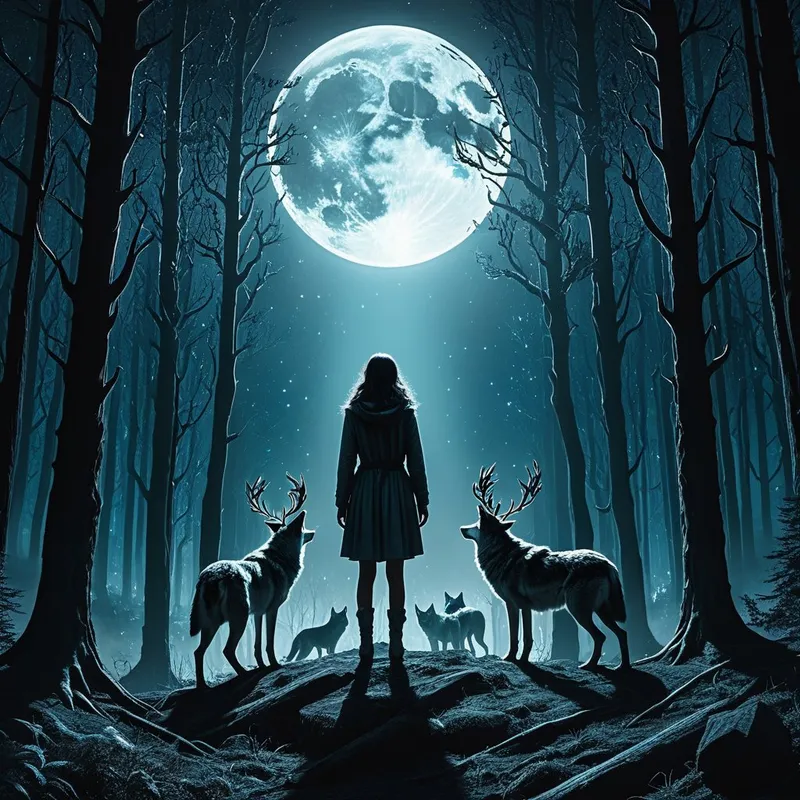
The alchemical journey modeled by Diana is that of becoming one’s own sovereign territory. It is the process of individuation where the individual establishes a sacred grove within the psyche—a space that belongs solely to the Self, inviolable to the demands of the collective, the family system, or the internal critic.
The first act of creation is not to build, but to draw a boundary. Within that circle, the true work of the soul can begin.
The initial stage is Diana’s request to Jupiter: a conscious claiming of one’s own domain. This is the "rebel" archetype in its highest form—not rebellion for its own sake, but for the sake of authentic being. It is saying, "This is my nature: my wilderness, my intuition, my cyclical rhythms. I will protect it."
The Actaeon phase is inevitable. As one establishes this inner sanctum, old patterns of the ego—the desire to control, to narrativize, to possess one’s own depths—will intrude. The alchemical "disintegration" that follows is the nigredo, the blackening. The ego-identity is dissolved by its own unrecognized instincts (the hounds). This feels like a crisis, a destruction of the personality.
But Diana’s purpose is not chaos; it is order—a deeper, wilder order. The dissolution makes space for the coniunctio, the sacred marriage within. The hunter (conscious striving) and the hunted (instinctual life) are revealed to be part of the same ecosystem. The ultimate alchemical translation is to become both Diana and the grove itself: to be the autonomous consciousness that presides over the teeming, creative, sometimes dangerous life of the unconscious, and to be that life in all its fertile, moon-governed wildness. One becomes the integrated Self, shining with a light that is both fiercely independent and eternally connected to the great, dark body of nature from which it sprang.
Associated Symbols
Explore related symbols from the CaleaDream lexicon: