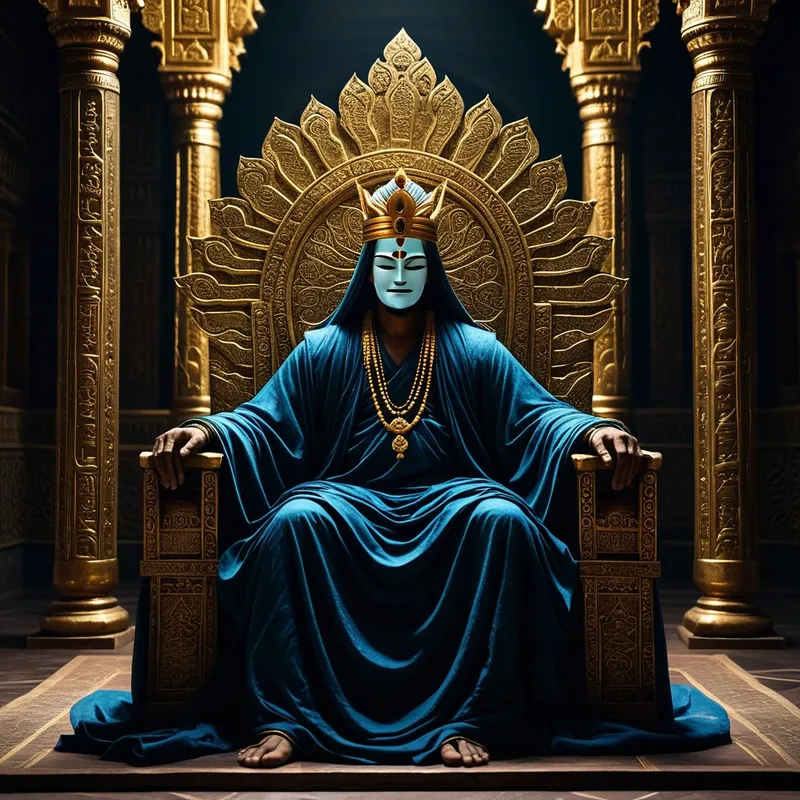
Dhritarashtra Myth Meaning & Symbolism
A king born blind, destined to rule a kingdom he cannot see, whose inner darkness births a war that consumes the world.
The Tale of Dhritarashtra
Listen. This is not a story of light, but of a darkness that was born a king.
In the hallowed line of the Kuru dynasty, a queen labored. Ambika, wife of the departed King Vichitravirya, trembled before the sage Vyasa, called to continue the royal line. When his austere, fearsome form entered her chamber, she shut her eyes tight, unable to bear the sight. From that act of refusal, from that closed vision, a son was conceived. And when he was born, his eyes were sealed. Not by skin, but by a profound, unseeing darkness. They named him Dhritarashtra: One Who Holds the Kingdom.
Thus, the heir to the throne of Hastinapura was blind. The kingdom murmured. Can a man who has never seen the sun judge the dawn? Can a king who cannot behold his subjects rule them? His younger brother, Pandu</abbr, was made king in his stead—a decision that planted the first, bitter seed. Dhritarashtra held the kingdom in name only, feeling its weight as a phantom limb, its splendor a rumor whispered in his eternal night.
He married Gandhari, a princess of fierce devotion. Upon learning of her husband’s blindness, she bound her own eyes with a silken cloth, vowing to share his world of darkness. In that shared night, one hundred sons were born to them, the eldest a boy of tempestuous heart named Duryodhana. The king’s love for this firstborn was a torrent, a possessive, deafening river that drowned all counsel. He felt in Duryodhana the vitality his own body lacked, the sight he was denied. His paternal bond became his sole compass in a formless world.
When Pandu retired to the forest, the crown inevitably fell to the blind king. He ruled not from vision, but from echo. He heard the wise words of his half-brother Vidura and the grandsire Bhishma, but they were like birdsong outside a shuttered window. The true sound that filled his palace was the voice of Duryodhana, whispering of jealousy, of the perceived injustice of his cousins, the Pandavas, and of a throne that should be wholly, violently, his.
The king’s inner court became a theater of the unseen. He felt the tension in the air, the heat of hatred from his son, the cooling sighs of the virtuous. He sanctioned the building of a lacquer house to burn the Pandavas alive, not by command, but by silent, complicit assent—a nod given in the dark. When the Pandavas returned, stronger, married to Draupadi, his heart split. He knew justice. He felt its shape. Yet, when Duryodhana devised the fateful dice game, Dhritarashtra again gave his silent permission. He heard the rattle of the dice in the assembly hall like the rattling of destiny’s bones. He heard the terrible silence as Draupadi was dragged in, and the choked outrage of the elders. His voice, when it finally rose to stop the disgrace, was a ghost of a thing, too late, already smothered by his son’s triumph and his own foundational weakness.
His darkness birthed a war. The Kurukshetra war was the materialization of his inner conflict—the blind, grasping will of the father made flesh in the armies of the son. For eighteen days, he sat in his palace, miles from the field, and listened. His charioteer, Sanjaya, gifted with divine sight, became his eyes. Through Sanjaya’s voice, Dhritarashtra witnessed the annihilation of everything he held dear: his sons, his brothers, his legacy, dying one by one on the bloody soil. He heard the teachings of the Bhagavad Gita meant for another’s ears, a philosophy of duty he himself had failed to embody.
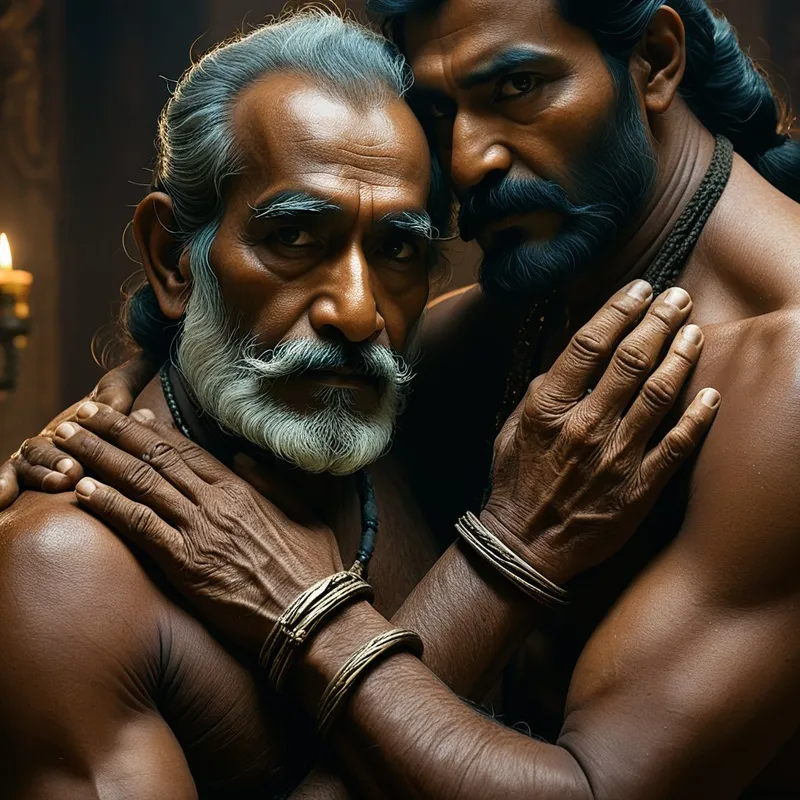
In the end, he held a kingdom of ashes and ghosts. The victorious Pandavas came to him, and the blind king, with hands that trembled, embraced them. He felt their faces, these nephews he had wronged through his inaction, and in that touch was the full, devastating knowledge of all his life had been. His final years were spent in the forest, in an ascetic’s retreat, where at last the external world matched his internal one: a bare, silent, featureless plain. In a final conflagration, he, Gandhari, and Kunti perished—a fire that cleansed what remained of the house his blindness had built.
Cultural Origins & Context
The story of Dhritarashtra is the dark, beating heart of the Mahabharata, an epic of staggering scale composed over centuries, likely between 400 BCE and 400 CE. It was not merely literature but itihasa—"thus indeed it happened"—a narrative history carrying the weight of cosmic truth. Passed down orally by bardic lineages like the sutas, the epic was performed, not just read, its characters voiced in public gatherings. Dhritarashtra’s plight served as a central moral and political conundrum for ancient Indian society: What is the duty of a king (dharma) who is physically incapable of fulfilling its most basic sensory requirement? His story is a cautionary tale about the perils of power divorced from clear perception and moral courage, a theme deeply relevant to the kshatriya (warrior-ruler) class. He is the ultimate grihasta (householder) failed, a ruler who could not see the ruin his own household would bring upon the world.
Symbolic Architecture
Dhritarashtra is not a villain, but a tragedy. He is the archetype of the Unseeing Will. His blindness is far more than a physical handicap; it is the symbol of a profound psychological condition.
The greatest darkness is not the absence of light, but the refusal to see the light that is offered.
His blindness represents willful ignorance, the choice to privilege personal attachment (to his son) over objective truth and justice (dharma). He is the shadow of the dharmaraja—a ruler who holds (dhrita) the structure (rashtra) but cannot perceive its cracks. Gandhari’s voluntary blindness is the complementary symbol: a loyalty so absolute it becomes a shared pathology, a co-created world of denial. Their hundred sons, the Kauravas, symbolize the monstrous progeny of an unexamined, entitled ego—the hundred-headed hydra of desire and jealousy that springs from a mind that will not look at itself.
Sanjaya, the narrator who sees for him, represents the potential for insight, the "inner witness" or conscience that speaks clearly. Yet, Dhritarashtra hears Sanjaya’s reports of the war and the sublime wisdom of the Gita, but he does not integrate them. The information enters his darkness and is lost, illustrating the futility of wisdom that falls on a psyche unwilling to undergo the crisis of sight.

The Dreamer's Resonance
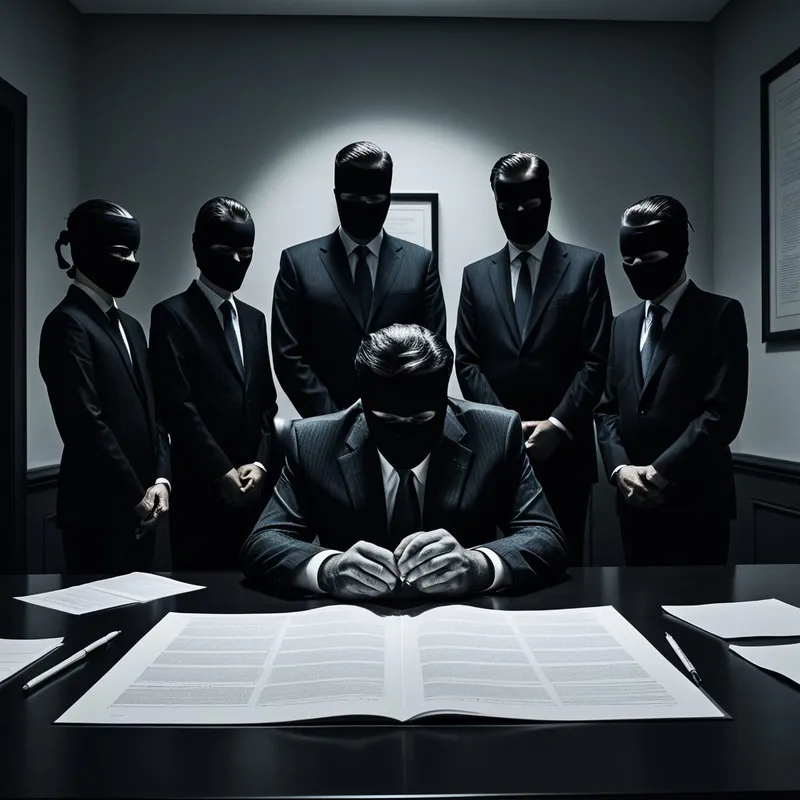
To dream of Dhritarashtra is to dream of a profound inner blindness. The dreamer may find themselves in a position of authority—a manager, a parent, a leader—but they are unable to "see" the consequences of their actions, the feelings of those around them, or a glaring truth everyone else perceives. The dream environment is often dim, foggy, or shrouded; key documents are blurry, faces are obscured, or the dreamer’s eyes are covered.
Somatically, this can manifest as a tightness in the forehead or a literal feeling of pressure over the eyes. Psychologically, it signals a critical moment of choice: the dreamer is being confronted by their own "Dhritarashtra complex"—a deep-seated attachment (often to a person, a habit, or a self-image) that is causing them to ignore reality. The emotional tone is one of deep anxiety and helplessness, a sense of being steered by a fate (the son/Duryodhana figure in the dream) that feels outside their control, yet is of their own unconscious making. It is the psyche’s alarm bell against the sleepwalk of complicity.
Alchemical Translation
The alchemical journey modeled by Dhritarashtra is the agonizing transition from the unconscious ruler to the conscious sufferer. His myth does not offer a triumphant individuation, but a roadmap through failure, illustrating the necessary death of an old, blind mode of being.
The first stage is nigredo, the blackening. This is Dhritarashtra’s congenital and chosen blindness—the identification with one’s limitation and the shadow it casts. The modern individual experiences this as being ruled by an unconscious complex: a deep wound (like inadequacy) that dictates life choices from the shadows. We sanction our personal "dice games" and ignore the resulting inner devastation.
The throne of the psyche cannot be held by a blind king. The first act of sovereignty is to demand sight, however terrifying the revelation.
The second stage is the mortificatio, the dying. This is the war of Kurukshetra, heard but not seen. Psychically, this is the inevitable inner conflict that erupts when the ignored truth (the Pandavas) clashes violently with the entitled ego (the Kauravas). The individual feels like a passive listener to their own inner civil war, experiencing anxiety, depression, or life crises as Sanjaya’s report—a narrative of their own soul’s battle they feel powerless to stop.
The final, sparse alchemy is the solutio, the dissolution. Dhritarashtra’s retreat to the forest and his death in the fire is not a redemption, but a dissolution of the identity that caused the catastrophe. For the modern seeker, this translates not as glorious enlightenment, but as a humble, stark honesty. It is the willingness to relinquish the "kingdom" of the old self—the attachments, denials, and pretensions of power—and to sit in the bare facts of one’s life. It is the consciousness that arises from the ashes of total failure: the sober, quiet knowledge of one’s own capacity for blindness, and the resolve to feel one’s way forward with hands no longer clenched in possession, but open in touch. In this, Dhritarashtra’s legacy is not one of kingship, but of the most profound warning and, ultimately, the most human of clearings.
Associated Symbols
Explore related symbols from the CaleaDream lexicon: