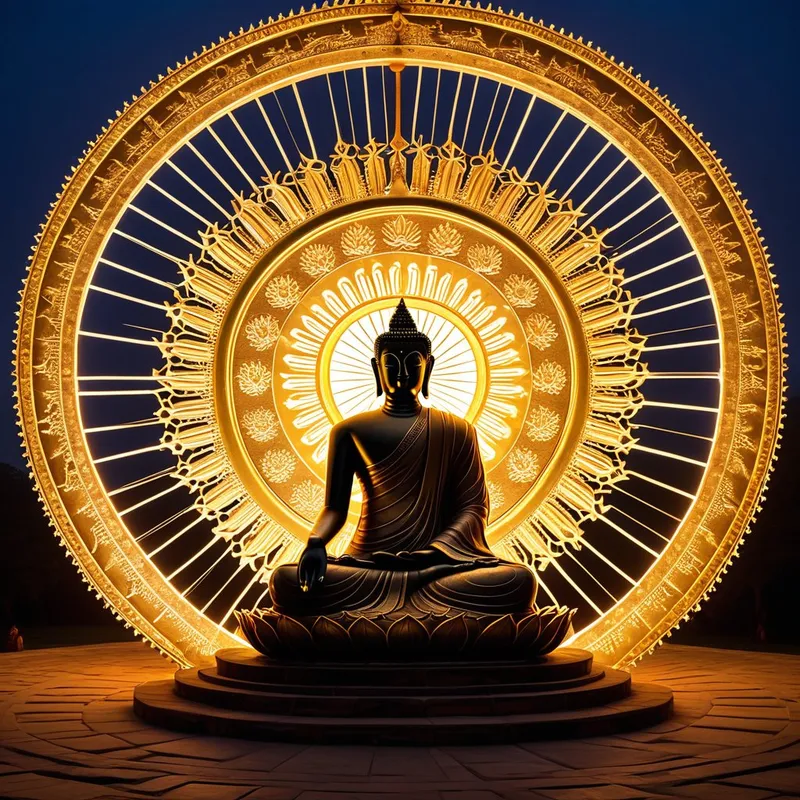
Dharma Chakra Myth Meaning & Symbolism
The story of the cosmic wheel of law, set in motion by the Buddha's first teaching, which offers a path from suffering to liberation for all beings.
The Tale of Dharma Chakra
The world held its breath in a grove of whispering trees. The air in the Migadāya was thick with the scent of damp earth and the quiet tension of a profound ending—or was it a beginning? For six years, a prince turned ascetic had walked the razor’s edge of existence, his body a map of starvation, his mind a battlefield against the very nature of life and death. His name was Siddhartha Gautama, but the title he had just won under the Bodhi tree now sat upon him like a crown of silent thunder: the Buddha, the Awakened One.
He had seen it. The ceaseless turning of Saṃsāra, the great wheel of suffering that grinds all beings between the spokes of birth, aging, sickness, and death. He had traced its cause to an unquenchable thirst, a desperate clinging. And he had found the path to stop it—not by fleeing the world, but by understanding it with a heart of boundless compassion. This truth, this Dharma, was a jewel in his palm, too precious to keep.
His footsteps, light as a deer’s, brought him to the five ascetics who had once been his companions. Seeing his radiant peace, they were caught between skepticism and awe. They prepared for a lecture, for a doctrine. What they received was an initiation.
The Buddha did not merely speak. He set in motion. Raising his right hand, his fingers formed the Dharmachakra Mudra. His thumb and forefinger touched, forming a circle, while his other fingers pointed outward. And as his voice, calm as a deep river, began to flow, it did not just describe a path—it became the path.
“There is suffering. There is the cause of suffering. There is the cessation of suffering. There is the path leading to the cessation of suffering.”
With each utterance, the very atmosphere changed. The listeners felt not words, but a profound reordering of reality. It was as if a cosmic mechanism, rusted and stuck for eons, was being gently, irrevocably, turned. A wheel, vast and silent, began to spin in the space between his hands and their hearts. This was the First Turning. The Dharma Chakra was set rolling. Its first revolution taught the Four Arya Satya. Its second would reveal the nature of emptiness. Its third would proclaim the innate Buddha-nature in all.
In that grove, with the gentle deer as witnesses, the wheel of suffering was met by the wheel of liberation. The great cosmic cycle was no longer a prison, but a path. The turning had begun, and its sound was the silence of a million minds waking up.

Cultural Origins & Context
The myth of the Dharma Chakra’s first turning is the foundational narrative of Buddhism, recorded in the Pāli Canon in the Dhammacakkappavattana Sutta. Emerging in the 5th century BCE in the fertile philosophical landscape of ancient India, it served a critical societal function. It was not merely a biography of the founder but a performative declaration of a new Sangha and a new law.
Passed down orally by monks for centuries before being committed to text, the story was told and retold not just as history, but as an ever-present reality. Every monastic recitation, every teaching given by a master to a student, was understood as a participation in that first turning. The myth established the Buddha not as a god to be worshipped, but as a physician (Mahāvaidya) diagnosing the universal disease of Dukkha and prescribing a practical cure. It provided a radical alternative to the rigid Brahmanical orthodoxy, offering a path to liberation accessible through personal effort and insight, not birthright.
Symbolic Architecture
The Dharma Chakra is one of humanity’s most potent symbols. It is not a static icon, but a dynamic map of psychic and cosmic order.
The wheel turns not to move from place to place, but to reveal that the center is everywhere and the circumference is nowhere.
Its hub represents ethical discipline (Śīla), the stable core from which all insight spins. The spokes, traditionally eight, symbolize the Ārya Aṣṭāṅga Mārga—the practical, integrated path of wisdom, ethics, and meditation that leads from the rim of suffering to the hub of liberation. The rim signifies the power of mindfulness and concentration (Samādhi) that holds the entire practice together, containing the energy of transformation.
Psychologically, the Chakra represents the individuated Self, the mandala of the psyche achieving wholeness. The “turning” is the moment of profound insight that re-contextualizes all past suffering. What was once a chaotic series of painful events (Saṃsāra) is suddenly seen as necessary steps on a coherent path (Dharma). The wheel transforms fate into destiny.
The Dreamer's Resonance
When the Dharma Chakra appears in a modern dream, it rarely manifests as a literal religious icon. Instead, it is the experience of the turning. One might dream of a stuck, massive gear in a forgotten machine beginning to move with a deep, resonant click. Or of finding a perfectly balanced stone circle in a forest, which begins to spin when touched. Perhaps it is the sudden, clear understanding of a lifelong pattern while looking at the spokes of a bicycle wheel.
Somatically, this dream pattern correlates with a release of tension in the solar plexus and a feeling of “things clicking into place.” Psychologically, it marks the end of a period of psychic stagnation or compulsive cycling through the same problems. The dreamer is undergoing a moment of synthesis, where disparate life experiences are suddenly integrated into a meaningful narrative. The unconscious is signaling that the dreamer has, often through great struggle, attained a new vantage point from which their life makes a new kind of sense. The wheel of their personal karma is being engaged by the wheel of conscious understanding.

Alchemical Translation
The myth models the alchemical opus of individuation—the transmutation of the lead of suffering into the gold of wisdom. The process begins with the Nigredo, the dark night of the soul represented by the Buddha’s ascetic years: a confrontation with the raw, unbearable truth of one’s condition.
The First Teaching in the Deer Park is the Albedo, the washing clean. It is not the arrival of new information, but the purification of perception. The Four Truths are the alembic that distills chaotic experience into a clear formula: 1) This is the problem (Suffering), 2) This is how it works (Craving), 3) Freedom is possible (Cessation), 4) Here is the method (The Path).
The alchemy occurs not in changing the elements of one’s life, but in changing the heat at which they are held—from the fire of aversion and craving to the gentle warmth of mindful awareness.
Finally, the turning wheel itself is the Rubedo, the reddening, the achievement of the philosopher’s stone. The stone is the realized Self, which has integrated the shadow (suffering) and now possesses the aurum potabile—the “drinkable gold” of compassion and wisdom that can be offered to others. For the modern individual, this translates to the moment when one’s personal healing ceases to be a private project and naturally becomes a grounding, calming presence for others. One’s centeredness (hub) begins to naturally order one’s actions (spokes) in the world, creating a life of integrity and purpose. The wheel, once a symbol of bondage to fate, becomes the vehicle of one’s authentic journey.
Associated Symbols
Explore related symbols from the CaleaDream lexicon: