Deucalion Myth Meaning & Symbolism
A righteous man and his wife survive a world-ending flood, receiving an oracle to repopulate the earth by casting the 'bones of their mother' behind them.
The Tale of Deucalion
Listen, and hear the tale of the great unraveling. It was an age of bronze, an age of men who had forgotten the sacred. Their hearts were iron, their deeds were shadow, and the very air grew thick with their impiety. From his high throne on Olympus, Zeus looked down upon the earth. He did not see the smoke of sacrifice, but the smoke of arrogance. He did not hear hymns, but the clamor of violence. A great sorrow, colder than the north wind, settled in his divine heart. The decision was made: the slate of humanity would be washed clean.
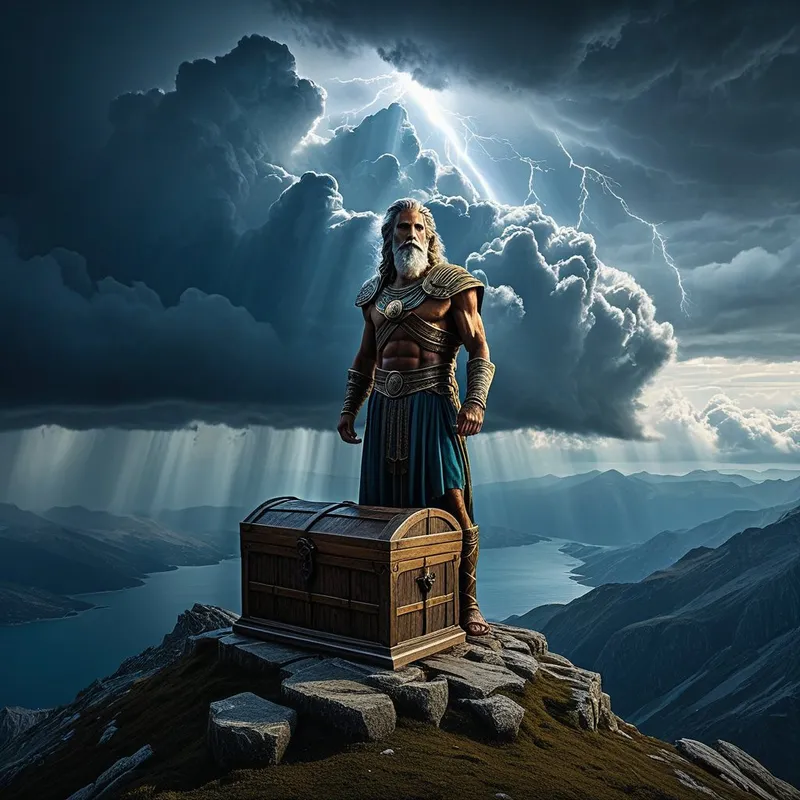
But in the land of Thessaly, there lived a son of the Titan Prometheus. His name was Deucalion, and in him flowed not the blood of bronze, but the clear water of foresight. His father, the great benefactor chained to a rock for his love of mankind, whispered a warning on the wind. “Build a chest,” the whisper said. “A great, sturdy chest. Store within it all you need to sustain life. The tears of heaven are coming.”
So Deucalion, with his faithful wife Pyrrha—daughter of Themis—labored. They hewed great timbers, sealed every seam with pitch and prayer. As they worked, the sky darkened not with night, but with intent. Then it began. Not a rain, but a deluge sent by the hand of Zeus. The Poseidon himself unleashed his trident, and every river, spring, and ocean rose in a single, roaring wall of vengeance.
For nine days and nine nights, the chest was tossed upon the chaos. They saw the world drown—the groves of Artemis, the temples of Apollo, the homes of kings and thieves, all swallowed by the grey, churning deep. All life, save the fish and the monsters of the abyss, was erased.
On the tenth day, the winds stilled. The waters sighed and began to recede. Their ark came to rest, not on soft soil, but on the bare, scraped-rock summit of Mount Parnassus. The door creaked open. Deucalion and Pyrrha stepped out onto a world of silence and mud. The green earth was gone. In every direction, only the bones of the world showed through: stone, silt, and a vast, empty sky. They were alone, the last man and the last woman, standing at the end of all things.
Cultural Origins & Context
The myth of Deucalion is the Greek iteration of a near-universal archetype: the Great Flood. It was primarily transmitted through the epic poetry of Hesiod and the later compilations of mythographers like Apollodorus. For the ancient Greeks, this story served a critical societal function beyond mere entertainment. It was a foundational aition—a myth explaining origins. It explained not just the destruction of a flawed, primordial humanity (the Bronze Race in Hesiod’s schema), but the very genesis of the current, hardier race of humans.
Told in symposia and around hearths, it reinforced core cultural values: the supreme, capricious power of Zeus, the necessity of piety (eusebeia), and the importance of heeding divine oracles. It connected the present people to a sacred, cataclysmic past, establishing a lineage that sprang not from mere biological continuity, but from a direct, miraculous intervention of the gods. The myth also served as a moral warning: civilization is fragile, and divine order (dike) must be maintained, lest the foundations of the world itself be dissolved.
Symbolic Architecture
At its heart, the myth of Deucalion is a story of psychic annihilation and paradoxical creation. The flood represents the total dissolution of a worn-out, corrupted conscious attitude. It is the ultimate nigredo—the blackening, the drowning of the known world in the unconscious.
The flood does not discriminate; it washes away both sinner and saint, for it is the purging of an entire psychic system.
Deucalion and Pyrrha are not saved because they are perfect, but because they possess the quality of metis—practical, forethoughtful intelligence—inherited from Prometheus, and a connection to divine law through Themis. They represent the surviving core of consciousness, the ego-complex that is adaptable and receptive enough to endure the total inundation by the unconscious.
The most potent symbol is the oracle from Themis: “Cast behind you the bones of your great mother.” Their literal interpretation—the stones of Gaia—unlocks the miracle. This is the alchemical coniunctio of spirit (the divine command) and matter (the stone). The act of not looking back as they perform this strange ritual signifies a commitment to the new, unknown order, a trust in the symbolic process over literal understanding. The stones transforming into people (Laos, from Laas, “stone”) symbolize the rebirth of the psyche from its most fundamental, mineral substrate—the bedrock of the Self, hard and enduring.
The Dreamer's Resonance
When this myth stirs in the modern dreamer, it signals a profound process of inner dissolution. To dream of a world-ending flood, of being the sole survivor on a mountain, is to experience the somatic reality of the ego facing its own irrelevance. It is a crisis point where old identities, relationships, and life structures feel utterly washed away, leaving a barren, lonely internal landscape.
The dreamer undergoing this is not in a process of gentle change, but of catastrophic transformation. The feeling is one of profound isolation and responsibility. The “chest” or “ark” in the dream might appear as a remembered childhood home, a specific memory, or a core talent—the one thing salvaged from the old life. The subsequent feeling of being on a “mountaintop” is not triumphant, but desolate. The psychological task here is to endure the silence, to face the emptiness without rushing to fill it. It is the necessary, fallow ground between death and rebirth. If the dream includes the casting of stones, it points to the moment where the dreamer, often through a seemingly nonsensical or intuitive act, begins to participate in their own recreation.

Alchemical Translation
The journey of Deucalion is a masterful map for the process of individuation—the psychic transmutation of the base self into a more integrated whole. It begins with the recognitio: the conscious awareness (Deucalion) that the current mode of being is leading to catastrophe. This awareness heeds the Promethean voice of intuition and prepares for the descent.
The flood itself is the solutio and mortificatio: the painful dissolution and death of the old personality. Everything that was familiar is lost. This is a non-negotiable stage of spiritual drowning. Survival on Parnassus represents the coagulatio—the ego, now humbled and stripped bare, condensing into a new, more resilient form upon the bedrock of the Self (the mountain).
The new humanity is not born from the old flesh, but from the enduring stone of the soul's essence, animated by the breath of a divine command.
The consultation of the oracle is active engagement with the transcendent function—seeking guidance from the deeper Self (Themis). The resulting, cryptic instruction forces a shift from literal to symbolic thinking. The act of casting the stones is the multiplicatio: the proliferation of new psychic energy, new potentials, and new inner figures (animus/anima, complexes) from a core, mineral truth. One does not create the new self; one discovers it by faithfully performing the symbolic ritual dictated by the soul. The myth concludes not with a return to the old world, but with the establishment of a new, conscious relationship with the divine, modeling the individuated person’s connection to the transpersonal psyche. We are, the myth whispers, the children of stone and oracle, of earth and meaning, reborn from the flood of our own undoing.
Associated Symbols
Explore related symbols from the CaleaDream lexicon: