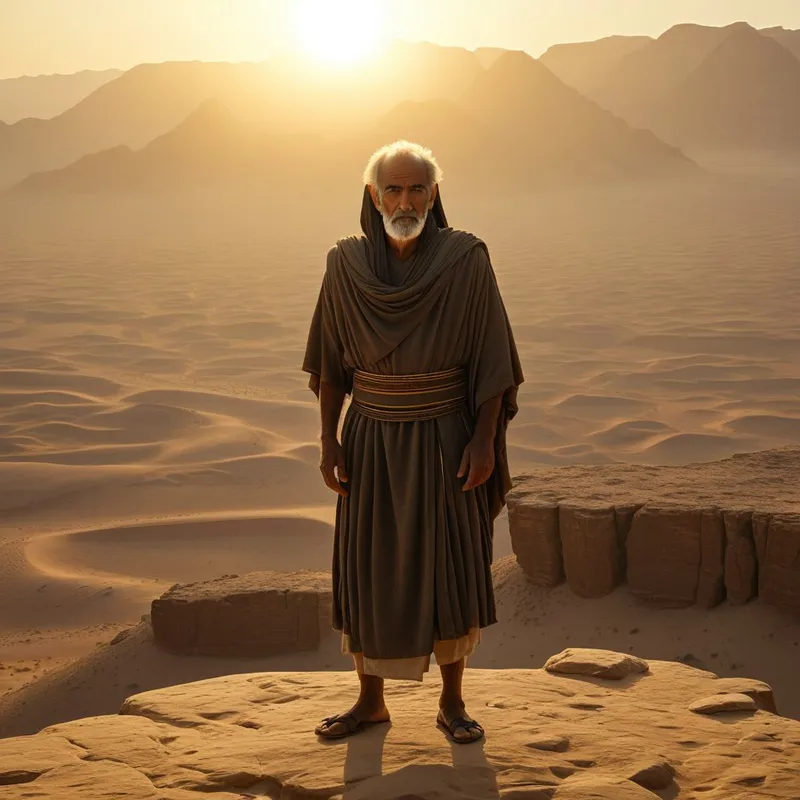
Desert Fathers Myth Meaning & Symbolism
A story of early Christian ascetics who fled civilization for the Egyptian desert, battling inner demons to achieve divine union and radical self-knowledge.
The Tale of the Desert Fathers
In the days when the world was turning from old gods to new, when the great cities of Rome echoed with both marble virtue and hidden vice, a strange wind began to blow. It was a wind not of air, but of spirit, a whispering call that could only be heard in the silent chambers of a restless heart. It spoke of a desert—a vast, sun-scorched, and silent expanse where the sky met the earth in a searing line of truth.
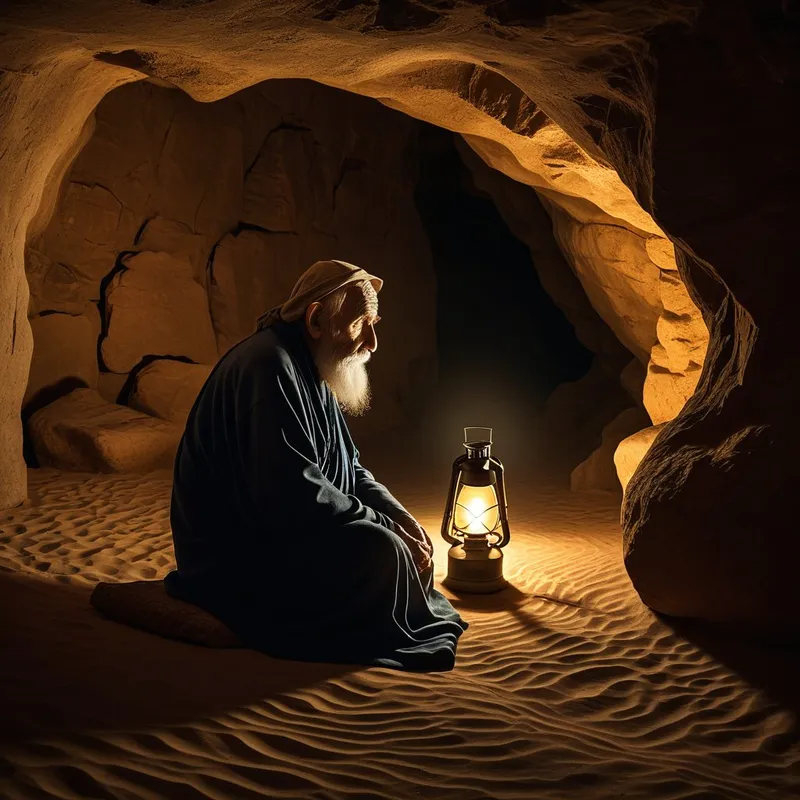
And so they went. Not as an army, but as scattered seeds. Anthony the Great, a young man of wealth, heard the call in a gospel verse and walked out of his village, leaving everything behind. Pachomius followed, and Abba Moses the Ethiopian after him. They were fathers, but not of flesh; they sought to birth something else entirely. They crossed the life-giving Nile and entered the Scetis, the utter wilderness. Their palaces were caves carved by the wind. Their riches were a rush mat, a water jug, a copy of the scriptures worn soft by fingers and time.
The conflict was not with lions, though they prowled, nor with scorpions, though they stung. The great battle was waged in the theater of their own souls. As the chatter of the world faded, a cacophony arose from within. Memories, long buried, rose like specters. Desires, fierce and hot as the noon sun, taunted them. Fantasies of pride, of lust, of anger, and of despair took on forms in the shadows of their cells—these were the demons. Anthony, in his fortress-ruin, was assailed by visions of silver and sensual pleasure, his solitude broken by the clatter of imagined mobs. Each man faced his own legion.
Their weapon was not the sword, but the prayer. Their shield was asceticism—fasting, vigils, manual labor. They wove baskets of palm leaves, not for trade, but to weave order into the chaos of the mind. They sought not to destroy the self, but to hollow it out, to become an empty vessel waiting to be filled. The resolution was not a roar, but a deepening silence. After the storm of temptation passed, a profound peace would descend, a clarity as sharp and clean as the desert air. In that stillness, they reported, the divine presence could be met—not as a blinding light, but as a boundless, loving quietude. They became, themselves, living springs in the wasteland. Seekers of God journeyed from the cities to sit at their feet, not to hear complex sermons, but to ask for a “word”—a single sentence of hard-won life. And the old man, squinting in the sun, might say, “Go, sit in your cell, and your cell will teach you everything.”
Cultural Origins & Context
This mythos emerged in the 3rd and 4th centuries AD, primarily in the deserts of Egypt, Palestine, and Syria. It was born at a critical juncture. Christianity had moved from persecuted sect to imperial religion, and many felt the path to radical discipleship was being diluted by compromise with the world. The Desert Fathers (and Mothers, like Amma Syncletica) represented a powerful counter-movement—a new kind of martyrdom. If the age of blood martyrdom was passing, the “white martyrdom” of asceticism began.
The stories were not written as formal hagiographies at first. They were oral lore, passed down as The Sayings of the Desert Fathers (Apophthegmata Patrum). Disciples memorized the pithy, often paradoxical wisdom of their elders. These narratives served a crucial societal function: they provided a radical model of authenticity. In a civilization experiencing immense social and spiritual flux, the desert hermits became living symbols of the ultimate priority—the direct relationship between the human soul and the divine, stripped of all social pretension and material mediation.
Symbolic Architecture
The myth is a masterclass in the symbolism of inner transformation. The Desert is not merely a location; it is the state of the soul pared down to its essentials, the tabula rasa necessary for encountering the absolute. It represents the unconscious itself—vast, seemingly barren, yet holding the potential for all life and revelation.
The desert is the condition of the soul when every borrowed identity has been shed, and only the essential question remains.
The Cell is the crucible, the bounded space where the infinite work of the self occurs. It is the conscious ego-container that holds the chaotic contents of the psyche for examination. The Demons are the unintegrated aspects of the personal shadow—repressed desires, traumas, complexes, and the inherited weight of collective human brokenness. The battle is not one of extermination, but of facing and naming. By confronting these figures in the silence, the hermit deprives them of their autonomous, haunting power and begins to assimilate their energy.
The goal, termed apatheia or hesychia, symbolizes a state of psychic integration. It is not emotional numbness, but the achievement of a central, unshakable point of consciousness from which all inner movements can be observed without being tyrannized by them.

The Dreamer's Resonance
When this mythic pattern stirs in the modern dreamer, it often signals a profound call to interiority. Dreams of being in a vast, empty landscape (a desert, a tundra, an empty city) reflect a psyche feeling over-civilized, cluttered with external demands and persona-masks. The dream ego may feel a compelling need to “get away” to find itself.
Somatic experiences might include feelings of intense restlessness alongside a deep craving for silence, or a sense of being “assaulted” by one’s own thoughts and emotions upon trying to be still. To dream of a simple, sparse room or a cave is to dream of the need for a psychological container—a therapy, a journal, a meditation practice—where this inner work can safely occur. Dream figures that are threatening, seductive, or mocking represent those specific demons—perhaps a critical inner voice, a compulsive pattern, or a buried grief—that are now demanding attention because the dreamer is finally ready to face them.
Alchemical Translation
The alchemical process mirrored in the desert journey is the nigredo, the blackening, the descent into the prima materia of the soul. The flight to the desert is the conscious decision to submit the leaden, confused ego to this dissolution. The confrontation with the demons is the necessary putrefaction, where the shadow contents are stirred up and brought to the surface.
The triumph of the desert is not the slaying of the demon, but the transformation of its energy from an autonomous complex into a source of insight.
The hermit’s ascetic practices—the fasting, the vigils, the labor—are the slow, meticulous processes of albedo and citrinitas. They are the means of separating the essential from the non-essential, of purifying intention. The final peace, the “word” of wisdom given to others, represents the rubedo, the reddening. This is the birth of the integrated Self, where the once-fragmented psyche achieves a paradoxical state: utterly humble and utterly potent, fully individual yet universally connected. The modern individual walking this path does not need a physical desert, but the courage to create interior silence. The goal is the same: to stop projecting one’s inner conflicts onto the outer world, to meet oneself in the bare cell of honest self-reflection, and in doing so, to find the bedrock of authentic being from which a genuine life can be built.
Associated Symbols
Explore related symbols from the CaleaDream lexicon: