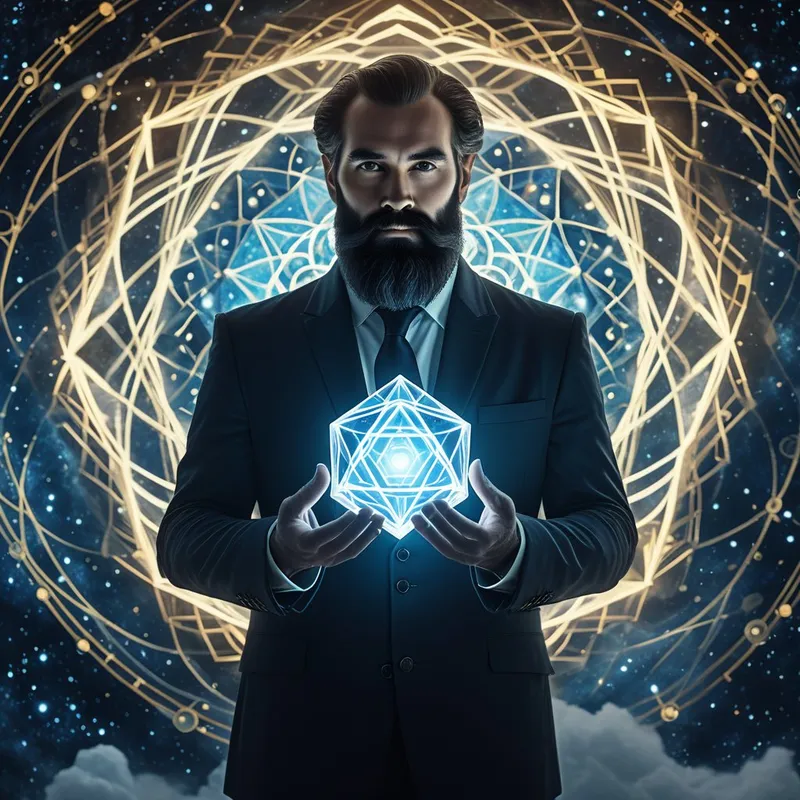
Demiurge Myth Meaning & Symbolism
The story of the divine Artificer who, guided by perfect Forms, brings order and soul to the primordial chaos, crafting the cosmos as a living, rational being.
The Tale of Demiurge
Listen. Before time was measured, before the dance of the seasons, there was only the Chora—the Receptacle. A formless, shifting, eternal womb of potential, murmuring with the ghost-tracks of all that might be. It was not darkness, nor light, but the substance of both, unformed and dreaming. Into this primordial soup gazed a presence, an intellect, a maker. He was the Demiurge, the Artificer, and he was good. Not good as mortals understand it, but good as mathematics is true: necessary, complete, and beautiful.
He looked upon the chaos and felt not disgust, but a profound, creative pity. For he perceived, not with eyes, but with the mind’s pure sight, the realm of the Forms. There shone the perfect Circle, the flawless Triangle, the essence of Justice, the absolute idea of the Living Creature Itself. These were his models, his divine blueprints, eternal and unchanging. The chaos had none of this. It was all becoming and no being, a restless shadow-play without a source of light.
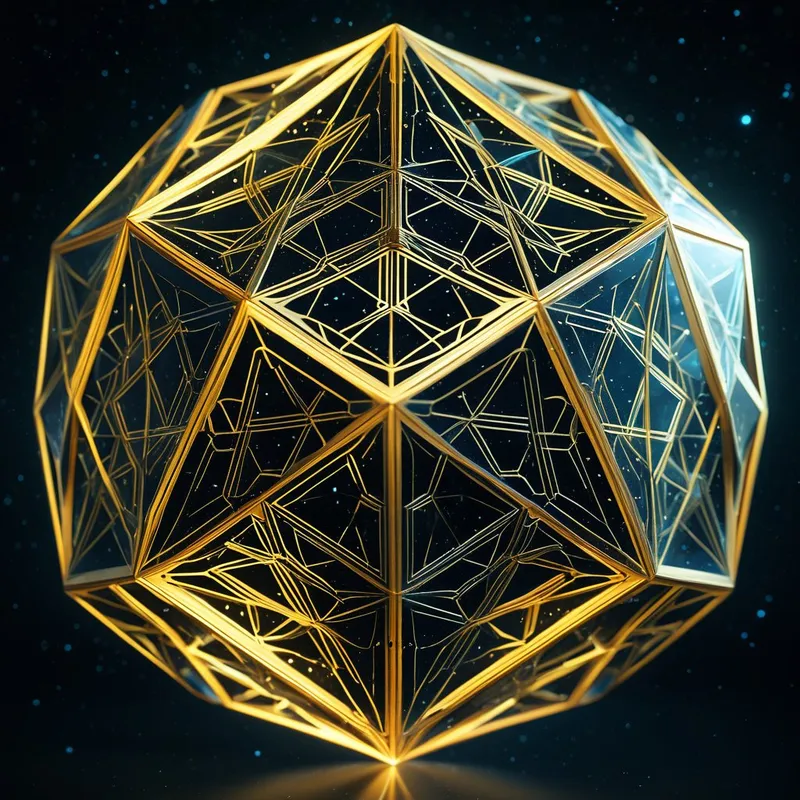
And so, with a will that was love for the perfect, he stretched his hands—not hands of flesh, but hands of intention—into the Receptacle. He did not create ex nihilo, from nothing. He was a craftsman, not a magician. He took the unruly, qualitative stuff of the Chora and began to persuade it. He impressed upon it number and harmony. From the swirling miasma, he distilled the elements, not as earth, air, fire, and water we know, but as their perfect geometric seeds: the cube of earth, the icosahedron of water, the octahedron of air, the tetrahedron of fire. He bound them with proportion, with the music of the spheres only he could hear.
His greatest work was the World Soul. He mixed a chalice of the indivisible Same (the principle of unity and eternity) and the divisible Different (the principle of plurality and change), blending them with the very essence of Being. From this psychic alloy, he forged a strip, which he divided according to sacred intervals, and then bent it into circles—the circle of the Same, the fixed stars, and the circle of the Different, the wandering planets. This soul-stuff he wrapped around the body of the cosmos, a living, intelligent skin from core to circumference, making the universe not a machine, but a divine, rational animal.
He looked upon his crafted cosmos, a moving image of eternity, and was pleased. It was the best it could be, for it was made from imperfect materials gazing upon perfection. He then tasked the younger gods—the celestial beings he had fashioned—with the final act: the weaving of mortal bodies and the planting of immortal souls within them. His work complete, the Demiurge retired to his contemplation, his benevolent gaze forever upon the spinning, singing, soul-infused cosmos he had persuaded into being.
Cultural Origins & Context
This is not a myth born around a campfire, but in the colonnaded walks of the Academy. Its primary vessel is Plato’s dialogue, the Timaeus, written in the 4th century BCE. Here, the character Timaeus, a philosopher from Locri, delivers a "likely story" (eikos mythos) about the origins of the cosmos. This is critical: it is presented not as divine revelation, but as a rational, philosophical narrative, the best account possible for mortal minds grappling with the divine.
The function was didactic and cosmological. In a culture where traditional Homeric gods explained capricious events, the Demiurge myth provided a teleological answer: the universe is the product of a benevolent, rational intelligence aiming at the Good. It served to bridge the perceived gap between the messy, imperfect world of sensation and the pristine realm of philosophical truth. It was a myth for intellectuals, a poetic framework to explain why mathematics governs nature and why the human soul, though trapped in flux, yearns for the eternal and the orderly.
Symbolic Architecture
The myth is a vast symbolic architecture for the human condition. The Demiurge represents the ordering principle of consciousness itself—the Logos. He is not the unconscious, primal source (that is the Chora), nor is he the perfect, static end (that is the Forms). He is the active, mediating intelligence that strives to bring light to darkness, form to matter, reason to passion.
The Demiurge is the archetype of the human mind when it creates: it does not make something from nothing, but takes the chaotic material of experience and memory and imposes upon it the forms of logic, narrative, and meaning.
The chaotic Chora symbolizes the raw, undifferentiated stuff of the unconscious—the swirling emotions, drives, and fragmented images that precede thought. The perfect Forms represent the innate, psychic archetypes and primordial patterns we intuitively recognize as true, beautiful, or just. The cosmos that results—beautiful but imperfect—is the very image of the individual psyche: a soul (the World Soul) woven through a mortal, material body, forever caught between the chaos of its origins and the perfection of its aspirations.
The Dreamer's Resonance
When this myth stirs in the modern dreamer, it often manifests as a profound somatic process of ordering. One might dream of trying to organize a profoundly messy room, a library with books scattered in a non-Euclidean space, or a complex machine with missing parts. There is a pressing, almost moral urgency to the task. The dream-ego is playing the role of the Demiurge, confronted with its own inner Chora.
The emotional tone is key: it is not panic, but a focused, determined, and often lonely responsibility. The dreamer may feel they are working from a blueprint they can only half-remember or see in fleeting glimpses (the Forms). The resolution, if it comes, is not a perfect victory, but a sigh of relief at achieving a functional order, a temporary harmony. This dream signals a phase of intense psychic integration, where the conscious mind is laboring to structure overwhelming unconscious contents—be it a life transition, a creative project, or a healing process—into a coherent, livable "world."
Alchemical Translation
The alchemical process mirrored here is not the creation of gold, but the creation of the Self. The individuation journey is the work of the inner Demiurge. The prima materia, the base lead of the soul, is our unexamined, chaotic life—our raw experiences, traumas, and potentials (the Chora). The lapis philosophorum, the philosopher’s stone, is the image of wholeness, the Self archetype (the Forms).
Our conscious ego, in its highest function, becomes the Artificer. It must engage in the patient, meticulous work of persuasion, not repression. It must take the chaotic emotion (the tetrahedron of fire) and give it a form—through journaling, art, or dialogue. It must take the fluid intuition (the icosahedron of water) and channel it into structure. It mixes the immutable truths of one’s own nature (the Same) with the adaptable skills needed for life (the Different) to forge a personal World Soul—a cohesive identity that is both stable and capable of growth.
The ultimate triumph is not a perfect life, for we are crafted from imperfect materials. It is the crafting of a cosmos—a personal universe—that is rational, beautiful, and alive, a fitting vessel for the soul’s journey. To individuate is to become the benevolent craftsman of your own being.
The myth’s enduring power lies in this compassionate realism. It does not promise paradise, but offers a dignified, creative purpose: to take the given chaos of existence and, looking always to the ideal within, shape from it a world that sings.
Associated Symbols
Explore related symbols from the CaleaDream lexicon: