
Demeter's Wreath Myth Meaning & Symbolism
A myth of the goddess Demeter crafting a wreath of grief and barley, a sacred act of mourning that forced the world to witness her loss and change.
The Tale of Demeter's Wreath
Hear now the silence that fell upon the world. It was not a peaceful quiet, but a breath held in terror. For the Demeter had lost her daughter. The radiant Persephone, plucked from a sun-drenched meadow by the god of the dead, was gone. The earth-mother’s cry did not echo; it was swallowed by a grief so vast it became a vacuum.
Demeter cast off her divine raiment. She wrapped herself in the grey cloak of a mortal crone, a disguise woven from dust and despair. For nine days and nine nights, she wandered the roads of the world, a hollow-eyed specter. Torches guttered in her hands, their flames cold and blue. She asked of every stream and stone, every passing nymph and shepherd, “Have you seen my child?” The world had no answer, only the growing chill of her absence.
Her feet, once which made flowers bloom with every step, now left frost in their prints. She came at last to Eleusis, and sat by the Maiden Well, a statue of sorrow. The daughters of King Celeus found her there. Thinking her a weary nurse, they brought her to the palace to care for their infant brother, Demophoön.
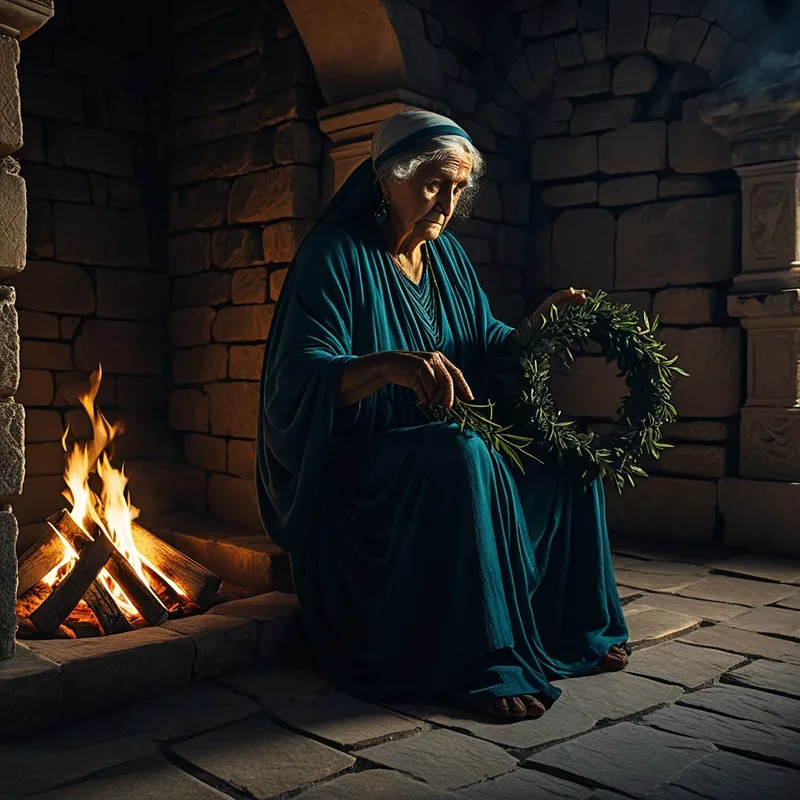
In the hearth-light of that royal house, the goddess performed her sacred, silent rite. She did not raise temples. She did not summon storms. She sat in the corner, the prince in her arms, and she began to weave. From the air she drew stalks of barley, not the golden kind of harvest, but a pale, ghostly grain. From her own endless tears, she conjured the fragile red petals of the poppy, the flower of sleep and oblivion. With fingers that could shape continents, she plaited them together, strand by painful strand.
This was Demeter’s wreath. Not a crown of victory, but a coronet of consummate grief. As she wove, she anointed the mortal child by night with ambrosia, holding him in the hearth’s fire to burn away his mortality, seeking to fill the void within her with a substitute divinity. By day, she sat, weaving her wreath, her silence a weight that bowed the very beams of the house. The air grew thick. The laughter of the court died. All who looked upon her felt the desolation of a field after the final sheaf is cut.
Queen Metaneira, in a panic of mortal fear, broke the ritual, snatching her son from the fire. The spell shattered. Demeter stood revealed, not as a crone, but in her terrible divine glory, the wreath now glowing with a cold, green light upon her brow. “Foolish are you mortals,” her voice was the rumble of roots in deep earth, “who cannot see the gift held within the sacred flame of loss.”
She cast aside the unfinished immortality for the child. But the wreath remained. It was her declaration. It was her strike. Until her daughter was restored, she would wear this symbol of her barren heart. And so she did. And the world, in sympathy, ceased to grow. The great Hunger began.
Cultural Origins & Context
This poignant episode is drawn from the Homeric Hymn to Demeter, a central liturgical text of the Eleusinian Mysteries. Composed likely in the 7th century BCE, the hymn was not mere entertainment; it was a sacred narrative performed during the Mysteries, the most famous and revered initiatory cult of the ancient Greek world. The story of Demeter’s wanderings and her time in Eleusis formed the mythological foundation for the rites.
The tellers of this tale were the hierophants, the “revealers of sacred things,” within the sealed confines of the Telesterion at Eleusis. Its societal function was profound: it modeled a path through catastrophic loss to a negotiated renewal. For an agricultural society, Demeter’s grief-strike was the existential threat of famine. The myth explained the seasonal cycle, yes, but for initiates, it promised something more personal—that even the “death” of the soul (Persephone’s abduction) could be followed by a return, changed but whole, just as the grain seed must descend into the dark earth (the Underworld) to sprout again.
Demeter’s act of weaving the wreath in a mortal king’s house grounds the cosmic drama in human-scale ritual. It transforms raw, paralyzing grief into a deliberate, crafted object—a first, crucial step from passive suffering into a form of active, symbolic mourning that eventually forces the gods themselves to negotiate.
Symbolic Architecture
The wreath is not an ornament; it is an artifact of sacred rage and a container for unbearable emotion. In a culture where public ritualized mourning (like tearing hair and garments) was common, Demeter’s quiet, focused weaving is a more profound internalization.
The wreath symbolizes the conscious shaping of grief into a form that can be witnessed. It is the transformation of chaotic suffering into a sacred symbol.
The barley represents the life that is withheld, the potential fertility frozen in stasis. The poppy signifies the numbness, the sleep of depression, and the necessary oblivion that cushions the psyche from immediate annihilation. By weaving them together, Demeter performs an alchemy of the soul: she acknowledges the life-force (grain) and the death-drive (poppy) as inseparable strands of her experience.
Her attempt to immortalize Demophoön is equally critical. It reveals the dangerous shadow of the Caregiver archetype: the attempt to fill the void of one’s own loss by making another eternal, by burning away their mortal nature in the fire of one’s own need. It is a projection of salvation that, if completed, would destroy the very individuality it seeks to preserve. Metaneira’s interruption, though born of fear, is a necessary failure that returns Demeter to her own specific quest.

The Dreamer's Resonance
When this myth stirs in the modern unconscious, it rarely appears as a literal goddess. One may dream of meticulously braiding grass or hair into a circle by a body of water (the Maiden Well). One may dream of trying to place a loved one—a child, a partner, a younger self—into a protective fire, only to be stopped. The somatic feeling is one of heavy, deliberate hands, a profound fatigue in the bones, and a chilling cold that emanates from the dreamer’s own chest.
This is the psyche’s depiction of a process, not an event. The dreamer is in the stage of crafting their wreath. They are actively, if painfully, engaging with a foundational loss—of a relationship, an identity, a future once imagined. The dream signals that the initial shock has passed, and the deep, quiet work of symbolic meaning-making has begun. The psyche is assembling the materials of its own suffering to create a testament, a “crown” that marks the dreamer as one who is undergoing a sacred, if terrible, transformation. It is a sign of moving from being victimized by grief to holding grief.

Alchemical Translation
For the individual, the myth of Demeter’s Wreath maps the alchemical nigredo—the blackening, the descent. The psychic transmutation here is not about bypassing the dark, but about dwelling within it so completely that one learns its secret language.
The modern journey begins with the Abduction—the sudden, often inexplicable loss that shatters our personal world (Persephone taken). We then enter the Disguised Wanderings—the period of depression, of feeling alien in our own lives, of searching fruitlessly (Demeter as the crone).
The crucial, active phase is the Weaving in Eleusis. This is the individuation step where we must consciously take the raw materials of our pain—the memories, the regrets, the anger (barley and poppy)—and sit with them. We must craft our own “wreath,” a personal symbol or ritual that honestly holds our loss without yet demanding a solution.
The Failed Immortalization (Demophoön in the fire) warns us of the temptation to transmute our grief by over-identifying with or trying to “save” others, a projection that avoids our own core work. This must be relinquished.
Only by fully wearing this wreath of acknowledged, crafted sorrow—by allowing our creative life-force to go dormant in protest—do we generate the necessary psychic tension. This tension, this sacred strike, eventually forces a negotiation between our conscious ego (the Olympian world) and the deep, possessive aspects of our unconscious (the Hades realm). The outcome is never a full return to the “meadow” of innocence, but a new, cyclical reality where loss is integrated into the fabric of a wiser, more complex self. The wreath, once a symbol of barrenness, becomes the first circle of a new, resilient identity.
Associated Symbols
Explore related symbols from the CaleaDream lexicon: