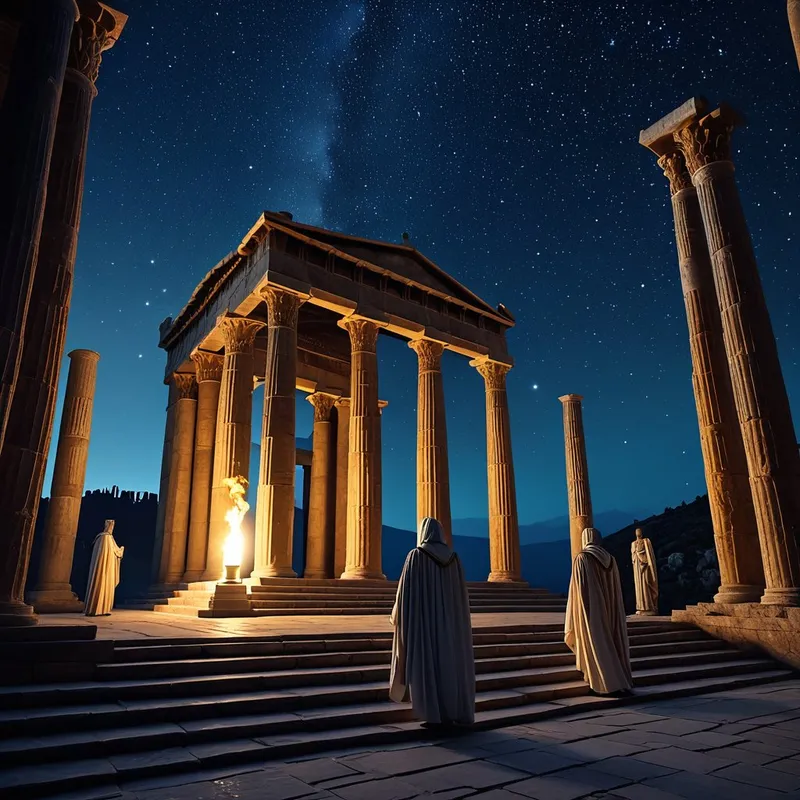
Demeter's Temple at Eleusis Myth Meaning & Symbolism
A goddess's grief for her stolen daughter leads to the founding of the Eleusinian Mysteries, offering initiates a sacred vision of life beyond death.
The Tale of Demeter's Temple at Eleusis
Hear now the tale that was never spoken aloud, the story that lived only in the hushed dark and the sudden, brilliant light. It begins with a scream that tore through the fabric of the world, a mother’s cry that stilled the very heart of the earth.
It was in the Nysian plain, where Persephone wandered, gathering roses and crocuses with the daughters of Oceanus. The earth was lush, the air sweet. Then, without warning, the ground split asunder. From the chasm roared a chariot of jet and gold, drawn by immortal steeds. Hades himself seized the shrieking maiden. Her girdle loosened, her flowers scattered, and the abyss swallowed her whole. Only her fading cry echoed back to the sunlit world, and a single narcissus, trampled into the mud.
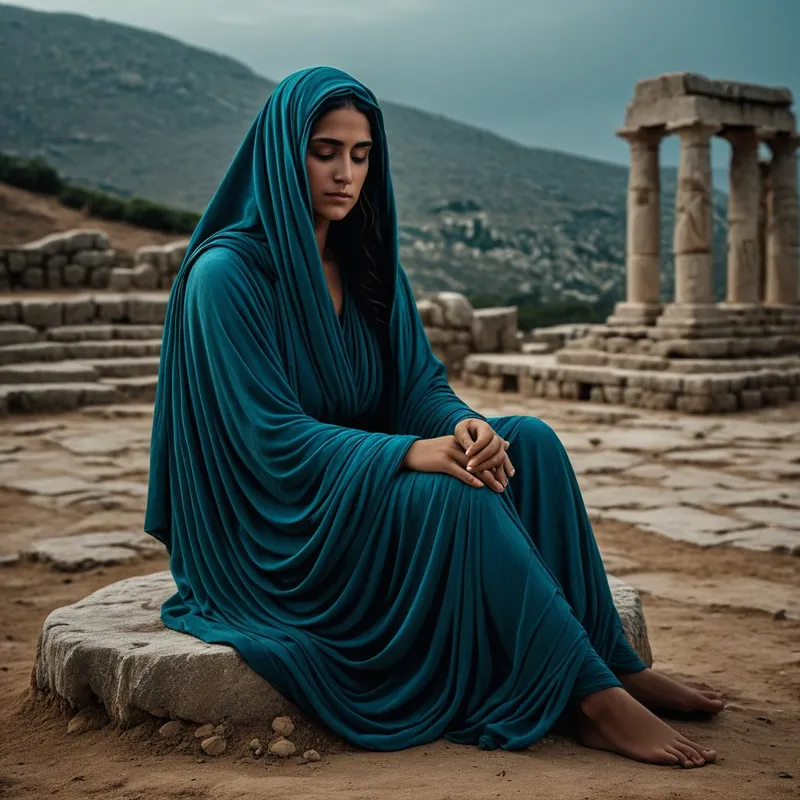
Her mother, Demeter, felt the rupture in her soul. She cast aside her divine radiance, wrapped herself in a dark cloak of mortal grief, and began her desperate wanderings. For nine days and nine nights, she roamed the earth, a torch in each hand, refusing ambrosia and nectar, tasting only her own bitter tears. No god would tell her; no nymph dared speak. The sun, Helios, finally took pity and revealed the grim truth: her brother Zeus had consented to the dark marriage.
Blinded by fury and sorrow, Demeter abandoned Olympus. She walked the roads of mortals, an old woman bowed by years. She came to Eleusis, and sat by the Parthenion well on the Agelastos Petra. There, the daughters of King Celeus found her. They took her to their mother, Metaneira, who offered her a place as nurse to the infant prince, Demophoön.
In the mortal palace, a flicker of purpose returned. Demeter anointed the child with ambrosia and each night placed him in the hearth’s sacred fire, to burn away his mortality and make him eternal. But Metaneira screamed in terror at the sight, breaking the spell. The goddess threw the child down, her disguise melting away in a blaze of terrible, divine light. “Foolish are you mortals,” her voice thundered, “who cannot foresee your fate.” Yet, in her anger, a command was given: Build me a temple here. A great temple upon the hill. And teach the people the rites I shall show you.
And so they built it. But Demeter’s grief was not appeased. She withdrew into her new temple, and a great catabasis fell upon the world. The earth became a stone. Seeds withered in the furrow. Cattle lowed at barren udders. Mankind faced extinction. The gods received no smoke of sacrifice. Olympus grew cold.
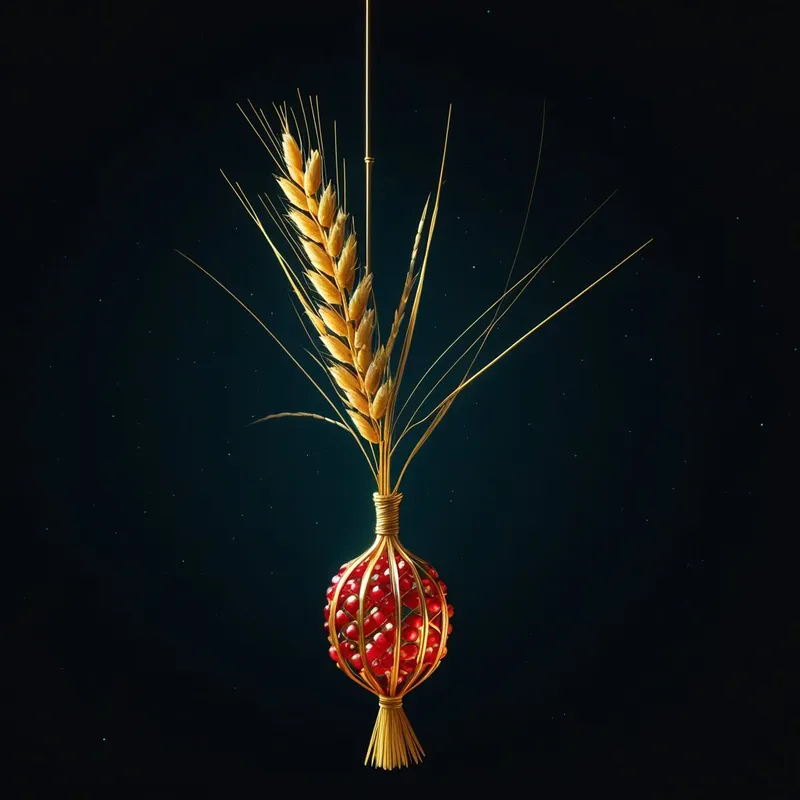
Finally, Hermes was sent to the sunless realms to parley. He found Kore seated beside her dark lord, homesick and pale. Hades consented to her release but, with a smile that was not kindness, offered her a pomegranate seed. She ate it—a simple, fatal act. Thus, a bond was forged. For whoever tastes the food of the dead must return to the dead.
Hermes led her back along the dark roads, up to the world of light. At the threshold of the temple at Eleusis, Demeter saw her and flew to her like a maenad. “Child! Did you eat anything?” she cried, searching her daughter’s face. And Persephone told her of the single, ruby seed.
Then the voice of Gaia herself was heard, and the counsel of the Fates was given. A compromise was struck, etched into the turning of the year. For the seed she ate, Persephone would return to the realm of shadows for one-third of the year. But for the rest, she would walk beside her mother in the sun.
As mother and daughter embraced, life surged back into the world. Flowers erupted at their feet. Vines climbed the temple columns. The fields turned gold. And Demeter, her heart thawed, revealed to the princes of Eleusis—Triptolemus, Eumolpus, and Diocles—the sacred, secret rites. The Mysteries were born. In that temple, the greatest and the least would learn the secret: that life springs from loss, and in the heart of darkness, a seed of light awaits.
Cultural Origins & Context
The myth of Demeter and Persephone, culminating in the foundation of her temple at Eleusis, is not merely a story but the sacred aition for the most revered religious institution of the ancient Greek world: the Eleusinian Mysteries. For nearly two millennia, from the Mycenaean period well into the Roman era, initiates from across the Mediterranean traveled to this site near Athens to undergo a ritual so profound that its specifics remain one of history’s best-kept secrets, protected by a vow of silence (aporrheton).
The primary literary source is the Homeric Hymn to Demeter, composed around the 7th century BCE. This hymn functioned as both sacred scripture and liturgical guide. The myth was not entertainment; it was the theological backbone of a state-sponsored cult that promised initiates (mystai) a blessed lot in the afterlife, freeing them from the gloomy fate of the common dead in Hades. Its societal function was immense: it provided a coherent, emotionally potent narrative for the cycles of nature (the seasons), addressed the universal human terror of death, and fostered Panhellenic unity through a shared, awe-inspiring experience. The temple complex, centered on the great hall called the Telesterion, was the physical and psychic container for this transformative experience.
Symbolic Architecture
At its core, this myth is an intricate map of the psyche’s journey through catastrophic loss, descent, and conditional return. Demeter represents the archetypal principle of nourishment, continuity, and cyclical growth. Her desolation is not just a mother’s grief, but the ego’s utter collapse when its most cherished connection—the vibrant, blossoming life of the soul (Persephone)—is violently severed by an unconscious force (Hades, the lord of the repressed and the unseen).
The abduction is not a crime, but a necessity of the soul. What is too bright, too innocent, must be taken down into the dark to acquire its depth.
Persephone’s ingestion of the pomegranate seed is the pivotal symbolic act. It is the moment of gnosis, the conscious acceptance of one’s own complex fate. She is no longer solely the Maiden (Kore) or the Mother’s daughter; she becomes Queen of a vast, inner kingdom. The seed signifies a binding contract with the depths—a commitment to integrate the shadow, the underworld of one’s own psyche. The resulting compromise—a life divided between upper and lower worlds—models the modern reality of the integrated individual, who must navigate daily consciousness while remaining accountable to the powerful, often hidden, dictates of the unconscious.
The temple at Eleusis, therefore, is not just a building. It is the symbolic temenos (sacred precinct) constructed by the ego (the people of Eleusis) at the directive of the grieving Self (Demeter). It is the inner sanctuary we must build to house and ritualize our most profound transformations.
The Dreamer's Resonance
When this myth stirs in the modern dreamer, it often manifests not as a literal retelling, but through its core patterns. To dream of a radiant child or beloved suddenly vanishing into the earth speaks to a felt experience of soul-loss—a depression, a creative block, a numbness where there was once passion. The dream-ego may find itself wandering a barren landscape (Demeter’s search), holding a light that seems useless against an overwhelming gloom.
Dreams of being offered or eating a single, potent piece of fruit—especially one that is dark red and seeded—can signal the psyche’s readiness to accept a difficult but necessary truth, a “deal with the devil” that ultimately leads to greater personal authority. The dream of a hidden, magnificent temple that one stumbles upon, or is led to by guides, points directly to the discovery of one’s own inner Telesterion: the psychic structure capable of holding the mystery of one’s transformation. These dreams are somatic maps of initiation, where the body itself feels the weight of the descent and the shaky, tentative hope of a return.

Alchemical Translation
The Eleusinian process is a perfect allegory for Jungian individuation. The initial state is one of unconscious unity (Mother and Maiden in the sunny fields). The nigredo is the abduction—the shocking, often painful confrontation with the shadow that shatters the conscious personality. Demeter’s rage and starvation represent the ego’s resistance, its refusal to accept this new, darker reality.
The building of the temple is the albedo—the conscious work of creating a container (through therapy, art, ritual, or deep reflection) to process the grief. It is the establishment of a sacred space within the psyche where the mystery can be held, not avoided.
The Mysteries were not about escaping death, but about dying before you die. The initiate entered the Telesterion to be shattered and reassembled, to know the seed in the dark heart of the fruit.
Persephone’s consumption of the seed is the rubedo, the integration of the opposites. She unites the upper and lower worlds within herself. Her return is not a full restoration of the old, but the birth of a new, cyclical consciousness. For the modern individual, this is the achieved state where one’s wounds, losses, and descents are not merely scars, but sources of authority and compassion. One becomes both the nourishing grain (Demeter) and the queen of the inner depths (Persephone), capable of yielding a harvest even after a long winter. The promise of Eleusis, then, is that our deepest griefs, when given a sacred temple within, can become the very ground of our most authentic rebirth.
Associated Symbols
Explore related symbols from the CaleaDream lexicon: