
Demeter's Mortar Myth Meaning & Symbolism
A grieving Demeter grinds a mortal in her mortar, a mythic act of raw, transformative rage that speaks to the sacred cycle of life and death.
The Tale of Demeter's Mortar
Hear now a tale not of gentle harvests, but of the iron heart of the earth. It begins in a grove, a place of deep, dappled silence. This was no ordinary wood, but a sacred precinct of Demeter, where every oak was a hymn, every rustling leaf a whispered prayer to the cycle that feeds the world. The air hummed with the presence of the goddess, thick with the scent of damp soil and ripening life.
Into this sanctity strode Erysichthon, a man whose soul was a barren field. He commanded his servants to fell the mightiest oak, a tree so ancient its boughs held up the sky, its trunk garlanded with votive ribbons and the tokens of the pious. His men trembled, their axes feeling like sacrilege in their hands. “Strike!” he roared, and when they refused, he seized the axe himself. The first bite into the living wood did not sound like timber. It screamed. From the gash, blood, dark and sap-thick, flowed freely, and a voice, the dryad’s voice woven into the tree’s heart, cried out a curse upon the violator.
The news flew on the wind, a stain of desecration that reached the ears of Demeter. Her sorrow, vast as the plains of Thessaly, curdled into a rage as cold and deep as the winter she would later invent. She did not merely weep; she conspired. Assuming the form of her own priestess, she confronted the king, her voice the rustle of dead stalks. “Cease this blasphemy, son of men.” He laughed, a sound like cracking ice, and raised his axe again. In that moment, the goddess unveiled a sliver of her divinity—not light, but a profound, hungry absence. She placed a curse upon him: an insatiable, gnawing hunger that would hollow him from the inside out.
And so it began. Erysichthon feasted. He devoured flocks, drained cellars, consumed the wealth of his entire kingdom, yet the void within him only grew, a chasm echoing with need. His wealth turned to dust in his mouth. Reduced to utter penury, he sold his own daughter into servitude—but she, blessed with the power of metamorphosis by the god Poseidon, escaped. Finally, with nothing and no one left, the hunger turned its teeth upon the king himself.
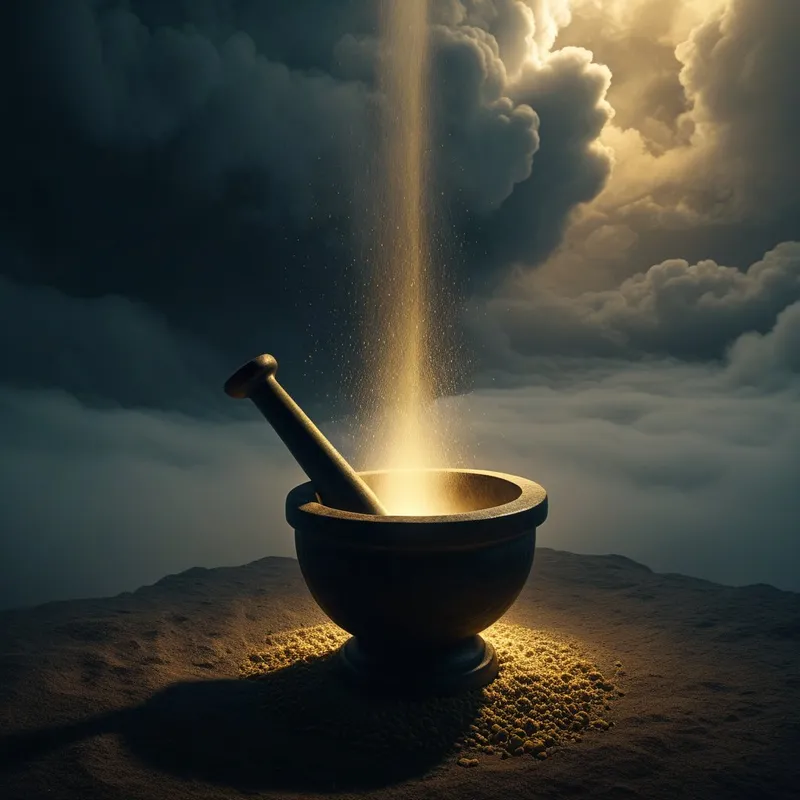
This is where the myth turns its darkest, most potent page. Demeter, the Nourisher, the Giver of Grain, enacted the ultimate inversion of her sacred art. She did not wield a sword or a thunderbolt. She took up her mortar and pestle, the tools of transformation that turn hard seed into life-giving flour. But into this sacred bowl, she did not place barley or wheat. She placed Erysichthon himself. The mortal who violated the cycle was now subject to its most raw, grinding logic. We are not told the specifics of his end, only the terrible, symbolic act: the goddess, in her boundless grief and fury, ground the hollow king in the vessel of creation, reducing the taker to nothing, returning him to the primal dust from which new life, perhaps, might one day hesitantly stir.

Cultural Origins & Context
This stark narrative comes to us from the Hellenistic poet Callimachus, in his Hymn to Demeter. It is not part of the central, Eleusinian mystery cycle of Demeter and Persephone, but rather a powerful folktale-like myth that explores the darker, more punitive aspects of the goddess’s power. It functioned as a sacred cautionary tale. In a culture deeply dependent on agriculture and keenly aware of nature’s fragility, the myth enforced a profound ecological and religious ethic: the sacred (the temenos or grove) is inviolable. To attack it is to attack the very principle of life, embodied by the goddess, and to invoke a retribution that is not merely punitive, but cosmically appropriate—a perversion of the very life processes one sought to destroy.
Symbolic Architecture
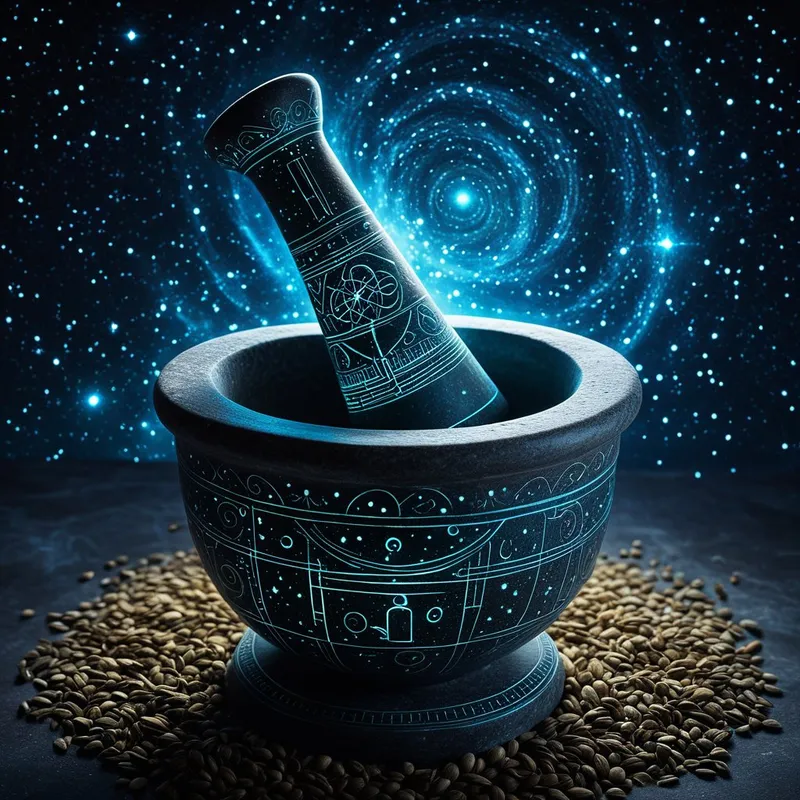
The myth’s power lies in its brutal, alchemical symbolism. Demeter, the archetypal Caregiver, reveals her shadow: the Caregiver whose love, when betrayed, becomes an annihilating force. Her mortar and pestle are the central symbols.
The mortar is the womb of transformation, the crucible where the hard, separate ego is broken down to be reconstituted. The pestle is the relentless, grinding pressure of necessity—in this case, the necessity of the sacred cycle.
Erysichthon represents the unchecked, consumptive ego. He is not just hungry; he is Hunger incarnate—a psychological state of bottomless lack that consumes all resources, relationships, and finally, the self. His axe is the instrument of dissociation, cutting the self off from the nourishing, sacred matrix (the grove, the mother, the unconscious). Demeter’s curse is not an external punishment, but the inevitable psychic state of such dissociation: a ravenous emptiness that can never be filled by external objects.
The act of grinding him is the ultimate, terrifying integration. The violator is forcibly re-incorporated into the cycle he denied. It is nature’s, and the psyche’s, non-negotiable law of return.
The Dreamer's Resonance
When this myth stirs in the modern dreamer, it often signals a profound encounter with what we might call Sacred Rage—not petty anger, but the deep, somatic uprising of a violated core principle. To dream of a grinding stone, a crushing vessel, or of being consumed by an endless hunger points to a psychological process where an old, consumptive pattern (a habit, a relationship, a self-image) is being forcibly broken down.
The dreamer may feel the “grinding” as anxiety, depression, or a period of intense, painful introspection. It is the psyche’s Demeter, in her fierce aspect, working on the Erysichthon complex within: the part of us that cuts down our own inner sacred groves—our creativity, our peace, our connections—for short-term gain or out of sheer blindness. The dream is an announcement that this pattern is now subject to the transformative, and often painful, process of being ground into awareness.
Alchemical Translation
For the individual on the path of individuation, Demeter’s Mortar models the nigredo—the blackening, the dissolution phase of alchemy. It is the necessary death of an outmoded structure of being.
The ego that identifies only with taking, consuming, and violating boundaries must be dissolved in the acid of its own consequences before the new grain of the Self can be sown.
The modern translation is not about literal punishment, but about the courageous submission to a transformative process. We all have inner Erysichthons: addictions, narcissistic wounds, capacities for profound disrespect toward our own souls or the world around us. The alchemical work is to consciously place these patterns into the “mortar” of our awareness—into therapy, meditation, creative expression, or simply honest reflection—and allow the grinding pressure of consciousness to reduce them to their basic components.
This is the Caregiver archetype working on itself. It is the nurturing principle learning that the deepest care sometimes requires the fierce, uncompromising destruction of what is poisonous, to make way for what is truly nourishing. From the dust of the ground king, the myth whispers, the possibility of a new, more humble, and integrated life may yet spring. The mortar of Demeter is thus the crucible of the soul, where our most devastating failures are ground into the fertile soil from which wisdom may grow.
Associated Symbols
Explore related symbols from the CaleaDream lexicon: