Demeter's Mill Myth Meaning & Symbolism
A grieving Demeter grinds a mortal king into dust, halting the world's fertility until a sacred bargain restores the grain and establishes the Eleusinian Mysteries.
The Tale of Demeter's Mill
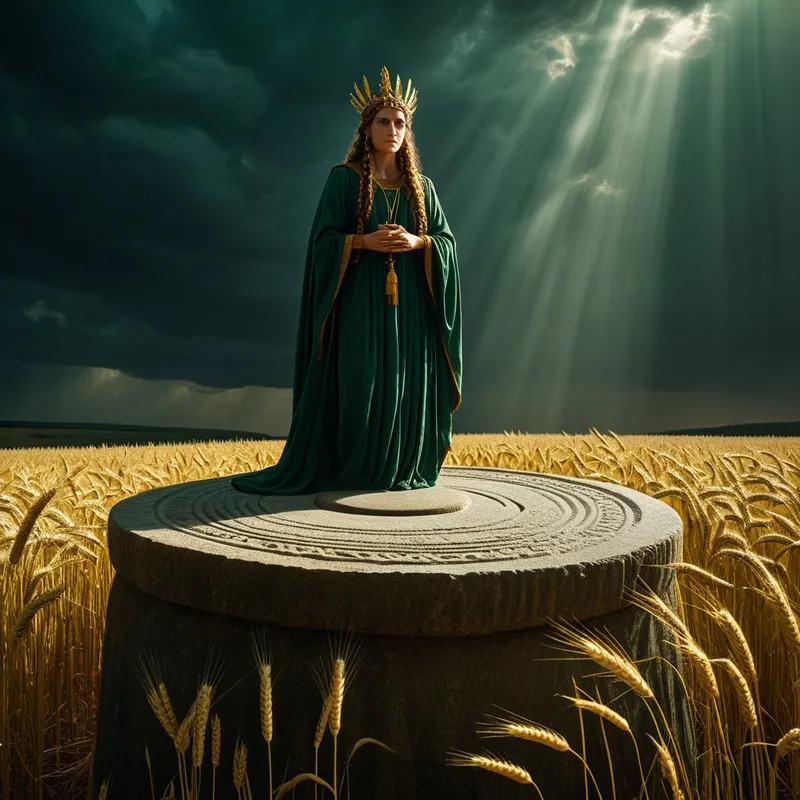
Hear now a tale not of Olympus’s bright heights, but of the deep, dark soil and the heart that beats within it. The world was young in its sorrow, for the Queen of the Grain, Demeter, walked the earth as a hollow shell. Her daughter, the radiant Persephone, had been swallowed by the yawning chasm of the underworld, stolen by its dark lord, Hades. In her fathomless grief, Demeter cast a grey shroud over the world. Seeds shriveled in the furrow. Vines turned to brittle sticks. The very breath of life grew thin and cold.
Wandering in the guise of a weary crone, she came to the city of Eleusis. There, the kindness of the royal family—King Celeus, Queen Metaneira, and their infant son, Demophoön—offered a sliver of solace. In gratitude, Demeter, still disguised, became the child’s nurse. By night, she worked a secret, divine alchemy. She anointed the babe with ambrosia and laid him in the heart of the household’s hearth fire, seeking to burn away his mortal coil and grant him eternal life.
But a mother’s fear is sharp. Queen Metaneira screamed upon seeing her child in the flames, shattering the sacred rite. The goddess’s disguise fell away in a blaze of terrible light. “Foolish mortals!” Demeter’s voice echoed, not with anger, but with a grief so vast it shook the foundations of the house. “You have robbed him of immortality. Yet for your earlier kindness, I shall grant a different boon.”
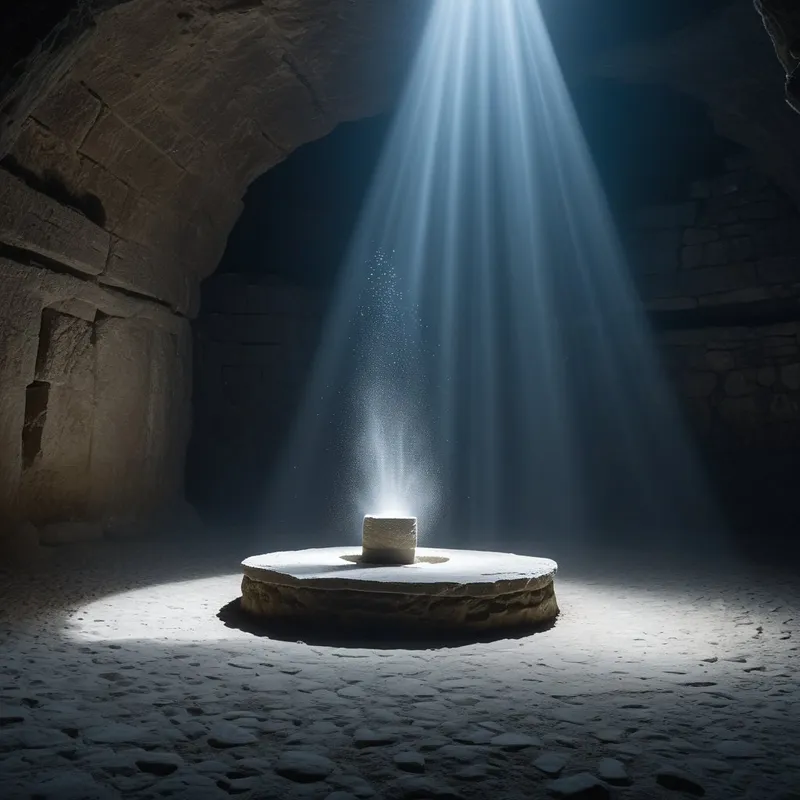
She commanded the people of Eleusis to build her a great temple. And within its deepest chamber, they constructed a mill—not for grinding grain, but for grinding a fate. For the king’s other sons, Triptolemus and Eumolpus, had mocked the goddess in her sorrow. Or, in some whispers, they had witnessed her secret rite and spoken of it carelessly. The price for this transgression against sacred grief was absolute.
Demeter summoned the brothers. In the temple’s hushed gloom, beside the silent millstone, she passed her judgment. One brother was to be ground by the mill. The other was to enact the grinding. The choice of roles was theirs. They chose, binding themselves in a horrific pact of fratricide. The great stone turned, its rumble a sound the world had never heard—the grinding not of sustenance, but of a mortal man into fine, white dust.
This was the zenith of Demeter’s despair, the moment her grief turned the very instrument of life into an engine of dissolution. The world held its breath, poised on the edge of eternal winter. Only then, from the depths, came a rustle of asphodel, a scent of damp earth. A bargain had been struck in the sunless halls. Persephone would return, for a season. Life would flow again, but forever changed, cycling between light and dark.
And from the dust of the mill, from that horrific sacrifice, something new was sown. Demeter, her heart a field now knowing both frost and thaw, taught Triptolemus the secrets of the plow and the sacred grain. She gave him a chariot drawn by dragons and sent him across the world to teach humanity agriculture. The mill of death had become the seed of civilization. And in Eleusis, in the very temple that housed the memory of the mill, the Eleusinian Mysteries were founded, where initiates would learn the great secret: that from dissolution comes rebirth, and that the millstone of fate grinds for all, yet what it produces is the very flour of the soul.
Cultural Origins & Context
The haunting episode of Demeter’s Mill is not a standalone fable, but a crucial, darkly luminous thread within the larger tapestry of the Homeric Hymn to Demeter, composed around the 7th century BCE. This hymn was the central liturgical text for the Eleusinian Mysteries, the most revered and secretive religious rites of the ancient Greek world for nearly two millennia.
The myth was not mere entertainment; it was sacred doctrine, performed and revealed in stages to initiates during the ceremonies at Eleusis. The storytellers were the hierophants, the high priests and priestesses, who wielded the narrative as a tool of profound psychological and spiritual revelation. Its societal function was multifaceted: it explained the origin of agriculture and the seasonal cycle, it established the divine authority and benevolence of Demeter (and by extension, the polis of Athens, which controlled Eleusis), and most importantly, it provided a mythic framework for confronting the human experiences of loss, mortality, and the hope of something beyond death. The mill scene served as the mythic “dark night of the soul” within the initiatory journey, a necessary ordeal before the revelation of the sacred grain (the kernos) and the triumphant return of the Maiden.
Symbolic Architecture
The Mill is the myth’s central, terrifying symbol. It represents the inexorable, grinding machinery of fate, time, and necessity (Ananke). In Demeter’s hands, it becomes the physical manifestation of a psyche in the absolute grip of transformative grief—a grief so powerful it inverts the natural order. The goddess of nourishment uses the tool of nourishment to enact destruction.
The Mill is where the psyche, in its deepest agony, processes the raw, indigestible material of loss. It grinds the literal and metaphorical “body” of the old world into a primal, undifferentiated state.
The brothers, Triptolemus and Eumolpus, represent a fractured human consciousness confronting the divine. Their transgression—whether mockery or careless revelation—symbolizes the ego’s failure to contain or properly honor a sacred, transformative process (the immortalization ritual). Their forced choice and the fratricidal grinding symbolize the brutal, often unconscious, sacrifices the psyche makes during profound change. One part of the self (the mocking, rationalizing, or careless part) must be “ground down” by another part (the enacting, compliant part) under the compulsion of a greater archetypal force (Demeter as the Magna Mater).
The product of this grinding—the white dust—is key. It is not mere death, but reduction to prime matter, the materia prima of the alchemists. From this sterile-seeming powder, Demeter generates the gift of agriculture and the Mysteries themselves. The dust is the essential, fertilizing residue of a shattered identity, without which new growth is impossible.
The Dreamer's Resonance
When the imagery of Demeter’s Mill surfaces in modern dreams, it signals a profound somatic and psychological process of deconstruction. The dreamer is likely in a state of acute grief, a major life transition, or a depressive episode where the foundational structures of identity, relationship, or purpose feel like they are being crushed.
Somatically, this may manifest as a feeling of being physically ground, pressed, or weighed down. Psychologically, the dream often features impossible choices (like the brothers’ choice), being forced to participate in one’s own dissolution, or witnessing a beloved object or aspect of the self being fed into a vast, impersonal machine. The mill in the dream may be archaic or hyper-modern—a stone quern or a gleaming industrial processor. This reflects the timeless nature of the archetypal process.
The dream is not a prophecy of doom, but a map of the psyche’s deepest workshop. It indicates that the conscious ego is being confronted with material it cannot assimilate in its current form. The “mill” is the unconscious itself, working to break down rigid complexes, outworn self-concepts, or frozen trauma into a more workable, fertile state, even if the experience feels annihilating.
Alchemical Translation
The myth of Demeter’s Mill is a precise allegory for the stage in individuation known as the nigredo, the blackening. This is the descent, the confrontation with the shadow, the experience of utter meaninglessness and psychic death. Demeter’s grief-stricken winter is the nigredo of the world soul, and her act at the mill is the nigredo made active and ritualized.
For the modern individual, the alchemical translation is this: we all, at times, become both Demeter and the brothers. We are the force that, in our pain, grinds our own life to a halt (Demeter). And we are also the consciousness that must suffer being ground, watching parts of ourselves be sacrificed (the brothers). The myth models that this horrific process is not a mistake, but a sacred, if terrifying, necessity within the archetypal order.
The triumph is not in avoiding the mill, but in discovering what can be built from the dust it creates. The gift of agriculture—sustenance, culture, continuity—is the lapis philosophorum born from this ordeal.
The modern “Eleusinian Mystery” is the realization that our most crushing experiences of loss, failure, or disintegration are themselves the millstones. Their function is not to punish, but to reduce us to our essential matter, stripping away the inessential. The “Triptolemus” that emerges is a new capacity within the psyche—the ability to carry the seeds of wisdom harvested from that dissolution and sow them into the future. We are asked to build our temple, our inner temenos (sacred precinct), around the very site of our grinding, and from there, learn to cultivate the field of a soul that now understands both darkness and light.
Associated Symbols
Explore related symbols from the CaleaDream lexicon: