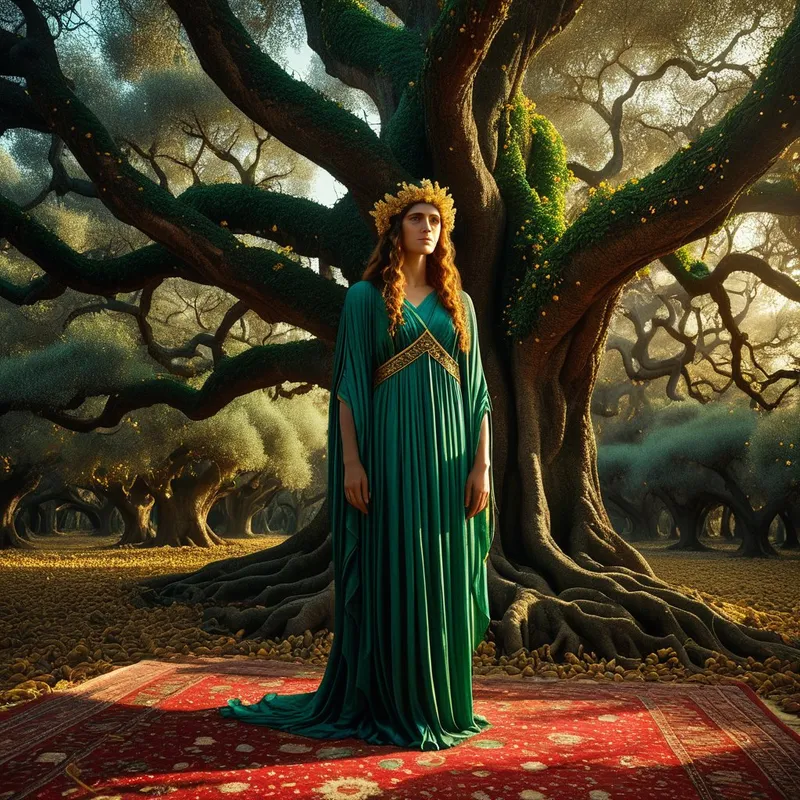
Demeter's Hidden Grove Myth Meaning & Symbolism
A myth of the goddess Demeter creating a hidden sanctuary of grief, halting all life, until a sacred bargain restores the cycle of growth and loss.
The Tale of Demeter’s Hidden Grove
Hear now a tale not of gleaming Olympus, but of the dark, rich earth. It begins with a sound—a single cry that shattered the harmony of the world. It was the cry of Demeter, the Mother of Grain, when her radiant daughter, Persephone, was torn from a sun-drenched meadow by the will of Hades and the silent consent of Zeus.
For nine days and nine nights, Demeter wandered the mortal world, a torch in each hand, her grief a cold wind that killed the green shoot in the furrow. She asked all, from the loftiest nymph to the simplest shepherd, but the earth, fearing Hades’ wrath, kept its secret. Her sorrow was not passive; it was a force of nature withheld. The land began to starve. Rivers shrank to mud. The olive tree withheld its oil. Humanity faced a silent, creeping end, not with a bang, but with the endless sigh of barren soil.
In her despair, she ceased to be a goddess recognizable to mortals. She shed her divine aura and took the form of an aged woman, worn and dusty from the road. In this guise, she came to Eleusis. There, at the well, the daughters of King Celeus found her. Seeing only a weary grandmother, they offered kindness, leading her to their mother, Queen Metaneira. In the warmth of the royal hearth, Demeter was given a cup of barley-water and mint—a simple offering that touched her sealed heart.
To repay this solitary act of human xenia—sacred hospitality—Demeter became the nurse to the queen’s infant son, Demophoön. By day, she fed him ambrosia. By night, she held him in the heart of the household fire, working a secret rite to burn away his mortality and grant him eternal life. This was her hidden grove—not a physical copse of trees, but a sacred, secret space of transformation she created within the walls of a human home. Here, in this fragile domesticity, her creative, nurturing power began, tentatively, to flow again.
But the grove was violated. Metaneira, fearing for her child, screamed at the sight of him in the flames. The spell was broken. Demeter stood revealed in her full, terrible divinity, sorrow now mixed with wrath at the loss of this second child. Yet, the bond was forged. She commanded the people of Eleusis to build her a great temple upon a hill. And into this new, monumental Hidden Grove she withdrew. There, in the heart of her temple at Eleusis, her grief crystallized into a permanent winter upon the world. The great cycle was broken.
Finally, the sun-god Helios, moved by the suffering of all, told her the truth. Her rage then turned to Zeus. No compromise, no Olympian decree would move her. The life of the world would not return until her eyes beheld her daughter. Faced with the absolute end of all nourishment and sacrifice, Zeus relented. He commanded Hades to release Persephone.
But in the underworld, Persephone had eaten. Not a full meal, but a single, fateful seed of the pomegranate. This small, dark act bound her to the realm of shades for a portion of each year. So the bargain was struck, the first alchemy of the soul: for two-thirds of the year, Persephone walks with her mother, and the earth laughs with flowers and grain. For one-third, she descends to her throne beside Hades, and Demeter, in her hidden grove of memory, lets the world grow cold and still. The grove is no longer a place of endless grief, but the sacred chamber where the terms of life itself—joy bound inextricably to loss—are honored and renewed.

Cultural Origins & Context
This core narrative, known as the Homeric Hymn to Demeter, was not merely a story but the foundational scripture of the most famous and enduring mystery cult of the ancient world: the Eleusinian Mysteries. For nearly two thousand years, from the Mycenaean era well into the Roman period, initiates from across the Greek and later Roman world traveled to Eleusis to participate in rites that promised knowledge of the fate of the soul and a blessed afterlife.
The myth was performed, not just read. The Hymn itself, composed likely in the 7th or 6th century BCE, served as a sacred text that established the aition (the founding cause) for the rituals. The story of Demeter’s search, her reception at Eleusis, her grief, and the final compromise provided the mythic blueprint for the secret ceremonies that took place in her Telesterion, or “Hall of Initiation.” The function was societal and profoundly psychological: it addressed the universal human terror of death, the pain of separation (especially of a child from a parent), and the anxiety over the failure of the harvest. By re-enacting Demeter’s journey from despair to a negotiated peace with loss, initiates underwent a symbolic process that transformed their understanding of life’s cycles, offering hope and a model of resilience.
Symbolic Architecture
At its heart, this is a myth of the Great Mother archetype in her dual aspect: the life-giver and the life-withholder. Demeter represents the conscious, cultivating principle of culture, agriculture, and nurtured growth. Her Hidden Grove—first the hearth at Eleusis, then her temple—symbolizes the interior psychic space where profound transformation occurs, often born of unbearable pain.
The most fertile soil is first broken by the plow; the deepest wisdom is often seeded in the dark chamber of grief.
Persephone’s abduction is not merely a kidnapping but a necessary katabasis (descent). She represents the innocent, blossoming aspect of the psyche (the Kore, or “Maiden”) that must be taken into the underworld—the realm of the unconscious, the repressed, the instinctual—to be forged into a queen (Persephone). The pomegranate seed is the symbol of the irreversible encounter with depth. Once tasted, the soul can never again be wholly innocent or wholly of the upper world; it gains complexity, authority, and a contract with darkness.
Hades, then, is not a villain but the necessary principle of hidden wealth (Plouton) and inevitable end. The resolution is not a “happy ending” but a sacred cycle. The myth architecturally models the psyche’s reconciliation of opposites: light and dark, life and death, attachment and release, mother and queen.

The Dreamer’s Resonance
When this myth stirs in the modern dreamer, it often manifests as dreams of profound loss, frozen landscapes, or searching through barren places. One might dream of a beloved garden that has suddenly died, a child who is lost in a crowd, or a home that feels warm and safe but has a single, inexplicably cold and empty room—the Hidden Grove within one’s own psyche.
Somatically, this can correlate with a feeling of “withering”—a loss of vitality, appetite, or creative flow. Psychologically, the dreamer is undergoing what Demeter endured: the acute phase of grief, where the instinct is to withdraw the life-force, to create a psychic winter. The dream of finding a hidden, nurturing space (like the hearth at Eleusis) signals the beginning of the healing process, where a small, often humble, act of self-care or human connection allows the frozen energy to begin moving again, however tentatively. The dream is the psyche’s way of building its own Telesterion, a sacred inner chamber where this necessary mourning can be contained and honored, not bypassed.
Alchemical Translation
The alchemical process mirrored here is the nigredo, the descent into the blackness of despair and the albedo, the washing by tears that leads to clarity. For the individual on the path of individuation, Demeter’s myth is a master guide for navigating life’s most devastating ruptures.
The first step is the honest, full-bodied experience of grief (Demeter’s wanderings). The second is the withdrawal into a protected, introverted space to honor that pain (the creation of the Hidden Grove/Temple). This is not depression, but a sacred retreat. The third is the acceptance of the irreversible change—the “pomegranate seed.” In a human life, this is the acknowledgment that after a deep loss, one is fundamentally different; a part of the self now belongs to the “underworld” of that experience.
Individuation is not about achieving perpetual spring, but about becoming sovereign over the entire year of the soul—the growth, the harvest, the fall, and the necessary, silent winter.
The final, alchemical triumph is the negotiation of a new cycle. The modern individual learns to let their personal “Persephone”—their joy, creativity, or connection—rise and descend according to an inner, sacred law. They become both the nurturing Demeter, tending their conscious life, and the Queen of the Depths, integrating the wisdom and shadows from their trials. The Hidden Grove becomes the permanent, inner sanctuary where this eternal, cyclical truth is held, the command center from which one learns to let the world bloom, and let it rest, in its appointed time.
Associated Symbols
Explore related symbols from the CaleaDream lexicon: