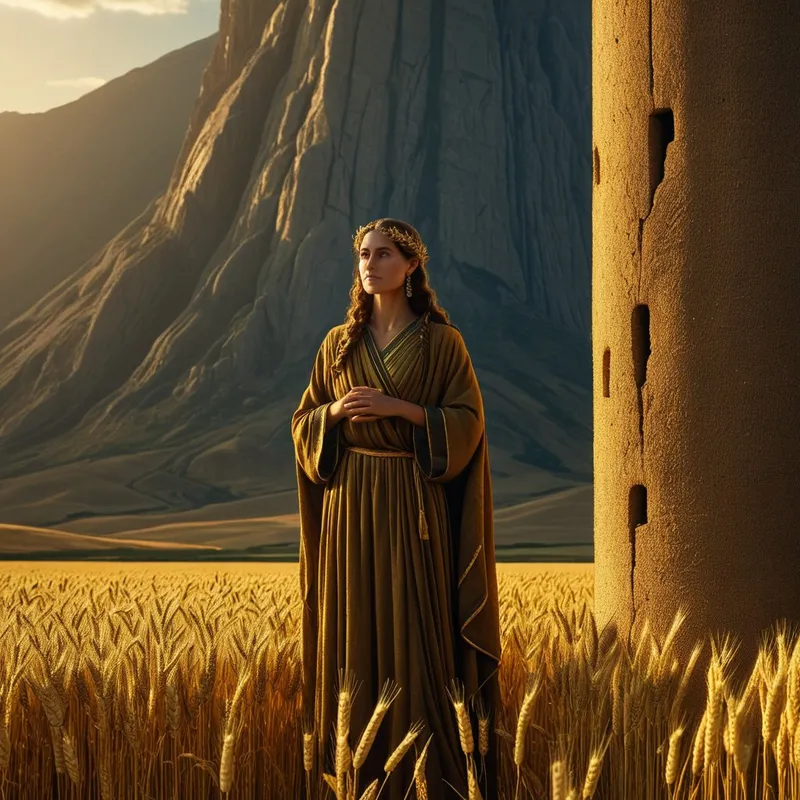
Demeter's Granary Myth Meaning & Symbolism
A myth of the goddess Demeter hiding the world's grain in a mountain, causing famine until a ritual reveals the secret of cyclical renewal.
The Tale of Demeter's Granary
Hear now a story not of thunder, but of silence. Not of war, but of a withering. It begins in the wake of a scream that tore the world in two—the scream of Demeter when the earth gaped open and swallowed her radiant daughter, Persephone.
The sun became a pale coin. The winds carried no scent of blossom or loam, only dust. Demeter, her hair a tangle of dried stalks, her eyes wells of black grief, wandered the mortal world. She sat by the Well of the Maiden in Eleusis, a statue of sorrow. The green world was her child, and her child was gone. In her fathomless pain, a cold resolution formed. If the earth could steal, so could she.
She turned her gaze to the mountains. Not to Olympus, where the gods feasted, oblivious, but to the mortal ranges that ribbed the land. With a whisper that rustled through every barn and silo, she called. From every field, from every threshing floor, from every granary yet unemptied, the spirit of the grain answered. Not the physical stalks, but its potency, its promise, its secret life-force. It streamed from the cultivated plains like a golden, silent river, flowing upward into the stony heart of a great mountain. The rocks sealed themselves behind it. This was Demeter’s Granary. She hid the soul of nourishment itself.
Famine, sharp-toothed and relentless, uncoiled. The plough bit uselessly into iron-hard soil. Seeds rattled in the furrows like dead teeth. Mothers held children with bellies swollen with nothing but air. Prayers rose to Olympus, thin as smoke, but the gods of the bright sky knew not how to mend a broken earth. The king of the gods, Zeus, saw the world dying. He sent commands, then threats. Demeter, seated on the bare rock, answered only with silence. Her condition was simple, immutable: no daughter, no grain.
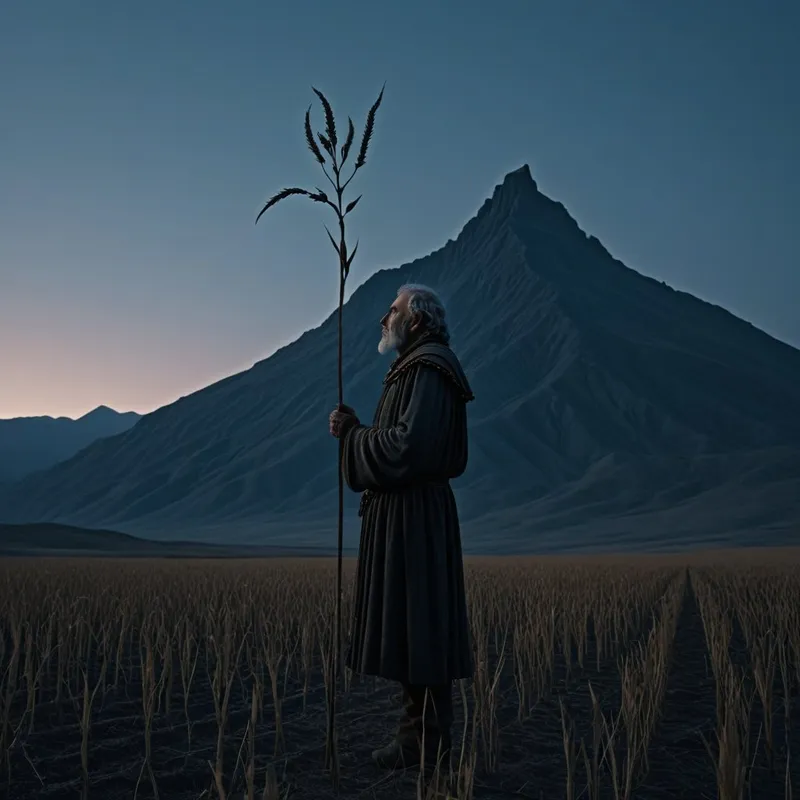
The resolution came not through divine decree, but through a fragile, mortal thread. In Eleusis, the queen Metaneira had been kind. In her household, Demeter had tried, and failed, to grant immortality to the queen’s infant son. From this place of shared mortal limitation, a fragile trust remained. It was to the Eleusinian prince, Triptolemus, that the goddess finally turned.
She did not lead him to the mountain with fanfare. She met him in the despair of his own fields, where his people starved. She placed in his hands not a weapon, but a secret—a whisper of location, a fragment of a ritual, a key made of right action and reverence. Guided by her, Triptolemus ascended. He did not break the mountain open. He approached the sealed stone with the steps of the sacred dance, with libations of water and honey, speaking the words of loss and hope she taught him. The rock did not shatter; it sighed open.
The golden light that spilled out was not blinding, but soft, warm, like the first sun after a long winter. It was the returned promise. With it came the knowledge: the grain was not stolen forever, but held in trust. It would return to the fields, but its giving was now part of a pact, a cycle mirrored by Persephone’s own return. Triptolemus descended, bearing not just grain, but the sacred art of agriculture—the knowledge of sowing and reaping within the great, turning wheel of loss and return.
Cultural Origins & Context
This narrative is not a single, codified Homeric hymn, but a powerful strand woven into the fabric of the Eleusinian Mysteries, the most revered and secretive religious institution of the ancient Greek world. For nearly two millennia, initiates traveled to Eleusis to undergo rites that promised spiritual liberation and a blessed afterlife. The myth of the granary was central to this dromenon—the thing done.
It was likely transmitted orally within the secretive context of the Mysteries, taught through ritual re-enactment, sacred drama, and revealed logoi (sacred words) rather than public texts. Its function was profoundly societal yet deeply personal. On a civic level, it explained the necessity of agriculture’s seasonal cycle and sanctified the state’s food security. On a mystical level, it modeled the initiate’s own journey: the soul’s descent into darkness (loss), its secret safeguarding (the granary), and its subsequent liberation and renewal through sacred knowledge (the rites).
The figure of Triptolemus became the archetypal initiate and culture hero, the mortal who bridges the chasm between divine wrath and human survival through pious action. The myth thus served as the foundational charter for the Mysteries, transforming a tale of maternal grief into a map for human salvation.
Symbolic Architecture
Demeter’s Granary is no mere storehouse. It is the ultimate symbol of potential held in stasis. The grain is the logos spermatikos—the seed-word, the unmanifested potential of life, withdrawn from manifestation. The mountain is the unconscious itself, the stony, hidden place where psychic contents are stored away during a period of trauma or profound depression.
The granary is the soul’s winter. It is not emptiness, but concentration. All abundance is drawn inward, protected, and held in sacred trust until the conditions for its safe emergence are met.
Demeter’s act is not one of petty vengeance, but of profound, if terrible, conservation. She refuses to let life force be spent wastefully on a world that does not honor the sacred cycle of descent and return. Her grief creates a temenos, a sacred precinct, around the source of life. The famine in the world mirrors the famine in the soul when its deepest connections are severed.
Triptolemus represents the ego-complex that must become an instrument of the Self. He does not storm the mountain (heroic ego inflation); he approaches with humility and the precise, ritualized gestures (adapted conscious attitude) required by the goddess (the Self). His successful return with the grain symbolizes the conscious integration of a powerful, life-giving content from the unconscious, which then becomes the foundation for a new, sustainable way of being (civilization through agriculture).
The Dreamer's Resonance
When this myth stirs in the modern dreamer, it often manifests as dreams of hidden rooms, sealed vaults, or forgotten storage spaces in familiar houses (the psyche). There is a sense of knowing that something vital—a talent, a memory, a capacity for joy—is “in there,” but the door is locked or obscured.
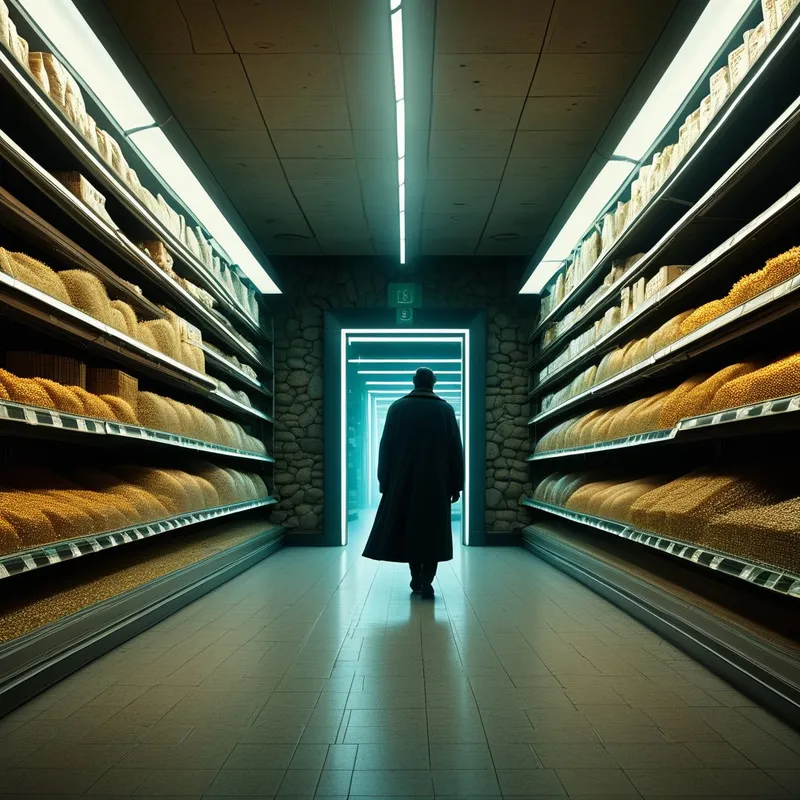
Somatically, this may accompany a period of creative barrenness, emotional numbness, or a feeling of being “dried up.” The dreamer might be wandering through empty markets, staring at full cupboards that contain nothing nourishing, or trying to feed others with food that turns to dust. These are the landscapes of Demeter’s famine.
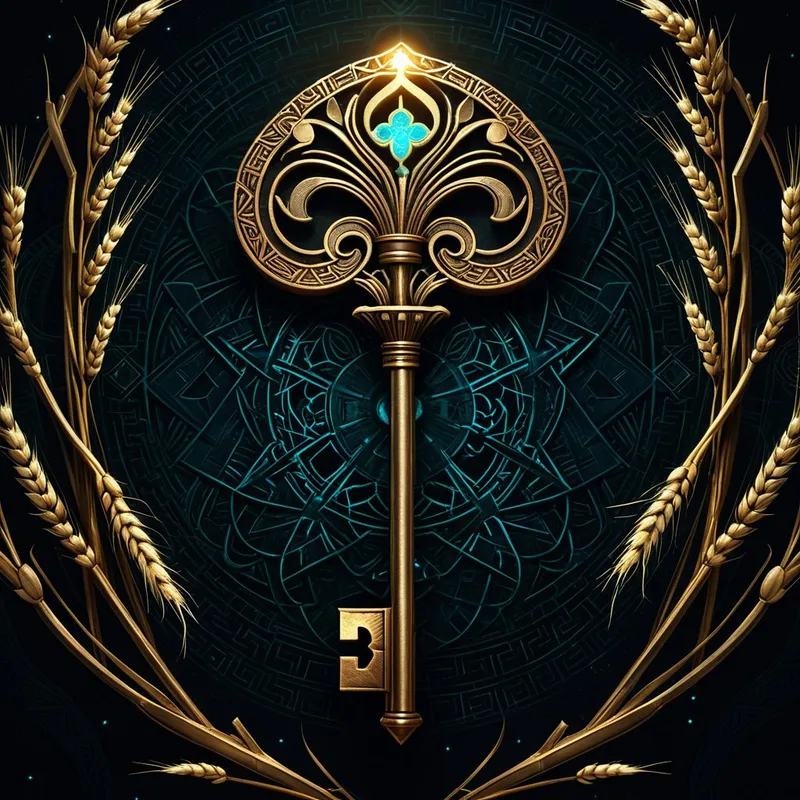
The psychological process is one of involutio—a necessary drawing-in. The psyche, faced with a loss (of a relationship, an identity, a hope), instinctively pulls its vital energies back into a protective, inner citadel. The ego feels this as depression, stagnation, or lack. The dream is signaling that a period of conservation is underway; the life force is not gone, but in deep, hidden storage. The conflict arises from the ego’s desperate, often clumsy, attempts to force the door open, rather than seeking the ritual key.
Alchemical Translation
The alchemical journey mirrored here is the nigredo—the blackening, the descent into utter despair and putrefaction. Demeter’s grief is the materia prima dissolved in its own tears. The hiding of the grain is the sealing of the alchemical vessel. Nothing can proceed until the primal matter is utterly broken down and contained.
Triptolemus’s journey is the beginning of the albedo, the whitening. He is the mediating consciousness that must learn the sacred opus (work). The ritual she teaches him is the precise regimen—the right temperature, the correct sequence—needed to transform the sealed, black mass into something liberatable.
Individuation demands a famine. The ego’s endless consumption of experience must cease so that the soul can gather its scattered gold into one, hidden place. The key to the granary is always a ritual of remembrance—remembering the loss honestly, and remembering the sacred pact that life is cyclical, not linear.
For the modern individual, the “granary” is that part of the Self that holds our unlived life, our dormant potentials, which are only withdrawn because our current conscious attitude cannot sustain them. The “famine” is the felt absence that forces us to change. Psychic transmutation occurs when we stop trying to plant seeds in frozen ground (forcing solutions) and instead, like Triptolemus, turn toward the mountain of our own unconscious with respect, performing the humble, daily rituals of attention, reflection, and symbolic engagement (therapy, art, prayer, journaling) that slowly convince the inner Demeter to release her guarded treasure. We do not get back what was lost. We receive something new: the knowledge of the cycle itself, and our role as its conscious, grateful participants.
Associated Symbols
Explore related symbols from the CaleaDream lexicon: