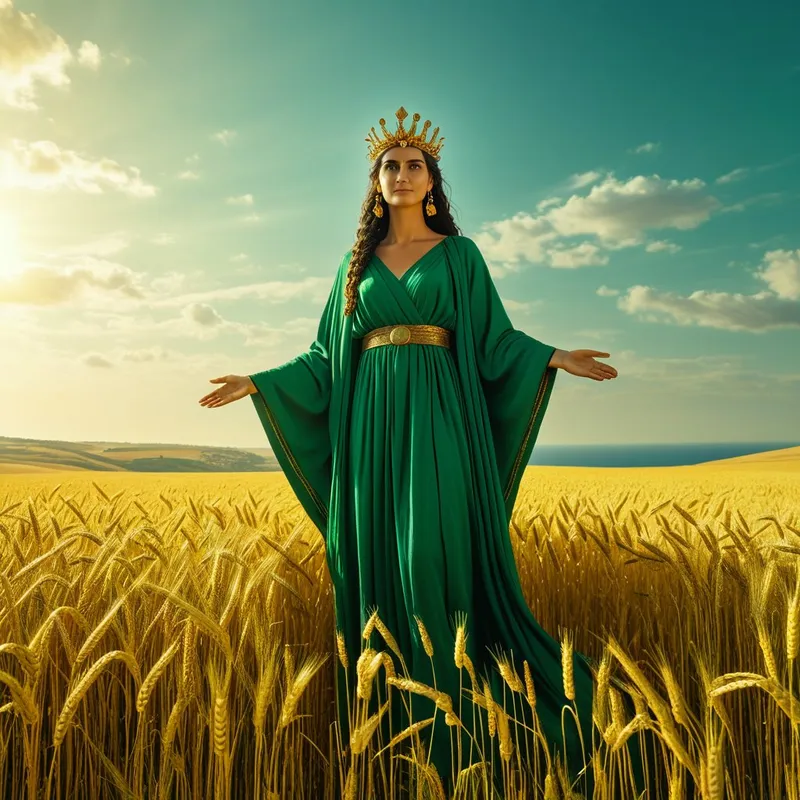
Demeter's Fields Myth Meaning & Symbolism
A myth of the grain goddess Demeter, whose grief over her daughter's abduction plunges the world into barren winter until a sacred compromise restores cyclical life.
The Tale of Demeter's Fields
Hear now the story of the green world’s turning, a tale not of heroes and swords, but of soil and soul. It begins in the Fields of Nysa, where the air was sweet with the scent of blooming crocus and hyacinth. Here, Demeter’s daughter, Kore, whom we would come to call Persephone, danced with her nymphs. Her laughter was the sound of spring streams, and the flowers burst forth wherever her light feet touched the earth.
But the earth has depths unknown to the sun. From a great chasm in the Nysian plain, a chariot of blackest obsidian erupted, drawn by steeds whose breath was mist. Its driver was Hades, lord of the unseen realms, and his heart had been pierced by a single shaft of light from the maiden above. With a hand both fierce and desperate, he seized her. Kore’s cry was swallowed by the closing earth, and the only trace left was a single, trampled garland of violets.
Demeter, the great nurturer, felt the rupture in the world’s web. A mother’s knowing is a terrible thing. She cast down her golden sickle and tore the diadem of grain from her hair. For nine days and nine nights, she wandered the mortal world, a goddess unmade by grief, holding two torches that burned with a cold, unyielding flame. No one, not god nor mortal, could tell her of her daughter’s fate.
In her despair, she came to the city of Eleusis, disguised as an old woman. There, in the house of King Celeus, she was hired to nurse the infant prince Demophoön. Seeking to grant him immortality, she held him in the hearth’s sacred fire by night. Discovered by the queen, her divinity was revealed, and she commanded a temple be built for her at Eleusis. There, she sat. And the world sat with her.
For Demeter’s grief was not a private sorrow. It was a law of nature revoked. The fertile fields became as stone. Seeds shriveled in the earth. The olive trees withheld their oil, and the vines their wine. A great winter fell upon the land, not of snow, but of absolute cessation. Humanity faced extinction, and the Olympians found their altars cold and empty.
The resolution came from the messenger, Hermes, sent by a concerned Zeus to the underworld. He found Persephone, now a queen in a crown of ash, seated beside a somber Hades. Zeus decreed she could return, provided she had eaten nothing in the land of the dead. But Hades, in a final, cunning act of love, had offered her a pomegranate seed. She had consumed it—a tiny, bloody sacrament.
A compromise was forged, the first sacred contract between life and death. For each seed eaten, Persephone would spend a corresponding month in the underworld as its queen. The rest of the year, she would walk in the sun with her mother. Hermes led her up the dark path, and when Demeter saw her daughter’s face at the temple threshold, she rose. Her torch-flame turned warm. Where her feet passed, the frozen ground cracked, and green shoots, tender and desperate, pushed through toward the light.

Cultural Origins & Context
This myth, central to what scholars call the Homeric Hymn to Demeter, was far more than a story. It was the foundational narrative of the Eleusinian Mysteries, the most revered and well-guarded initiatory cult of the ancient Greek world for nearly two millennia. The hymn itself, likely composed in the 7th century BCE, served as a sacred text for these rites.
The myth was not merely told; it was experienced. Initiates (mystai) underwent a profound ritual journey at Eleusis, believed to grant them blessings in this life and a favorable fate in the next. The details remain secret, but the myth’s structure—descent, loss, search, and joyful reunion (the hieros gamos or sacred marriage)—provided the archetypal blueprint. It functioned as a societal anchor, explaining the essential, terrifying, and beautiful cycle of the agricultural year upon which civilization depended. It transformed the existential terror of seasonal death into a divine drama with a guaranteed resolution, offering hope against the finality of the grave.
Symbolic Architecture
At its core, the myth maps the psyche’s relationship to the cycles of attachment, loss, and renewal. Demeter represents the Archetypal Mother and the conscious ego’s domain of cultivation, order, and manifested life. Persephone is the virgin soul, the nascent psyche, or the precious content of the unconscious (an idea, a relationship, a state of innocence) that is suddenly abducted into the depths.
The abduction is not a crime, but a necessity. The soul must be claimed by the depths to become more than itself.
Hades is the ruler of the Underworld, the compelling pull of the unconscious that demands integration. His realm is not evil, but essential—the place where raw potential and forgotten truths reside. The pomegranate seed is the symbol of irrevocable change; once knowledge or experience is internalized (“eaten”), one can never fully return to a state of prior innocence. The resulting compromise—the cyclical journey between upper and lower worlds—models the fundamental rhythm of a mature psyche: engagement with the world (summer) must be balanced by periodic withdrawal, introspection, and confrontation with the inner darkness (winter).
The Dreamer's Resonance
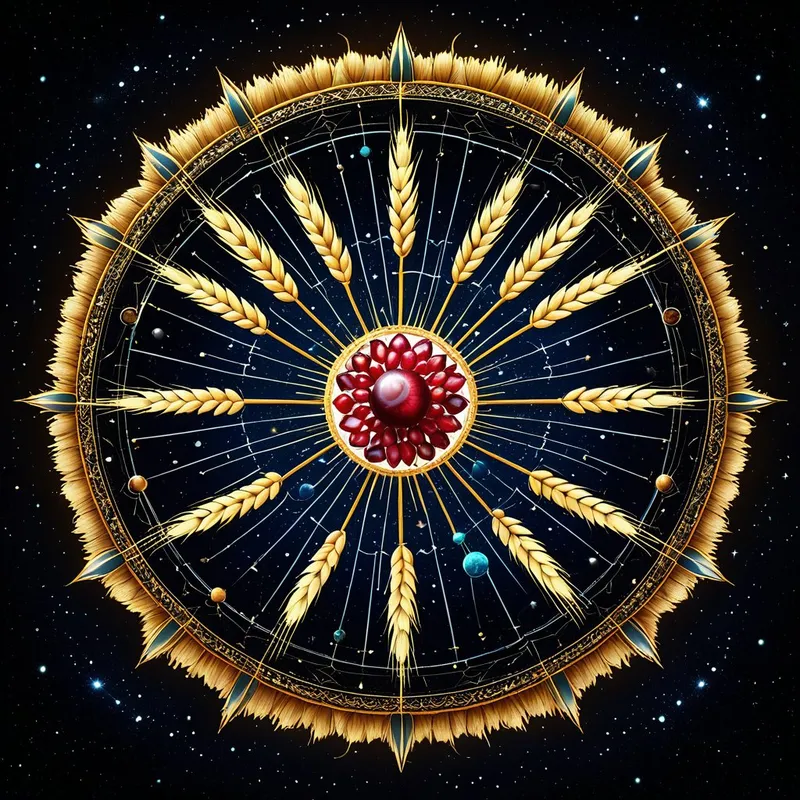
When this myth stirs in modern dreams, it often signals a profound process of psychic re-organization around loss or a forced maturation. Dreaming of a suddenly barren landscape, a cherished garden that will not grow, or a beloved figure who vanishes into the earth points to the “Demeter phase”: a somatic experience of creative or emotional famine, a depression that feels like a perpetual winter of the soul. The dream ego may wander, searching with a sense of futility.
Conversely, dreams of being pulled underground, of finding beauty or sovereignty in a dark, labyrinthine place, reflect the “Persephone phase.” This is the soul’s necessary descent—into grief, illness, depression, or a major life transition—where the task is not escape, but finding one’s authority in the darkness. The dream may present a pomegranate or other sealed fruit, representing the choice (often unconscious) to ingest a difficult truth that will forever alter one’s relationship to the world above.
Alchemical Translation
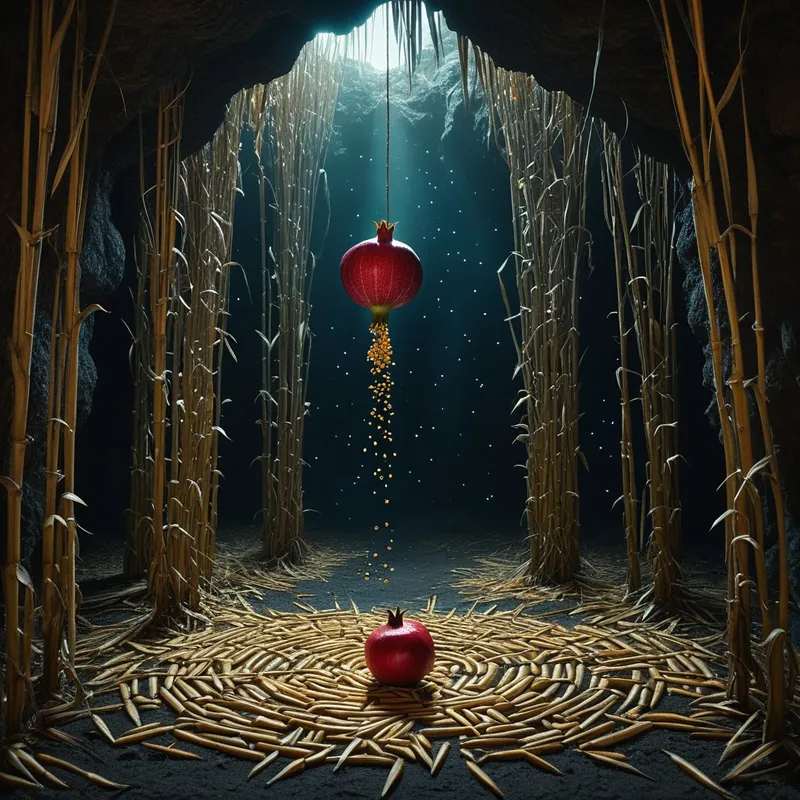
The alchemical journey modeled here is the transmutation of naive, cyclical suffering into conscious, sacred cyclicity. The initial state is unconscious unity (Mother and Maiden in the field). The separatio is the brutal, involuntary abduction—the loss, the diagnosis, the betrayal, the failure. The nigredo, the blackening, is Demeter’s grief-stricken winter and Persephone’s sojourn in the dark; it is the necessary dissolution of the old identity and its certainties.
The mystery is not in the return of spring, but in the creation of a soul capable of dwelling in two kingdoms.
The coniunctio, or sacred marriage, is the compromise. It is the psyche’s hard-won agreement to live a dual citizenship. One learns to be both a capable ruler in the world of light (Demeter’s nurturer) and an acknowledged queen in the world of shadow (Persephone’s sovereignty). The final stage is not a return to the beginning, but the establishment of a new, more resilient order: the conscious acceptance of life’s inherent rhythm of expansion and contraction, joy and grief, engagement and retreat. The individual no longer falls into winter but descends with purpose, knowing the seeds of the next spring are being forged in that fertile dark.
Associated Symbols
Explore related symbols from the CaleaDream lexicon: