Demeter's Cornucopia Myth Meaning & Symbolism
A horn of infinite plenty born from a god's broken horn, gifted to the grieving mother Demeter, symbolizing abundance forged from rupture and sacred reciprocity.
The Tale of Demeter’s Cornucopia
Hear now the tale not of a hero’s sword, but of a horn. A horn of impossible bounty, born from a god’s pain and given to a goddess in the depth of her despair.
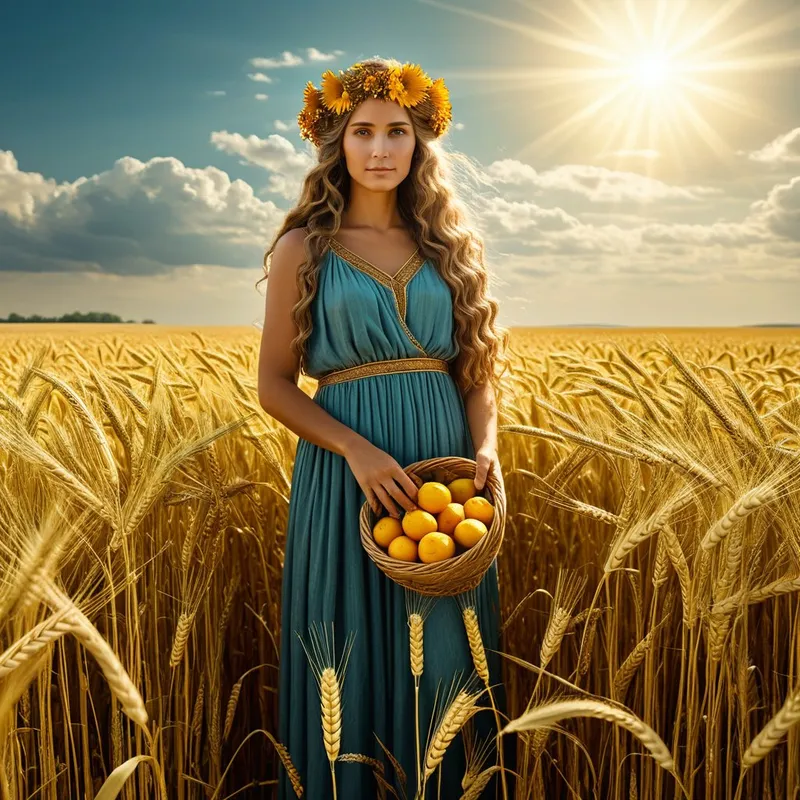
[The world](/myths/the-world “Myth from Tarot culture.”/) was barren. Not from winter’s chill, but from a mother’s bottomless grief. [Demeter](/myths/demeter “Myth from Global/Universal culture.”/), she who makes the wheat swell and the poppies bloom, walked [the earth](/myths/the-earth “Myth from Hindu culture.”/) as a hollow wraith. Her daughter, the radiant [Persephone](/myths/persephone “Myth from Greek culture.”/), had been swallowed by the dark maw of [the earth](/myths/the-earth “Myth from Hindu culture.”/), taken by [Hades](/myths/hades “Myth from Greek culture.”/) to be his queen. In her fury and sorrow, [Demeter](/myths/demeter “Myth from Global/Universal culture.”/) withheld her grace. Seeds rotted in the cold ground. Olive trees withered. The laughter of mortals turned to the rasp of hunger. The great wheel of life had ground to a terrifying halt.
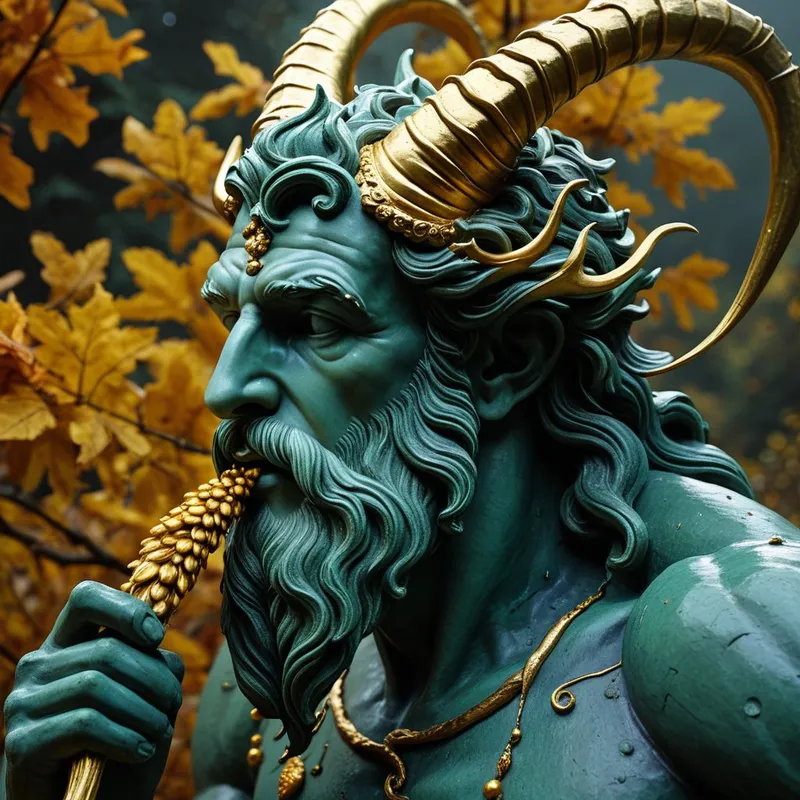
In the rivers and mountains, the lesser deities watched the world grey and shrink. Among them was Achelous, the great river god whose waters fed the plains. He, too, felt the parching drought. But another conflict stirred him. The hero [Heracles](/myths/heracles “Myth from Greek culture.”/), in his brute passage through the world, had challenged Achelous for the hand of the princess Deianeira. They fought, a titanic struggle of muscle against divine current, hero against primal force. In the clash, [Heracles](/myths/heracles “Myth from Greek culture.”/) seized one of the god’s mighty horns and wrenched it from his brow.
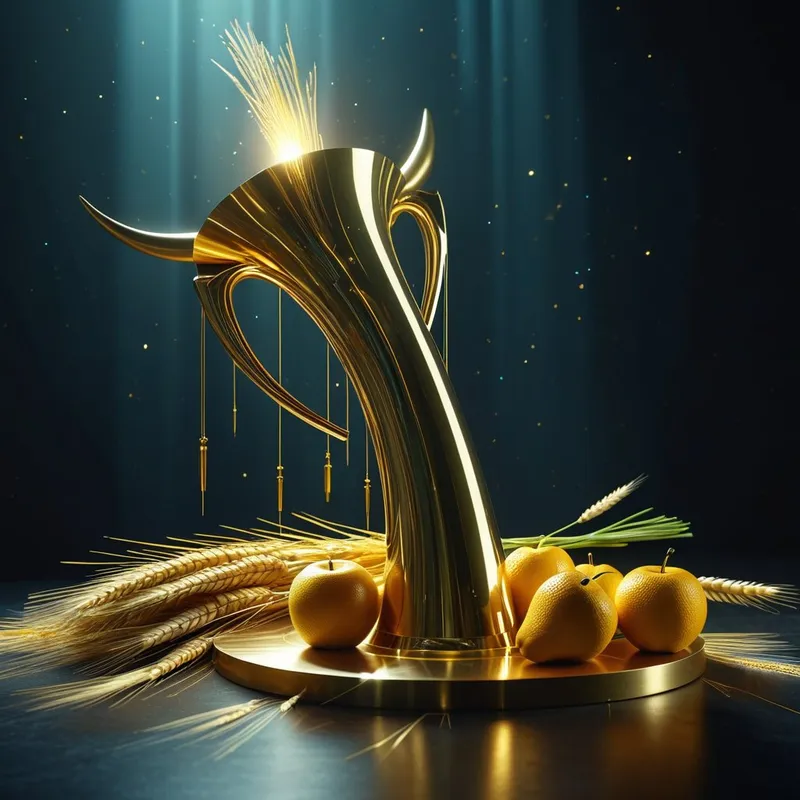
The snap echoed like a falling oak. Not just a wound, but a diminishment. [The river](/myths/the-river “Myth from Buddhist culture.”/) god’s power, his very essence, flowed from that broken place. But from the stump, a miracle began. Not blood, but a thick, golden nectar welled forth. The horn itself, fallen to the mossy bank, did not lie inert. It began to breathe. From its hollow core spilled not river [water](/myths/water “Myth from Chinese culture.”/), but the very essence of life: clusters of fat grapes, figs splitting their purple skins, olives gleaming like jade, and sheaves of wheat heavy with grain. The Naiads, the freshwater [nymphs](/myths/nymphs “Myth from Greek culture.”/) who attended Achelous, saw the wonder. With gentle hands, they took the horn. They filled it to overflowing with the riches of the still-fertile wilds—pomegranates, apples, trailing vines—and made it an offering.
They carried this horn of spontaneous, overflowing life to the desolate Demeter. She sat on a barren rock, her face as empty as a plowed field in drought. They placed [the Cornucopia](/myths/the-cornucopia “Myth from Global/Universal culture.”/)—the [Horn of Plenty](/myths/horn-of-plenty “Myth from Norse culture.”/)—at her feet. For the first time since her loss, the goddess looked not inward at her grief, but outward at this gift born of another’s rupture. She touched a grape, and felt its potential for wine and joy. She held a grain of wheat, and remembered the cycle of sowing and reaping. This horn, this symbol of abundance emerging directly from a breaking, spoke to her shattered heart. It did not cure her grief—that would come only with Persephone’s partial return—but it reminded her of her own nature. She accepted the horn, and in that acceptance, the first green shoot pushed through the cracked earth.
Cultural Origins & Context
The myth of the [Cornucopia](/myths/cornucopia “Myth from Greek culture.”/) is not a single, centralized epic, but a fluid story woven into the fabric of several larger narratives. It appears most notably in the context of the [Eleusinian Mysteries](/myths/eleusinian-mysteries “Myth from Greek culture.”/), the profound secret rites dedicated to Demeter and Persephone at Eleusis. Here, the promise of life emerging from [death](/myths/death “Myth from Tarot culture.”/) was the core mystery, and the [Cornucopia](/myths/cornucopia “Myth from Greek culture.”/) served as a powerful symbol of that promise—abundance is not a given, but a miraculous gift that follows a breaking.
Its telling was likely part of a broader oral tradition concerning river gods and local heroes like Heracles. The version where Achelous is the source is recorded by the Roman poet Ovid, showing how the symbol transcended its specific origin story. In Greek households, the Cornucopia was a common artistic motif on pottery and in mosaics, a perpetual prayer for household prosperity. Its societal function was dual: it was a folk-etiological myth explaining a symbol of abundance, and a deeper, cultic reminder that fertility and nourishment are divine gifts, contingent upon the sacred order and the favor of the gods, always poised on the edge of potential loss.
Symbolic Architecture
The Cornucopia is an archetypal [symbol](/symbols/symbol “Symbol: A symbol can represent an idea, concept, or belief, serving as a powerful tool for communication and understanding.”/) of paradoxical [origin](/symbols/origin “Symbol: The starting point of a journey, often representing one’s roots, source, or initial state before transformation.”/). It is not a naturally occurring [fruit](/symbols/fruit “Symbol: Fruit symbolizes abundance, nourishment, and the fruits of one’s labor in dreams.”/) or a crafted [bowl](/symbols/bowl “Symbol: A bowl often represents receptivity, nourishment, and emotional security, symbolizing the dreamer’s needs and desires.”/); it is a broken [horn](/symbols/horn “Symbol: A horn symbolizes primal power, warning signals, and spiritual connection, often representing strength, alertness, or divine communication in dreams.”/) that becomes a [vessel](/symbols/vessel “Symbol: A container or structure that holds, transports, or protects something essential, representing the self, emotions, or life journey.”/) of [infinity](/symbols/infinity “Symbol: A mathematical and philosophical symbol representing endlessness, eternity, and limitless potential.”/). This is its first and greatest teaching.
The most profound abundance does not arise from perfection, but from a sacred wound. The vessel that holds limitless giving is itself a fragment of a greater, now-incomplete whole.
The horn, an attribute of the [bull](/symbols/bull “Symbol: The bull often symbolizes strength, power, and determination in many cultures.”/)-like [river](/symbols/river “Symbol: A river often symbolizes the flow of emotions, the passage of time, and life’s journey, reflecting transitions and movement in one’s life.”/) god Achelous, symbolizes raw, untamed, masculine potency and [fertility](/symbols/fertility “Symbol: Symbolizes creation, growth, and abundance, often representing new beginnings, potential, and life force.”/)—the fertilizing flood. Its breaking by Heracles represents the taming of chaotic natural forces by culture and heroic (or violent) order. Yet, from this act of domination springs a new, more civilized form of fertility: curated, overflowing, and giftable. The transformation performed by [the Naiads](/myths/the-naiads “Myth from Greek culture.”/)—female [nature](/symbols/nature “Symbol: Nature symbolizes growth, connectivity, and the primal forces of existence.”/) spirits—is crucial. They civilize the raw horn, filling it with nature’s cultivated bounty, making it an object fit for a [goddess](/symbols/goddess “Symbol: The goddess symbolizes feminine power, divinity, and the nurturing aspects of life, embodying creation and wisdom.”/).
When given to Demeter, the symbol completes its circuit. The horn of male potency, broken and transformed, is presented to the archetypal [Mother](/symbols/mother “Symbol: The symbol of ‘Mother’ represents nurturing, protection, and the foundational aspect of one’s emotional being, often associated with comfort and unconditional love.”/) in her state of barrenness. It re-minds her of her own [capacity](/symbols/capacity “Symbol: A measure of one’s potential, limits, or ability to contain, process, or achieve something, often reflecting self-assessment or external demands.”/). It does not replace her lost [daughter](/symbols/daughter “Symbol: In dreams, a daughter symbolizes innocence, potential, and the nurturing aspects of oneself or one’s relationships.”/) (the true [source](/symbols/source “Symbol: The origin point of something, often representing beginnings, nourishment, or the fundamental cause behind phenomena.”/) of her fertility), but it acts as a symbolic placeholder, a promise that the cycle can and will turn again. The Cornucopia thus symbolizes the reciprocity of [abundance](/symbols/abundance “Symbol: A state of plentifulness or overflowing resources, often representing fulfillment, prosperity, or spiritual richness beyond material needs.”/): it flows from nature (Achelous), is transformed by culture (Naiads/Heracles), and is received by the nourishing principle (Demeter), who then reactivates it for the world.
The Dreamer’s Resonance
To dream of a cornucopia is to dream of potential nourishment, but in the realm of dreams, nothing is mere decoration. A dream Cornucopia often appears when the [psyche](/myths/psyche “Myth from Greek culture.”/) is in a state of transition between scarcity and plenty, between a psychic “winter” and a longed-for “spring.”
If the horn in the dream is cracked, dry, or empty, it may point to a feeling that one’s inner resources—creativity, emotional warmth, vitality—have been ruptured or depleted, perhaps by a personal “Heracles” event: an overwhelming force, a conflict, or a loss that has broken off a piece of one’s identity. The dreamer may be in their own “Demeter phase,” grieving a profound loss that has made their inner world feel barren.
Conversely, a dream of an overflowing Cornucopia, especially if received as a gift, signals the beginning of psychic replenishment. It suggests that from the very site of a past breaking or sacrifice, unexpected sustenance is now emerging. The somatic feeling is often one of relief, a deep inhalation after a long period of breath-holding. The dream is the psyche’s way of enacting the myth: presenting [the self](/myths/the-self “Myth from Jungian culture.”/) with the symbol of abundance to catalyze the return of one’s own nourishing capacities.
Alchemical Translation
The alchemical journey mirrored in this myth is the transmutation of the wound into [the vessel](/myths/the-vessel “Myth from Alchemical culture.”/). In the process of individuation, we are all, at some point, Achelous: we possess a raw, instinctual power or identity. Then life—a crisis, a betrayal, a necessary failure—wrenches away a part of that identity. This is the [nigredo](/myths/nigredo “Myth from Alchemical culture.”/), the blackening, the experience of rupture and despair.
The hero Heracles here is not an external figure, but an internal one: the relentless, often brutal, drive of the conscious ego to overcome obstacles. This inner “hero” can wound the deeper, more fluid self (the river god). The critical alchemical stage is what happens next. The nymphs represent the anima, the soul-making function of the psyche. They do not discard the broken piece. They attend to it. They honor it. They transform the raw, painful fragment (the horn) into a sacred vessel (the Cornucopia) by filling it with the forgotten fruits of the unconscious—memories, talents, insights, and latent potentials.
Individuation demands we take up our own broken horn and, through the soul’s work, learn to see it not as evidence of damage, but as the only vessel wide enough to hold the bounty of a life fully lived.
Finally, we must become Demeter. We must be in a state of receptive grief, having lost our “Persephone” (an old way of being, a relationship, a dream). The completed work is to accept the gift from our own depths. To take the Cornucopia—now symbolizing the integrated Self, born of wounding and care—and, by accepting it, reactivate our capacity to nourish ourselves and the world. The abundance that flows forth is not naive or infinite; it is cyclical, earned, and deeply connected to the reality of loss. It is the psychic harvest that can only grow in soil that has known both the fracture of the plow and the patience of the dark.
Associated Symbols
Explore related symbols from the CaleaDream lexicon: