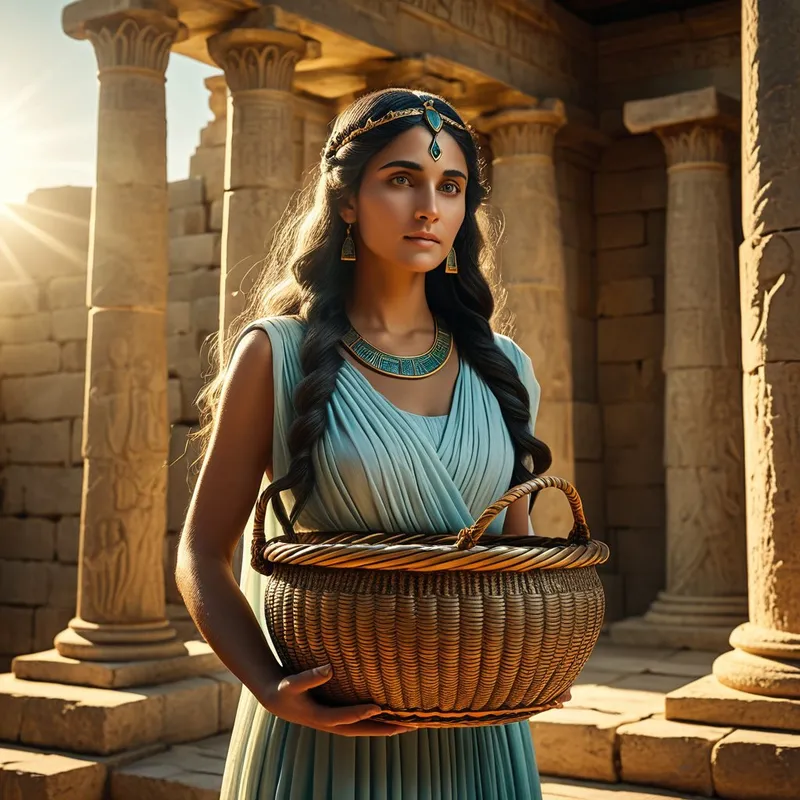
Demeter's Basket Myth Meaning & Symbolism
A sacred basket, veiled in secrecy, holds the core of the Eleusinian Mysteries, symbolizing the profound cycle of loss, descent, and miraculous return.
The Tale of Demeter's Basket
Hear now a tale not sung in the open air, but whispered in torch-lit halls beneath the earth. It begins not with a hero’s shout, but with a goddess’s silent scream.
The world was golden once, under the careless smile of Demeter. Then, the earth cracked open. From a fissure in a Nysian meadow, a chariot of obsidian and shadow erupted, and the god of the unseen realm, Plouton, seized her radiant daughter, Kore, later Persephone. He took her into the sunless depths. Demeter’s scream withered the flowers. Her grief was a scythe that laid waste to the fields. For nine days and nights, she wandered the mortal world, a veil of ash upon her hair, a drought in her footsteps.
In her despair, she came to Eleusis, disguised as an old woman. There, in the king’s household, she was given shelter and asked to nurse the infant prince, Demophoön. In the quiet of the royal hearth, a fierce, maternal magic stirred. Seeking to grant the child immortality, she anointed him with ambrosia and each night laid him in the hearth’s sacred fire to burn away his mortal coil.
But the queen, Metaneira, witnessed this and shrieked in terror, breaking the spell. In that moment of shattered trust, the goddess cast off her disguise. Light filled the hall. She declared her divinity and her eternal sorrow. Yet, for the kindness shown, she left a command and a gift: the command to build her a great temple. The gift was the secret.
From the folds of her divine peplos, she drew forth a basket. Not a basket of reeds for the market, but a sacred kiste, woven of mysteries. Its contents were veiled, known only to the initiated. She entrusted it to the princes of Eleusis, Triptolemus chief among them, with solemn rites. This basket, she implied, held the answer to the riddle of her grief—and the promise of its end. It became the heart of the Eleusinian Mysteries. In the deepest night of the ritual, within the Telesterion’s echoing hall, the hierophant would lift the lid of the sacred basket. What was revealed was never spoken. But those who saw wept not for sorrow, but for a joy beyond telling. It was the silent, visual culmination of the story: the secret of the grain that falls into the dark earth and rises again, the truth of the daughter who returns.
Cultural Origins & Context
This is not a myth for the public square, but for the sealed chamber. The story of Demeter’s Basket is the narrative core of the Eleusinian Mysteries, the most revered and secretive religious rites of the ancient Greek world, celebrated for nearly two millennia. Unlike the Homeric epics, this tale was not disseminated by bards but enacted by priests and experienced by initiates—mystai—who took a vow of silence.
The myth served as the sacred script for a profound ritual of initiation. Participants would re-enact Demeter’s search, her despair, and her final revelation. The basket, or kiste, was a central ritual object. Its unveiling was the climax of the ceremony, a moment of epopteia—beholding. The power of the myth and its ritual lay in this direct, experiential transmission. It functioned less as a doctrine to be believed and more as a mystery to be undergone, offering initiates a personal confrontation with the fundamental cycles of life, death, and what lies beyond. It provided not intellectual answers, but an emotional and spiritual catharsis that promised a better lot in the afterlife, transforming existential terror into hopeful awe.
Symbolic Architecture
The basket is a vessel, and all vessels are symbols of the feminine, the containing, the womb. Demeter’s Basket is the womb of mysteries. It holds what cannot be spoken, the ineffable core of experience.
The sacred is not explained; it is contained. The mystery is not solved; it is beheld.
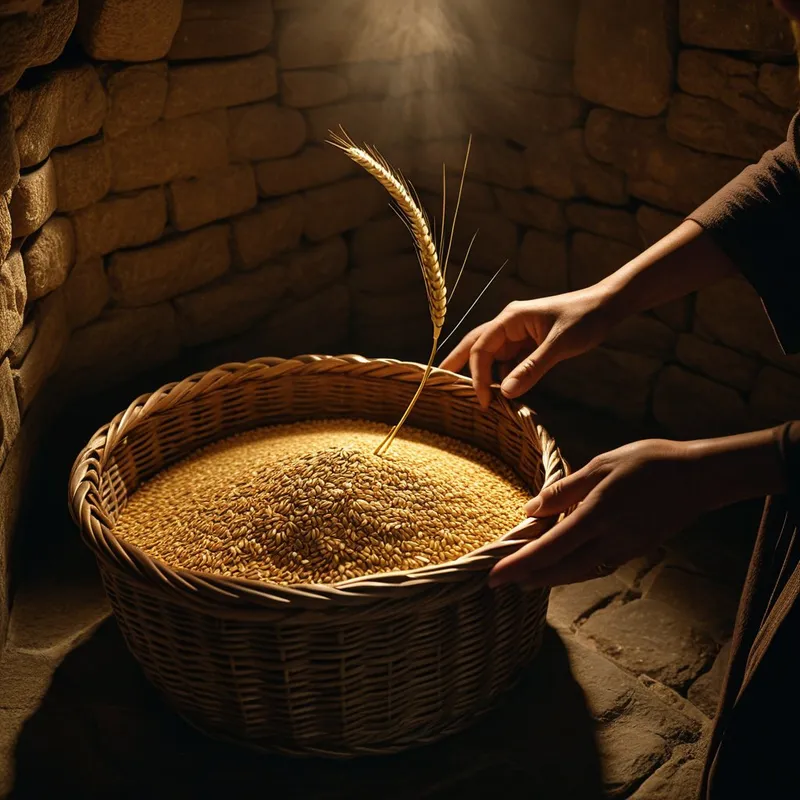
The basket’s hidden contents directly parallel Persephone’s fate—a cherished life (Kore) is sequestered in the underworld (the basket’s darkness). Yet, from that confinement comes revelation. The most common interpretation, hinted at by early Christian writers who sought to discredit the rites, is that the basket contained a phallus and a pomegranate, or more simply, a sheaf of wheat. The wheat is the key symbol: the seed that must be buried in the dark, secret earth (the basket/underworld) to be reborn. Thus, the basket symbolizes the necessary, terrifying descent. It is the dark, fertile soil where the psyche’s most vital potentials lie dormant, awaiting the conditions for growth.
Demeter herself, in this context, transcends the “grieving mother.” She becomes the Mystagogue. Her gift is not the return of her daughter—that was negotiated by Zeus—but the gift of understanding that return. She gives humanity the ritual container to process the universal trauma of loss and the hope of renewal.
The Dreamer's Resonance
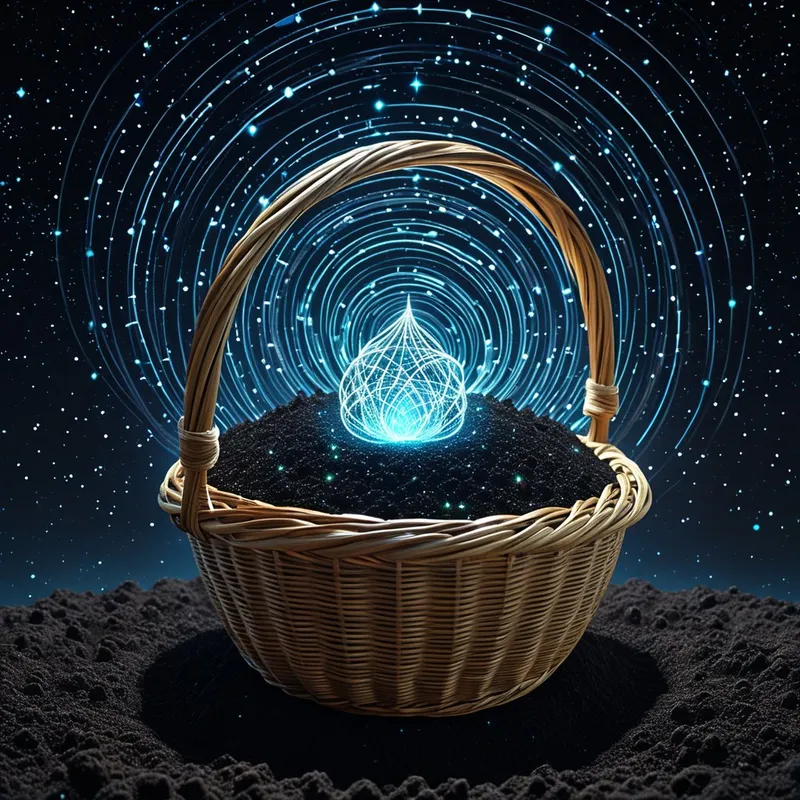
When this myth stirs in the modern unconscious, it rarely appears as a classical tableau. One does not simply dream of Demeter in a chiton. Instead, the dreamer may encounter a simple, often overlooked basket in an ordinary setting—a closet, an attic, the corner of a modern kitchen. The dream’s energy focuses on this basket: there is a powerful compulsion to look inside, coupled with a deep, somatic dread.
This dream pattern signals a psyche at the threshold of its own shadow work. The basket is the dreamer’s personal kiste, holding contents they have consciously or unconsciously “buried”—a forgotten talent, a repressed trauma, a un-lived passion, a profound grief that has been sealed away. The dread is the resistance to re-entering that sealed chamber of the self. The compulsion is the soul’s imperative toward wholeness. The somatic feeling is often one of deep, gravitational pull in the gut, a literal “gut feeling” that something essential resides in that interior darkness, waiting to be acknowledged and brought back into the light of consciousness.

Alchemical Translation
The journey of the Eleusinian initiate models the alchemical process of psychic individuation. The first stage, nigredo, is represented by Demeter’s devastating grief and the barren world—the ego’s confrontation with loss, despair, and the blackness of the unknown. The wanderer is stripped of their old identity.
The basket ritual is the heart of the albedo, the whitening. It is not an escape from the dark, but a sacred confrontation with it. The initiate must willingly descend (psychologically, into the unconscious) and behold the contents of the personal and collective shadow, contained within the symbolic basket.
Individuation requires a descent into one’s own Eleusis, a willing entry into the temple of the unconscious to behold what the soul has kept hidden.
What is “seen” in the basket—the wheat, the seed—symbolizes the lapis philosophorum, the philosopher’s stone of the psyche: the realization that within the very core of our suffering, loss, and buried darkness lies the latent potential for rebirth and meaning. The “miracle” is not that Persephone returns, but that her return is part of a eternal, sacred cycle. The alchemical rubedo, the reddening or culmination, is the integration of this knowledge. The initiate returns to daily life not naive to suffering, but transformed by the understanding that life, death, and renewal are inseparable threads in the fabric of being. They carry their own “basket”—now a symbol of sacred containment rather than fearful secrecy—holding the mystery of their own resilient, cyclical soul.
Associated Symbols
Explore related symbols from the CaleaDream lexicon: