Demeter & Persephone Myth Meaning & Symbolism
A mother's grief for her abducted daughter creates the seasons, a timeless story of separation, descent, and cyclical return.
The Tale of Demeter & Persephone
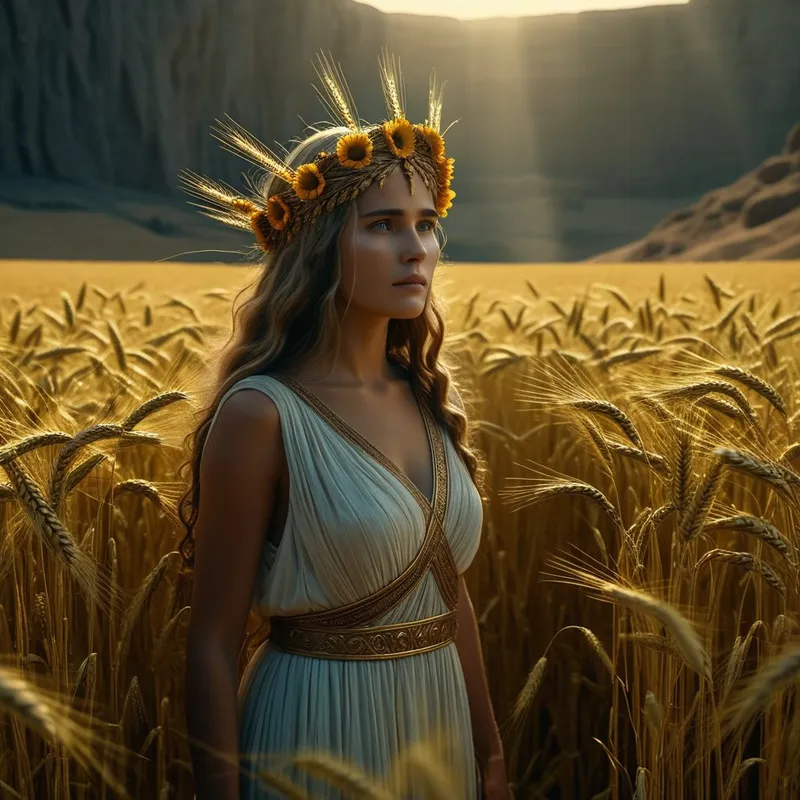
Listen, and hear a story older than the olive groves, a tale woven into the very soil. It begins in light, in the realm of Demeter, whose footsteps cause flowers to bloom and grain to swell heavy on the stalk. Her joy was her daughter, Kore, whose laughter was the sound of spring streams and whose grace made the meadows dance.
On a day painted with perfect light, Kore wandered in the vale of Nysa, gathering roses, crocuses, and violets with her companions. The air was thick with the scent of nectar. Then she saw it—a narcissus of such stunning beauty, a hundred blooms on a single stem, a trap planted by the earth itself. As she reached for its radiant stem, the ground beneath her feet roared and split asunder. From the yawning chasm, a chariot of obsidian and cold iron erupted, drawn by steeds as dark as a starless night. The hand that seized her was that of Hades, lord of the unseen realms. Her cry was swallowed by the closing earth, and the meadow fell silent, save for the echo of her torn girdle falling upon the barren grass.
A coldness entered the world then, a chill that began in the heart of Demeter. She heard the fading echo, felt the rupture in the web of life. For nine days and nine nights, the great goddess roamed the earth, a torch in each hand, her form no longer that of a bountiful mother but of a wraith of grief. She refused ambrosia, refused to bathe, consumed only by her loss. The green world began to wither in sympathy; leaves browned, stems snapped, and the soil hardened into infertile clay.
In her despair, disguised as an old woman, she came to Eleusis. There, in the palace of King Celeus, she nursed the infant prince Demophoön, anointing him with ambrosia and holding him in the hearth’s sacred fire to burn away his mortality. When the queen Metaneira discovered her and shrieked in terror, Demeter cast off her disguise. In her divine rage and sorrow, she demanded a temple be built, and there she sat, in the darkness of her shrine, and the world above died. Famine gripped the earth; mortals’ prayers rose like smoke, and the gods themselves grew weak for lack of sacrifice.
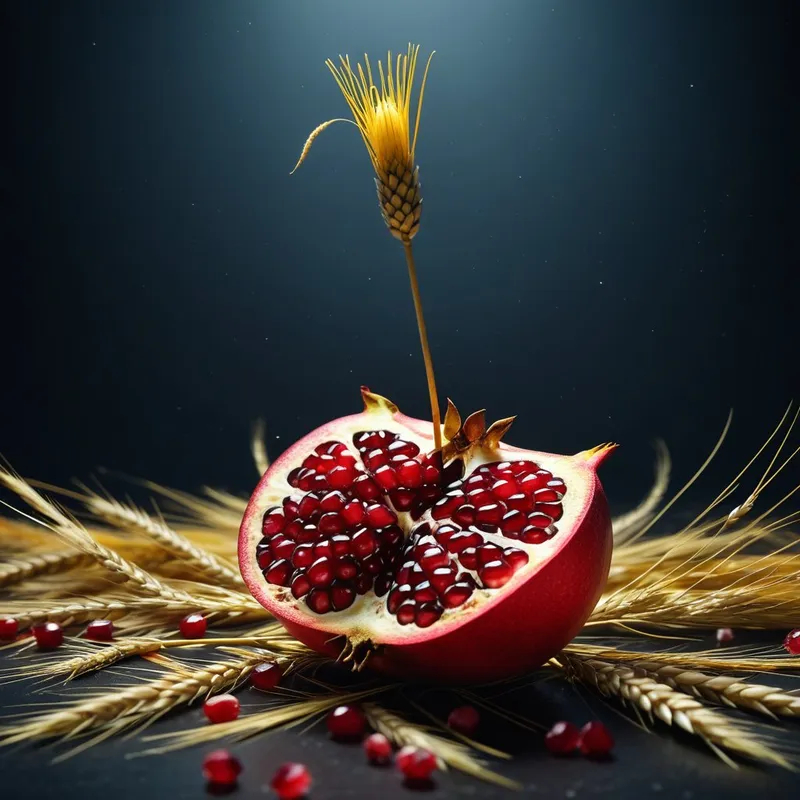
Finally, the great Zeus could bear the unraveling of his creation no longer. He commanded Hermes to descend to the sunless land and bid Hades release the maiden. Hades, cunning lord, agreed. But before she departed, he offered Persephone a pomegranate seed—a simple, ruby-red token. In her innocence, or perhaps in a dawning understanding of a new power, she ate it. That single act bound her to him, a contract written in the juice of the underworld.
So she returned, bursting into the gray world from a cleft in the earth at Eleusis. Demeter’s grief shattered into a light so fierce it thawed the very stones. She embraced her daughter, but her joy was checked when she learned of the seed. Zeus decreed a balance: for each seed consumed, a month must be spent below. Thus, for one-third of the year, Persephone reigns as dread Persephone beside her dark husband. And for the other two-thirds, she walks the earth as Kore, the flowering maiden. And the earth, the heart of Demeter, responds in kind—with the barren sleep of winter and the exuberant awakening of spring.

Cultural Origins & Context
This myth is the sacred heart of the Eleusinian Mysteries, the most famous and revered initiatory cult of the ancient Greek world. For nearly two thousand years, from the Mycenaean era to the end of paganism, initiates traveled to Eleusis to undergo a ritual that promised knowledge of the afterlife and a blessed lot in death. The Homeric Hymn to Demeter, composed around the 7th century BCE, is our primary literary source, functioning as both sacred text and liturgical script.
The myth was not merely entertainment; it was a foundational narrative that explained the natural world (the seasons) and addressed the most profound human anxieties: the fear of death, the agony of a child’s loss, and the hope for renewal. It was told and re-enacted by the entire polis, binding the community to the cycles of agriculture and offering a powerful metaphor for the soul’s journey. The goddesses were the central figures, with the male gods (Zeus, Hades) acting as catalysts or arbiters of a divine law older than themselves. This was a woman-centered story of immense public and private significance, providing a framework for understanding loss, descent, and the possibility of return.
Symbolic Architecture
At its core, this is a myth of profound separation and the creation of consciousness through rupture. Demeter and Kore represent an original, unconscious unity—the mother-daughter bond as a self-contained world of perpetual spring. The abduction is the necessary trauma that differentiates the daughter’s psyche from the mother’s, forcing an individual identity to form in the darkness of the unknown.
The pomegranate seed is the symbol of conscious choice within compulsion. It is the moment the soul, even in captivity, accepts a fragment of its new reality and is forever changed.
Persephone’s descent is not a passive victimhood but an initiation into sovereignty. In the underworld, she transitions from Kore (the Maiden) to Persephone (the Queen), integrating the realm of death, shadow, and the unconscious into her being. Her dual citizenship—of the upper and lower worlds—makes her the ultimate mediator. She becomes the archetype of the one who has seen the depths and returned, carrying the wisdom of both life and death. Demeter’s grief, meanwhile, symbolizes the creative/destructive power of the life force itself when it is wounded. Her rage is not petty; it is the ecological and psychological consequence of a deep, natural bond being severed.
The Dreamer's Resonance
When this myth stirs in modern dreams, it often signals a critical process of psychological separation and the confrontation with the "underworld" of one’s own psyche. Dreaming of a lost daughter or a grieving mother may not be literal but symbolic of a part of the self (innocence, creativity, joy) that has been suddenly taken, often by a powerful, unconscious complex (the Hades figure).
The somatic experience can feel like a sudden coldness, a fall, or being swallowed by the earth—a sense of depression or enforced introversion. Dreaming of barren landscapes mirrors a felt sense of creative or emotional infertility. Conversely, dreaming of a return, of finding a lost person in a dark place, or of eating a potent, dark fruit (like the pomegranate) can indicate the beginning of integration. The dreamer is navigating the painful but necessary journey from an old, dependent state (Kore in the meadow) to a new, more complex identity (Persephone the Queen), which requires a voluntary or involuntary descent into what has been repressed or feared.
Alchemical Translation
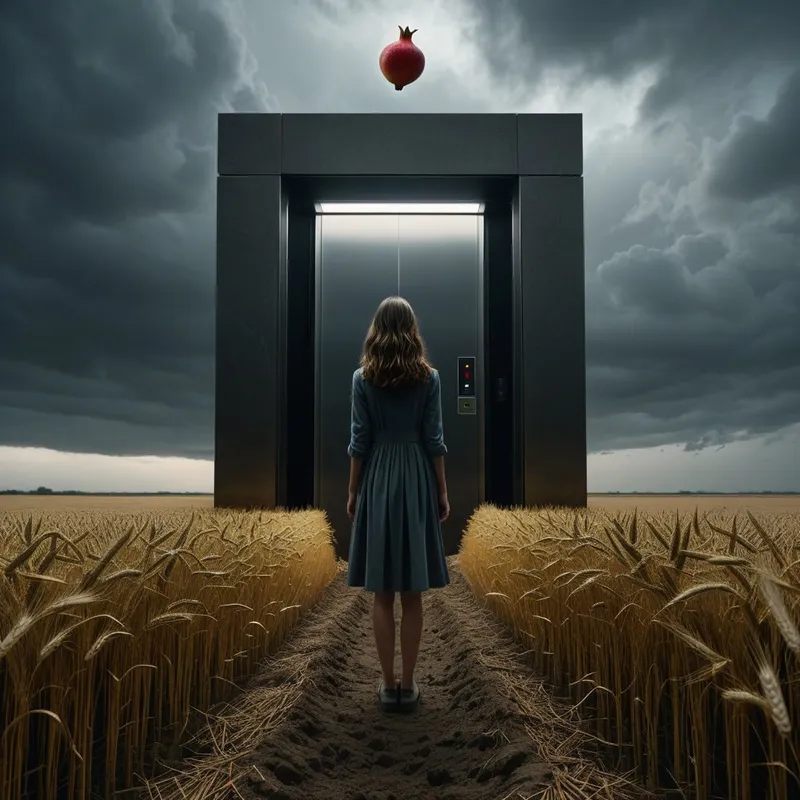
For the modern individual, the myth models the alchemical process of nigredo (blackening) and solutio (dissolution) followed by a new coagulatio (coagulation). The initial, unified state of innocence (the golden meadow) must be shattered. The ego is abducted by the unconscious (Hades), plunged into the nigredo of depression, loss, or crisis—the barren winter of the soul where all former certainties die.
The work of the myth is not to rescue Kore from the underworld, but to allow Persephone to be born from the ordeal. The goal is not a return to the previous spring, but the establishment of a conscious cycle.
Demeter’s rage and withdrawal represent the necessary, painful period of solutio, where old structures and attachments dissolve. The pivotal transformation is Persephone’s act of eating the seed. Psychologically, this is the moment we consciously internalize our experience of the "underworld"—our trauma, our shadow, our depth. We claim it. We say, "This too is part of me." This acceptance is the pomegranate seed that binds us to our own depths, ensuring we can never again be merely innocent, but must become sovereigns of our dual nature.
The final resolution is not a static happiness but the establishment of a cyclical rhythm—the individuated self. One must learn to reign in the inner darkness (winter, introspection, work with the unconscious) and also to flourish in the outer world (spring, creativity, relationship). We become, like Persephone, beings who move between realms, and like Demeter, forces who learn that love encompasses both holding and letting go, both abundance and necessary fallowness. The myth teaches that wholeness is not a state of perpetual bloom, but the sacred, seasonal rhythm of descent and return.
Associated Symbols
Explore related symbols from the CaleaDream lexicon:
- Greenhouse
- Grown
- Parent
- Pumpkin
- Portal Pizza
- Pulled Pork
- Holding On
- Slicing Cake
- Zinnia Garden
- Outdoor Picnic
- Birthday Cake
- Harvest Festival
- Marble Mortar and Pestle
- Teddy Bear
- Teddy Bear Picnic
- Compassionate Embrace
- Ceremonial Offering
- Cultural Rituals
- Seasonal Migration
- Berry Gathering
- Seasonal Foraging
- Culinary Ritual
- Harvest Celebration
- Pollen Dust for Sacrifice
- Cooking Grain Over Fire
- Shared Feast
- Seed Exchange
- Ritual Offerings
- Mother Complex
- Phase
- Growth
- Fertility
- Granulation