Demeter Myth Meaning & Symbolism
A mother's profound grief for her abducted daughter plunges the world into barren winter, teaching humanity the sacred cycle of loss and renewal.
The Tale of Demeter
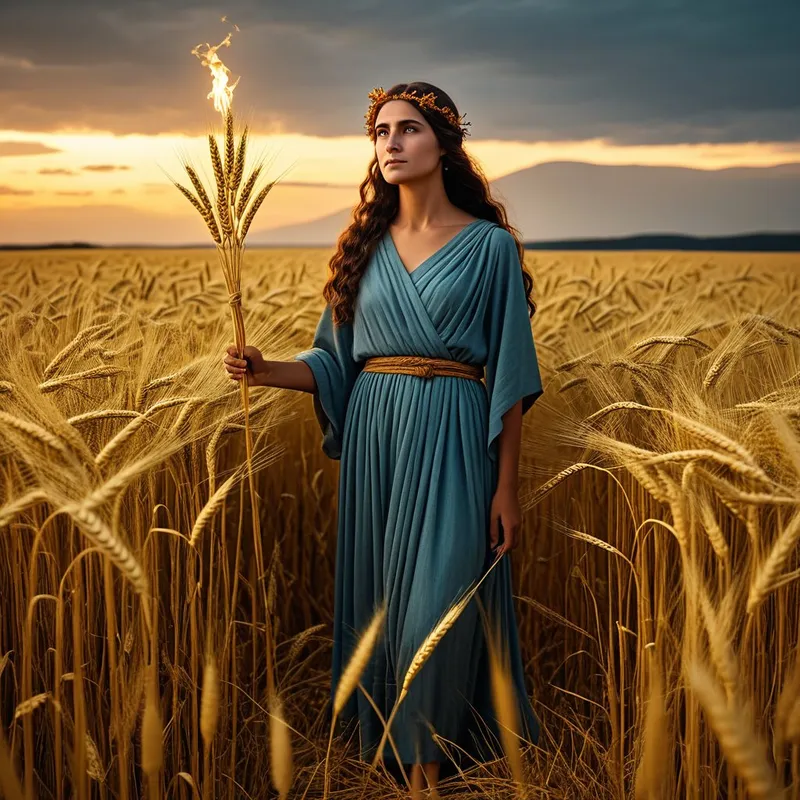
Listen. Before time was counted in years, when the world was young and gods walked openly in the light, there was a goddess whose joy was the joy of the earth itself. Her name was Demeter. Where she stepped, flowers burst from the soil. Where her hand passed, wheat grew tall and heavy. Her laughter was the rustle of orchards, and her love was poured into her radiant daughter, Kore, later called Persephone.
One day, as Kore gathered narcissus blooms in a sun-drenched meadow of Nysa, the earth groaned and split. From the yawning chasm, a chariot of blackest iron drawn by immortal steeds erupted. Its driver was Hades, lord of the unseen realms. His hand, cold as shadow, closed around Kore’s wrist. Her cry was swallowed by the closing earth. The meadow fell silent, save for the echo of her dropped flowers.
A chill entered Demeter’s heart before she knew the cause. She felt the absence in the hum of the bees, in the stillness of the wind. For nine days and nine nights, the great goddess roamed the earth, a torch in each hand, her divine form cloaked in mortal grief. She ate no ambrosia, drank no nectar. She asked the sun, Helios, who told her of the dark pact: Zeus had given their daughter to the underworld king.
Blinded by rage and sorrow, Demeter abandoned Olympus. In the guise of an old woman, she came to Eleusis. There, she sat by the Maidens' Well on the Mirthless Stone, a statue of despair. The family of King Celeus took her in, and she nursed their infant son, Demophoön, anointing him with ambrosia by night to make him immortal, until a terrified mother interrupted the sacred fire. Revealing her divinity in a blaze of terrible light, Demeter commanded a temple be built for her at Eleusis. And there she remained.
Her grief was a blight upon the world. Seeds shriveled in the soil. Vines turned to dust. Cattle lowed in empty fields. A great winter fell upon the earth, not of snow, but of barren, silent stone. Humanity faced extinction. The gods received no smoke from sacrificial fires.
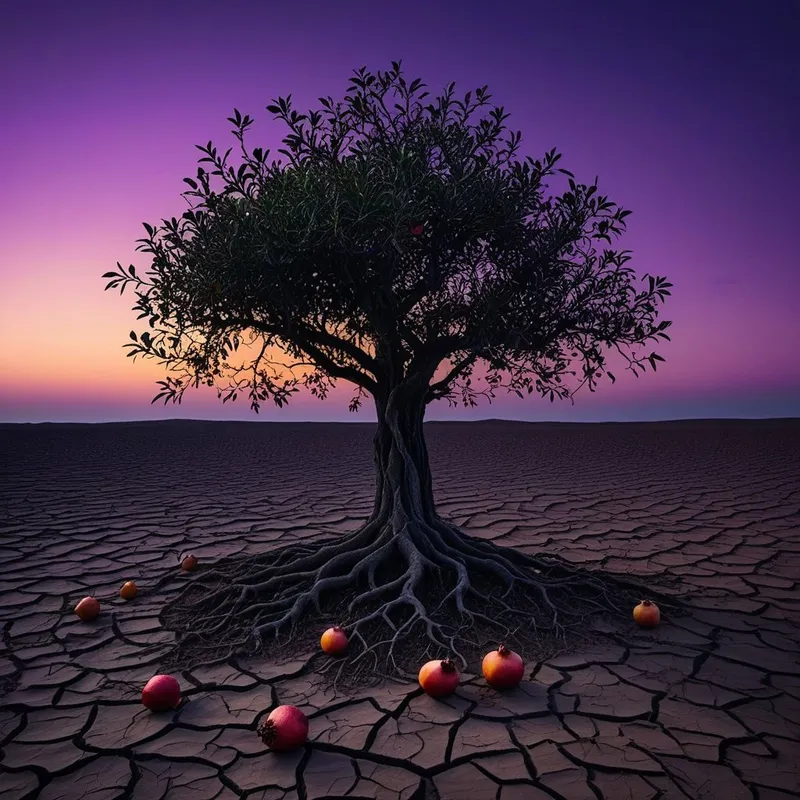
Finally, Zeus sent messenger after messenger. Demeter’s answer was a wall of silence, the unyielding freeze of the soil. She would not relent until she saw her daughter’s face. Zeus commanded Hades to release Persephone. But in the underworld, the girl had eaten. Not a full meal, but a fateful handful of seeds—four, or six—from a pomegranate offered by Hades. This simple act bound her to the realm of the dead.
A compromise was struck in the cold halls of necessity. For each seed eaten, Persephone would spend a month of the year in the underworld as its queen. The rest, she would walk in the sun with her mother. When Hermes led Persephone from the darkness, Demeter, watching from a hill, felt the ice in her heart crack. She ran, and the earth trembled with her footsteps. Where mother and daughter embraced, flowers erupted through the frozen ground. Life rushed back in a green-gold wave.
But the pact stood. For a third of the year, Persephone descends, and Demeter’s grief brings autumn and winter. Her return brings the explosion of spring. The first law was given: life must pass through death. The great cycle was born from a mother’s love and a daughter’s fate.

Cultural Origins & Context
This is the Homeric Hymn to Demeter, a foundational text of the ancient Greek world, composed around the 7th century BCE. It was not merely a story but the sacred narrative at the heart of the Eleusinian Mysteries, the most famous and revered initiatory cult of the ancient Mediterranean for nearly two thousand years.
The myth was performed, chanted, and enacted within the secret confines of the Telesterion at Eleusis. Initiates—from enslaved persons to emperors like Marcus Aurelius—underwent a profound ritual journey (dromena), saw sacred things (deiknymena), and were told secret words (legomena). The function was societal and deeply personal: to conquer the fear of death by revealing that life, like the grain, continues in another form. The myth provided an etiological explanation for the seasons, yes, but more importantly, it modeled a path through catastrophic loss to a hard-won, cyclical renewal. It was a map for the soul, passed down not as folklore but as direct, transformative experience.
Symbolic Architecture
At its core, the myth of Demeter is an archetypal drama of the psyche’s confrontation with irreparable loss and the necessary descent into darkness that precedes any authentic renewal.
The grain must fall into the dark earth and die to become the sheaf. The self must be shattered to be remade.
Demeter represents the life-giving, nurturing principle of the Magna Mater, but also its shadow: the possessiveness that cannot let go, the creativity that, when wounded, turns to absolute negation. Her grief is not passive; it is a world-ending power. Persephone is the youthful, unconscious vitality (Kore, "the maiden") that is compelled by life itself to experience the depths, to be initiated into the realm of Hades. Her abduction is not a crime in a modern sense, but a symbolic necessity—the inevitable call of the deeper self.
The pomegranate seeds are the ultimate symbol of the point of no return. They represent the conscious acceptance of a fate, the internalization of an experience so profound it changes one’s fundamental identity. One cannot "un-eat" the seeds of deep knowledge or trauma.
The compromise is the revelation: wholeness is not a state of permanent light, but the rhythmic acceptance of both the upper and lower worlds.

The Dreamer's Resonance
When this myth stirs in the modern dreamer, it often manifests as dreams of profound loss, barren landscapes, or searching for a lost child or vital part of oneself in labyrinthine, underground spaces. One might dream of a garden that suddenly withers, a mother figure who is desolate and powerful, or of finding a strangely compelling fruit that one feels compelled to eat, despite a sense of foreboding.
Somatically, this can correlate with feelings of emptiness, a "winter" in the soul, digestive issues (the "un-metabolized" experience), or a deep, grieving fatigue. Psychologically, the dreamer is likely undergoing what analyst Carl Jung called a numinous encounter with the archetypal Mother and the necessity of separation from her. It is the process of the psyche forcing a necessary "abduction"—a depression, a life crisis, a major transition—to initiate the conscious ego into a broader, more complex relationship with life and death. The dream is the psyche’s way of enacting the Eleusinian ritual: you are being taken to the underworld to learn that what is lost is not gone, but transformed.
Alchemical Translation
For the individual, the Demeter-Persephone cycle is the alchemical map of individuation through the crucible of loss. The initial state is the innocent, vegetative identification with the nurturing matrix (Demeter and Kore in the meadow). The abduction is the nigredo, the blackening—the devastating event, depression, or betrayal that shatters this unity.
Demeter’s rage and grief represent the necessary, fiery protest of the ego (the rubedo, the reddening). This is not a stage to bypass. One must fully inhabit the "Mirthless Stone," the frozen despair that says, "The world as I knew it is dead." This is the incubation in the temple of solitude.
The alchemical vessel is the self in its state of suspended animation, where the old meaning has died but the new has not yet been born.
Persephone’s eating of the pomegranate seeds is the critical moment of mortificatio and separatio—the death of the old maiden identity and the separation from the mother-world. It is the soul’s clandestine agreement with its own depth. The compromise brokered by Zeus is the coniunctio oppositorum—the union of opposites. The conscious self (the upper world) must now make room for, and regularly commune with, the queen of the underworld (the unconscious, the shadow, the complex).
The return is not to the original meadow, but to a conscious partnership. The modern individual who integrates this myth no longer fears the "winters" of the soul. They understand these periods of barrenness and descent as part of the sacred, fruitful cycle. They become, like the initiated at Eleusis, one who has seen the core mystery: that personal grief, fully lived, connects us to the universal rhythm of death and rebirth, and in that connection lies the only true solace and the seed of resilient, cyclical joy.
Associated Symbols
Explore related symbols from the CaleaDream lexicon:
- Grandmother
- Farm
- Result
- Scenery
- Refrigerator
- Handful
- Salad
- Care
- Mum
- Bread
- Pig
- Bakery
- Cookie
- Farmer
- Spoon
- Bun
- Toast
- Pantry
- Ripe Berries
- Fertile Valley
- Abundant Harvest
- Watering Can
- Salt Shaker
- Spatula
- Gardening Tools
- Giant Bowl of Soup
- Beautifully Baked Pie
- Ripe Avocado
- Rustic Bread
- Roasted Nuts
- Candied Ginger
- Baked Potato
- Corn on the Cob
- Fruit Tart
- Crispy Chips
- Grilled Vegetables
- Bountiful Harvest
- Packed Lunchbox
- Dining Table Overflow
- Maternity Dress
- Planting Seeds
- Scattering Seeds
- Absent Parent
- Severe Drought
- Drought
- Amber Waves
- Stroller
- Goldenrod Glow
- Geranium Bloom
- Harvest Moonlight on Trees
- Fruitful Orchard
- Harvest Pumpkin
- Crystalized Succulent
- Nurtured Amaryllis
- Sea Otter
- Resourceful Chef
- Patient Gardener
- Gardener's Trowel
- Horticulturist's Seed Packets
- Baker's Rolling Pin
- Farmer's Tractor
- Gardening Gloves
- Tamagotchi
- Baking Cookies
- Pumpkin Pie
- Harvest Basket
- Baked Ham
- Eco-Friendly Spade
- Garden Rake
- Gardening Hoe
- Spice Jar Collection
- Engraved Wooden Spoon
- Electric Slow Cooker
- Cutting Board
- Muffin Tin
- Pasta Server
- Spice Rack
- Herb Planter
- Crockpot
- Pie Dish
- Gravy Boat
- Bread Knife
- Gingham Sunhat
- Hitchhiked Pickup
- Miniature Garden Set
- Quaint Windmill
- Aromatic Herb Garden
- Sunkissed Field
- Waving Wheat
- Layered Cake
- Waves of Grain
- Foraging Basket
- Millet Harvest
- Chickweed Patch
- Wheat Sheaf
- Beech Nut
- Heathland Berries
- Salt Lick
- Raspberry Canes
- Pulses
- Tuber Harvest
- Willow Basket
- Cereal Grain
- Millet Pancakes
- Nitrogen-Fixing Legumes
- Cherished Spelt
- Tilled Earth
- Sunset Cultivation
- Threshed Wheat
- Flour Dust
- Maize Sun
- Ripe Quinoa
- Emmer Grain
- Kamut Grain
- Canopy of Nuts
- Savannah Grass
- Trampled Grass
- Gathered Nuts
- Harvest Moon Glow
- Cattail Pollen
- Plenty of Bait
- Ocean’s Bounty
- Aquatic Harvest
- Ripe Sedge
- Woven Baskets
- Cured Meat
- Milled Grain
- Wheat Sheaves
- Cattail Roots
- Primitive Trowel
- Nut Gathering
- Sun-Dried Tomatoes
- Ramp Antlers
- Seasonal Crops
- Clam Digging
- Grain Storage Pit
- Salt Ceremonial Dish
- Venison Jerky
- Ground Acorns
- Forage Basket
- Soil Fertility
- Sun-Dried Herbs
- Compost Heap
- Stone Metate
- Nut Harvest
- Root Vegetable Storage
- Reed Basketry
- Fertile Ground
- Farming Field
- Corn Maiden
- Coarse Grain
- Buttery Softness
- Caregiver
- Humidity
- Protein
- Dividend
- Investment
- Supply
- Harvest
- Abundant
- Lanina
- Grief
- Sadness
- Grain
- Robust