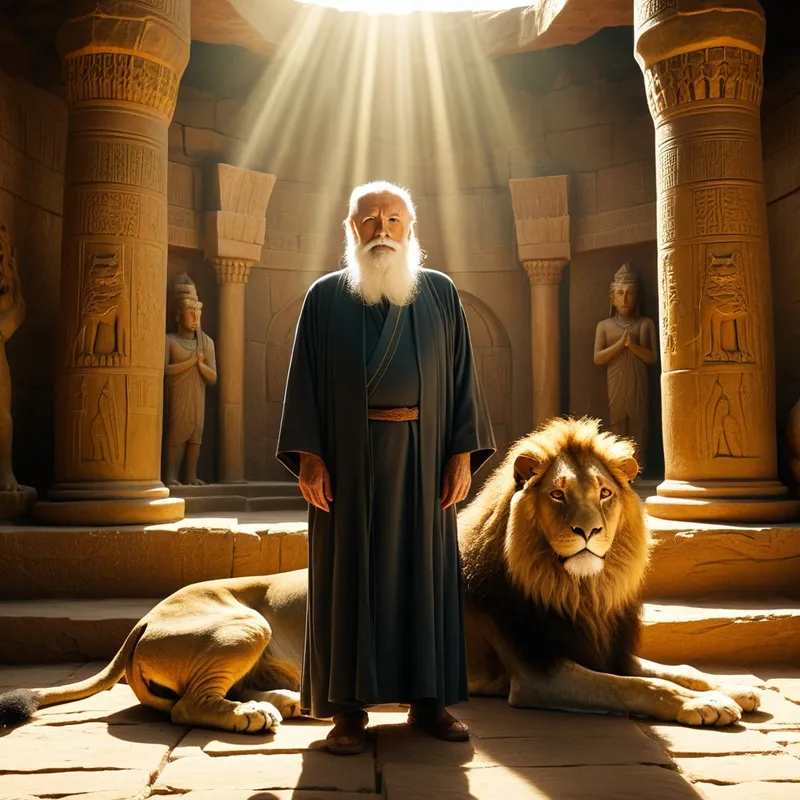
Daniel Myth Meaning & Symbolism
A Hebrew exile maintains his faith and interprets divine dreams for foreign kings, surviving a den of lions through unwavering conviction.
The Tale of Daniel
Listen, and hear the tale of a soul cast into the furnace of empire.
The world had been shattered. The holy city of Jerusalem lay broken, its temple plundered, its people scattered like dust on the wind. Among the captives dragged across the desert to the glittering, oppressive heart of Babylon were four youths of noble blood: Daniel, Hananiah, Mishael, and Azariah. In the palace of King Nebuchadnezzar, they were given new names, fed rich food and wine, and instructed in the language and lore of the Chaldeans, a deliberate erasure of their identity.
But Daniel set his heart. He would not defile himself. In the shadowed storerooms, he and his friends ate only vegetables and water, and to the astonishment of the eunuchs, their faces grew fairer, their wisdom sharper. To Daniel, the God of his fathers gave knowledge, skill in all learning, and—most precious of all—the understanding of visions and dreams.
This gift would become his fate. The king was tormented by a dream, a colossal statue of dazzling metals crushed by a stone not cut by human hands. The wise men of Babylon wailed in fear; they could not recount, let alone interpret, a dream the king refused to describe. A decree of death hung over all. Daniel entered the king’s presence, not with spells, but with prayer. That night, the mystery was revealed to him in a vision. He stood before the throne and spoke not of his own wisdom, but of the God in heaven who reveals mysteries. He described the dream in terrifying detail: the head of gold, the chest of silver, the belly of bronze, the legs of iron, the feet of mingled iron and clay. And he revealed its meaning: the succession and ultimate shattering of earthly kingdoms by an everlasting divine kingdom. The king fell on his face, declaring Daniel’s God the God of gods.
Years passed. A new king, Belshazzar, feasted arrogantly, drinking from the sacred vessels stolen from Jerusalem. A disembodied hand appeared, writing cryptic words on the plaster wall: MENE, MENE, TEKEL, PARSIN. Terror seized the hall. Daniel, now an old man, was summoned. His interpretation was a judgment: God had numbered the days of the kingdom, weighed it and found it wanting, and would divide it. That very night, Belshazzar was slain.
Under the next empire, the Medes and Persians, Daniel’s integrity became a trap. His excellence provoked the envy of other satraps. They could find no fault in his conduct, so they attacked his faith. They tricked King Darius into signing an irrevocable law: for thirty days, all prayers must be to the king alone. Daniel heard the decree. He went to his upper chamber, its windows open toward Jerusalem, and three times a day he knelt and prayed to his God, as he had always done. The conspirators found him, and the king, bound by his own law, was forced to cast his most trusted servant into a den of lions. “May your God, whom you serve continually, deliver you,” the anguished king said. A stone was sealed over the mouth of the pit.
Darius passed a sleepless night. At dawn, he rushed to the den, his voice trembling. “O Daniel, servant of the living God, has your God been able to deliver you from the lions?” And from the darkness came a voice, clear and unharmed: “O king, live forever. My God sent his angel and shut the lions’ mouths.” Daniel was lifted out, without a scratch. And those who had accused him met the fate they had designed for him. The king then issued a decree that in all his dominion, men should tremble and fear before the God of Daniel.
Cultural Origins & Context
The Book of Daniel is a complex text, a product of the Jewish experience of exile and persecution. While set during the Babylonian Exile (6th century BCE), most scholars agree its final form was crafted during the brutal oppression of the Seleucid king Antiochus IV Epiphanes (167-164 BCE), who outlawed Jewish practice and desecrated the Temple. It is apocalyptic literature, a genre born in times of profound crisis.
The stories of Daniel in the court (chapters 1-6) functioned as court tales, a popular genre across the ancient Near East. They provided a model for a dispersed people: how to maintain religious and ethnic identity while serving a foreign, often hostile, power. Daniel embodies the ideal of the faithful Jew in the diaspora—uncompromising in core identity, yet excelling in wisdom and service. The visions (chapters 7-12) offered coded hope to a persecuted community, assuring them that the terrifying empires of the world were numbered and weighed, and that divine justice, though hidden, would ultimately prevail. It was a myth for survival, telling a people under threat that their faithfulness in the lion’s den of history was seen and would be vindicated.
Symbolic Architecture
At its heart, the myth of Daniel is a profound drama of consciousness maintaining itself against the overwhelming pressures of the unconscious, represented by the imperial state and the primal beasts.
Daniel himself is the archetype of the conscious ego grounded in a transcendent principle. His refusal of the king’s food is not mere dietary law, but a refusal to be assimilated by the collective psyche of Babylon. He retains a connection to his origin (Jerusalem), his true nourishment. His great gift is interpretation—the ability to translate the chaotic, terrifying symbols of the unconscious (the king’s dreams, the writing on the wall) into coherent meaning.
To interpret a dream is to make the unknown known; it is the foundational act of consciousness bringing light to the depths.
The statue of metals symbolizes the totality of worldly power and history—impressive, rigid, but ultimately brittle, destined to be replaced by something not of human construction. The lion’s den is the ultimate symbol of the raw, devouring instinctual psyche. Daniel’s survival does not come from fighting the lions, but from a grace that “shuts their mouths.” This represents the integration of instinctual power, not through domination, but through a state of psychic integrity so complete that the destructive aspects of the unconscious are neutralized.

The Dreamer's Resonance
When the pattern of Daniel emerges in modern dreams, it signals a profound crisis of integrity within the psyche. The dreamer may find themselves in a vast, bureaucratic “Babylon”—a corporate office, a labyrinthine institution—where they are forced to comply with values that feel alien and corrupting. They may be offered a “king’s rich food”—a promotion, a compromise, a seductive but soul-numbing reward—and feel a deep, somatic resistance.
Dreams of being thrown to lions, or of lions circling just outside a safe but fragile space, point to the activation of immense instinctual fear. The psyche is sensing a threat to its core identity. Alternatively, one might dream of being tasked with interpreting an impossible, glowing text or a colossal, crumbling statue. This is the ego being called to a terrifying but necessary act: to confront and make sense of the overwhelming, archetypal material rising from the unconscious. The somatic feeling is often one of awe, dread, and a heavy responsibility. The Daniel process in dreams is the soul’s insistence on maintaining its covenant with itself, even as the collective demands conformity.
Alchemical Translation
The alchemical journey of Daniel is a masterclass in individuation. It begins with the separatio: the conscious choice to separate from the undifferentiated collective (Babylonian culture). This is the nigredo, the darkening, as the individual enters the exile of standing apart.
The central operation is interpretatio. The king’s dreams and the wall writing are the prima materia—the confusing, prima materia of the unconscious. Daniel’s prayerful contemplation represents the albedo, the washing and whitening, where the ego does not invent meaning but becomes a vessel for a meaning that emerges from a dialogue with the transcendent function (his God). By translating the symbolic language of the Self, he performs a sacred mediation between the divine and the human, the unconscious and consciousness.
The den is the vas, the sealed vessel of transformation. Here, in utter darkness and facing annihilation, the final test occurs.
The lion’s den represents the ultimate coniunctio, not a gentle union but a terrifying confrontation with the shadow in its most potent, instinctual form. Survival here is not an ego victory; it is the evidence that the ego, by being faithful to its connection with the Self, has been transformed. The lions are not slain; their power is integrated. This is the rubedo, the reddening, the achievement of the philosopher’s stone: an indestructible psychological integrity. The individual emerges not just unscathed, but radiant with an authority that comes from having been sealed in the pit and preserved by a grace greater than themselves. They become the sage who has seen the statue of worldly identity crumble, and who now carries the unshakable stone of the true Self within.
Associated Symbols
Explore related symbols from the CaleaDream lexicon: