Danaë Myth Meaning & Symbolism
A king imprisons his daughter to thwart a prophecy, but a divine golden rain finds her, conceiving the hero Perseus.
The Tale of Danaë
Hear now the tale spun on the loom of fate, a story of stone, gold, and sea. In the ancient city of Argos, a shadow fell upon the house of King Acrisius. An oracle’s voice, cold as a tomb, slithered into his heart: You will die by the hand of your daughter’s son. Terror, that old tyrant, seized the king. His daughter, Danaë, was the vessel of this doom.
To outwit the Fates, Acrisius built not a tower of stone, but a prison of bronze. Deep within his palace courtyard, he fashioned a chamber with walls of impenetrable metal, its roof open only to a narrow slit of sky. There he placed Danaë, with her attendant maidens. No suitor’s footstep, no mortal man’s gaze, could ever breach that tomb. She was to be buried alive, her womanhood entombed, her destiny sealed away from the light. The air in the chamber was still and heavy, smelling of metal and damp earth. Danaë’s world shrank to that patch of sky, watching the slow parade of clouds by day, the cold glitter of stars by night. Her father believed he had caged prophecy itself.
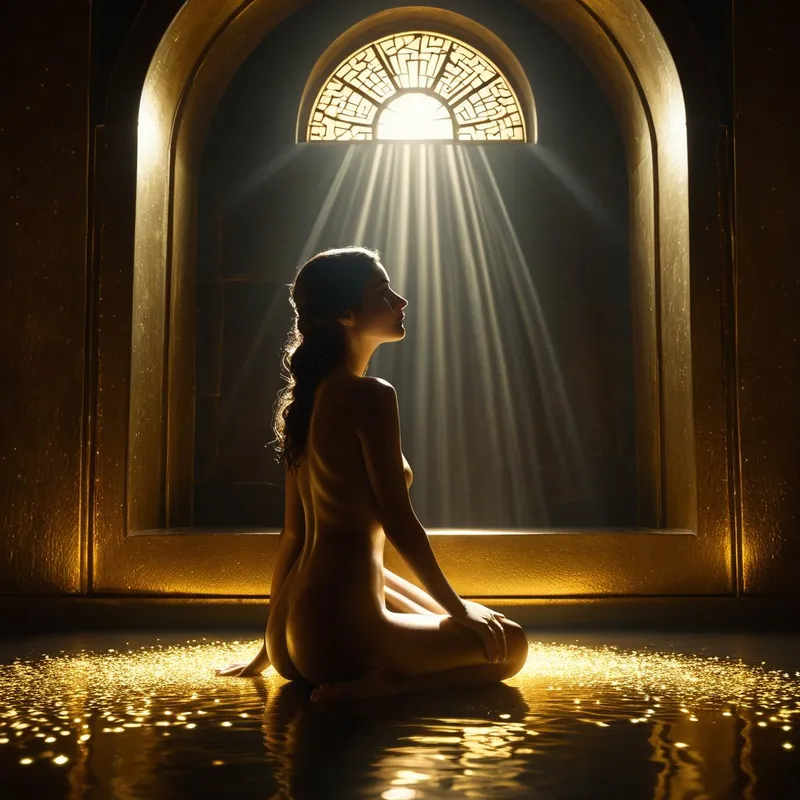
But what is bronze to a god? Zeus, the cloud-gatherer, whose eye misses nothing, saw the radiant maiden in her metallic gloom. Desire, for the gods, is a form of action. He would not shatter the walls; he would transform them. Descending from Olympus, he became a shower of gold—not coin, but liquid, radiant light. It poured through the high window of the bronze chamber, a warm, dazzling rain that filled the dark space with a divine effulgence. It fell upon Danaë’s lap, her skin, her hair, a baptism of celestial metal. In that luminous visitation, the impossible union was made: the immortal with the imprisoned.
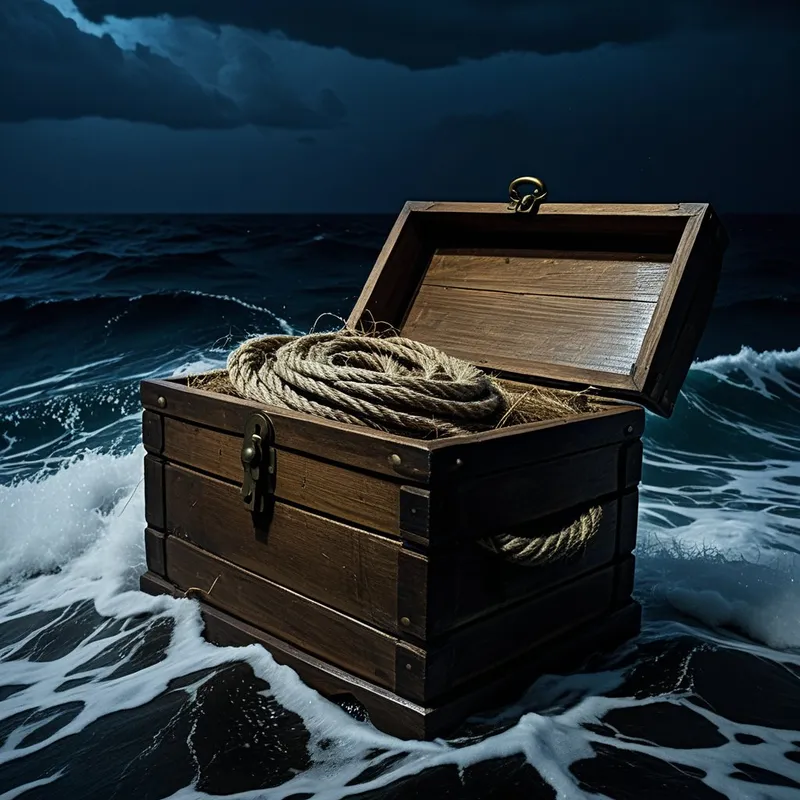
In time, a child was born within the bronze walls: Perseus. His infant cry was the sound of prophecy breaking free. When Acrisius discovered the boy, his fury was a storm. Refusing to directly spill kin-blood and incur the Furies’ wrath, he sealed mother and son in a great wooden chest and cast them into the wine-dark sea. The bronze tomb was exchanged for a wooden one, the static prison for a chaotic, heaving grave. For days and nights, Danaë held her son close as the chest rode the abyss, her lullabies a spell against the roaring deep. Yet the child of Zeus was guarded. The chest washed ashore on the island of Seriphos, found by the fisherman Dictys, a kind man who offered them sanctuary. The prison of the deep had delivered them to a new beginning, setting the stage for the hero’s journey yet to come.
Cultural Origins & Context
The myth of Danaë is woven deeply into the foundational tapestry of Greek heroic lineage. As a daughter of Acrisius, who was son of Abas, who was son of Hellen, Danaë’s story is not a peripheral folktale but a crucial link in the genealogical chain that connects the age of mythic founders to the era of canonical heroes like her son Perseus. It was a myth told to explain origins—of great dynasties, of inescapable fate, and of the precarious nature of royal power.
The primary sources are the poets. Hesiod mentions it, and the Athenian tragedians, particularly Euripides in his lost play Danaë, explored its emotional and ethical dimensions. The myth functioned as a societal narrative about the limits of control, especially patriarchal control. A king, the ultimate earthly authority, attempts to use his power to subvert divine will, only to see that will fulfilled through a channel he could never anticipate or block. It served as a cautionary tale about hubris and the futility of trying to imprison life and destiny, while also reinforcing the belief in the absolute, if inscrutable, power of the gods. The image of the golden shower became one of the most recognizable and artistically rendered scenes in all of Greek vase painting and later Renaissance art, a testament to its enduring symbolic potency.
Symbolic Architecture
At its core, Danaë’s myth is an alchemical parable of impregnation and transformation within a state of profound containment. The bronze chamber is not merely a physical prison; it is the ultimate symbol of isolation, overprotection, and the stifling of potential. It represents the psyche—or a life situation—that has been sealed off from the outer world, often by external authority (the father/king) or internalized fear, for the stated purpose of safety, but with the true result of stagnation.
The most profound transformations often begin not in freedom, but in the deepest confinement, where the only opening is to the heavens.
The golden rain of Zeus is the symbolic antidote. Gold, the metal of the sun, of kings, and of the incorruptible, represents the highest value, the divine spark, the illuminating insight. It is not a violent invasion but a permeating, transformative visitation. It signifies the moment of inspiration, grace, or profound psychological insight that enters a sealed-off life from a transcendent source—what Carl Jung might call a numinous experience from the Self. This divine conception is the birth of something new and heroic (Perseus) within the condition of imprisonment. The hero is conceived not after escape, but within the prison itself, suggesting that the seed of our liberation is often planted in the very soil of our confinement.
The final act—the chest upon the sea—completes the symbolism. The womb-like chest replaces the rigid bronze chamber, and the chaotic, unconscious realm of the sea replaces the static courtyard. This is the necessary expulsion into the unknown, the journey through the psychic unconscious (the sea) that follows the moment of conception. It is a perilous, passive phase where the newly born potential is at the mercy of larger forces, yet is ultimately guided to a shore where it can grow and act.
The Dreamer's Resonance
When the pattern of Danaë manifests in modern dreams, it speaks to a profound experience of creative or psychological incubation under duress. The dreamer may find themselves in a featureless room, a vault, a basement, or any enclosed space from which there is no apparent exit. The feeling is one of safe stagnation—it’s not a dungeon of terror, but a sterile, limiting container. This mirrors life situations: a job that pays but deadens the soul, a relationship that is secure but lifeless, a period of illness or depression that confines the body and spirit.
The golden element may appear not as rain, but as dust collecting in a sunbeam, a gilded key, a piece of jewelry that glows with inner light, or simply an overwhelming feeling of warm, golden peace flooding the space. This is the somatic signature of the numinous entering the sealed system. It is the dream-psyche announcing an impregnation—not necessarily literal, but the conception of a new idea, a new direction, a new depth of self-understanding that has occurred while the dreamer felt trapped. The dream is not about the escape yet; it is about the miraculous fact of fertilization within the prison. It confirms that even in our most confined states, the unconscious is at work, preparing the heroics of future transformation.

Alchemical Translation
The alchemical journey modeled by Danaë is the nigredo and albedo of the soul. The bronze chamber is the nigredo: the blackening, the experience of being sealed in the dark matter of one’s own isolation or life circumstance. It is a necessary, if painful, condensation where all outer distractions are removed, forcing a confrontation with the bare essence of the self.
The golden rain is the dazzling albedo, the whitening, but achieved through a golden, solar medium. It is the illumination that arises from within the darkness, not as an escape from it. This is the critical psychic transmutation:
The goal is not to break down the walls of your confinement from the outside, but to allow them to become the crucible in which you are visited by, and give birth to, your own golden, destined self.
For the modern individual, the myth instructs that periods of enforced stillness, limitation, or "stuckness" are not wasted time. They are the bronze chamber where the old, controlling structures of the ego (the fearful King Acrisius) attempt to freeze life. The work is to remain open, like Danaë, to the narrow window of the transcendent—to be receptive to the insights, inspirations, and inner knowings that come as a subtle, permeating grace. The child Perseus, conceived here, is the nascent, heroic consciousness that will eventually venture out to face the Gorgons and sea monsters of the outer world. But first, he must be conceived and nurtured in the dark. The myth teaches that our deepest destiny is often born not in the field of action, but in the silent, receptive, and miraculously fertile heart of our imprisonment.
Associated Symbols
Explore related symbols from the CaleaDream lexicon: