Damballa Myth Meaning & Symbolism
The myth of Damballa, the cosmic serpent whose movement formed the world, embodying creation, divine order, and the cyclical flow of primal energy.
The Tale of Damballa
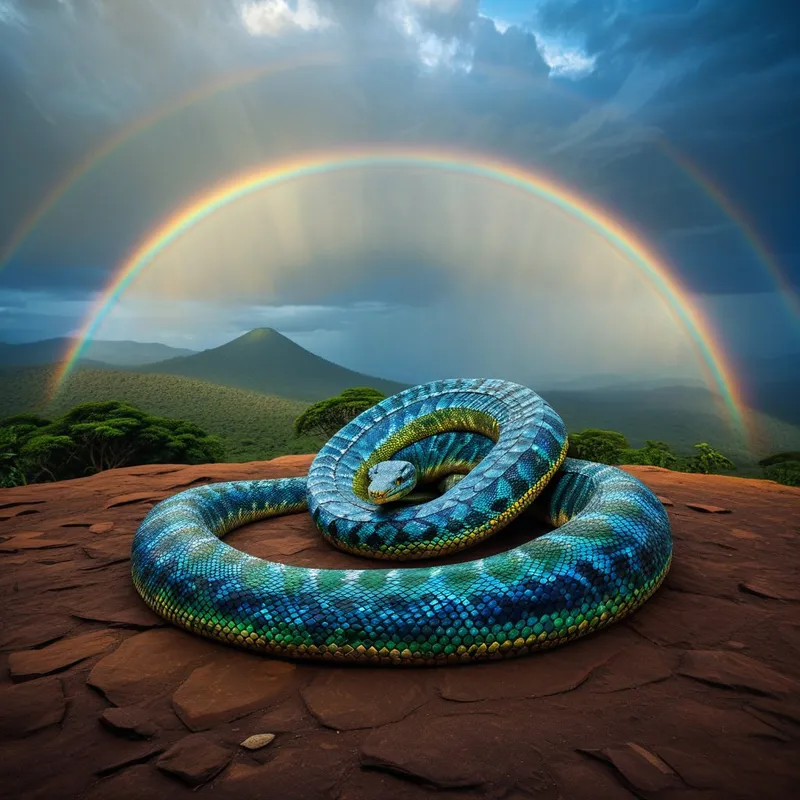
In the time before time, there was only Mawu, the great silence, and Gbonuga, the boundless deep. It was a world of pure potential, a dark, watery womb without shape or song. Then, a stirring. A presence uncoiled from the heart of the silence. This was Damballa, the Great Serpent, whose body was the arc of the sky and whose scales held the promise of all colors.
He moved. Not through water or air, for these did not yet exist, but through the very fabric of possibility. His immense, sinuous form began to push against the formless dark. Where his head pressed, mountains of clay and stone heaved themselves upwards, groaning as they broke the surface of the endless waters. The path of his body carved the first riverbeds, and from his breath, the first mists rose to become clouds.
His journey was a slow, deliberate act of love. He did not conquer the void; he courted it. He wrapped his coils around the rising earth, not to constrict, but to define, to give the world a spine. As he arched his back against the darkness, the first vault of the sky was formed. His scales, brushing against the newborn firmament, shed a luminous dust that became the stars. His most profound gift was water. From his essence flowed the first springs, the sacred rivers that would become the veins of the world, carrying life and memory.
His work done, Damballa did not depart. He ascended, but he remained. His body became the arc of the rainbow, a bridge between the world he shaped and the infinite Mawu-Lisa beyond. He coiled himself around the axis of the world, an eternal, watchful presence. The first rain that fell did so along the path he had charted. The first plants grew in the soil he had raised. And in the deep, cool pools fed by his springs, the reflections of the first humans would one day appear, seeing in the shimmering water the undulating memory of the serpent who made room for them to be.
Cultural Origins & Context
The narrative of Damballa finds its roots in the spiritual traditions of the Fon and Ewe peoples of West Africa, particularly within the framework of what would later be systematized as Vodun. This was not a singular, canonical text, but a living cosmology passed down through oral tradition by priests, elders, and storytellers. The myth served as the foundational bedrock of a worldview, explaining the origin of the physical landscape—the rivers, mountains, and sky—and establishing a sacred, animate relationship with the environment.
Damballa, often paired with his wife Ayida-Weddo, represented the primordial, benevolent forces of creation and order. The myth was invoked in rituals, from rites of passage to agricultural ceremonies, to align the community with this fundamental cosmic order. It was a story that taught reverence for the source of life (water), the structure of the world (the serpent's coils), and the ever-present bridge between the divine and the earthly (the rainbow). Its societal function was one of integration, weaving the people, their land, and their gods into a single, coherent, and sacred tapestry.
Symbolic Architecture
At its core, the myth of Damballa is a profound map of psychic and cosmic genesis. The serpent is one of humanity's most ancient and universal symbols, and here it is stripped of any moralistic "evil" and restored to its primary function: the symbol of pure, creative energy.
Damballa is the archetypal movement that differentiates consciousness from the unconscious, form from the formless.
The primordial waters of Gbonuga represent the undifferentiated unconscious—the state of potential where all things are possible but nothing is actualized. Damballa's movement is the first act of consciousness, the primal urge to become, to manifest. The mountains he raises are the emerging structures of the ego and the psyche, the first stable ground of identity. The rivers he carves are the channels of libido—the life force, emotion, and intuition—that must flow for the inner landscape to be fertile and alive.
His final form as the rainbow is the ultimate symbol of reconciliation. It is the bridge (pontifex) that does not deny the separation between spirit and matter, but provides a luminous path between them. He is both the creator and the creation, the process and the result, forever coiled in a perfect circle of being.
The Dreamer's Resonance
When the pattern of Damballa stirs in the modern dreamer, it often signals a profound process of inner re-creation or re-ordering. To dream of a vast, benevolent serpent moving through one's psychic landscape—perhaps coiling around a dream-house (the self), or causing new springs to burst forth in a wasteland—points to a somatic awakening of creative potential.
This is not the chaotic creativity of explosion, but the ordered, intentional creativity of genesis. The dreamer may be experiencing a period where old, formless patterns (a career, a relationship, a self-concept) are being actively shaped into something new and solid. There is a feeling of immense, slow, inevitable force at work within them. The somatic sensation is often one of deep, coiling energy in the spine—a kundalini-like awakening—or a profound sense of fluidity and release, as if internal blockages are being carved into rivers. The psyche is doing the work of Damballa: making space within the inner chaos for a new world to take form.
Alchemical Translation
For the individual on the path of individuation, Damballa models the alchemical stage of Nigredo—not as decay, but as the necessary confrontation with the primal, watery unconscious. The journey begins by acknowledging one's own inner Mawu, the silent, formless potential that feels like stagnation.
The act of psychic creation is not about adding something new, but about courageously moving through the formless material of one's own soul to reveal the structures that already exist in potential.
The "rising action" of individuation is this deliberate, often slow, movement. It is the discipline of therapy, meditation, or artistic practice that pushes against inner chaos to raise the mountains of personal truth and carve the riverbeds for emotional expression. Damballa’s coiling represents the need for structure and containment—the creation of healthy boundaries and a stable ego—not as walls, but as the riverbanks that allow the life force to flow with direction and power.
The final transmutation is the realization of the rainbow-self. This is the Rubedo, where the individual becomes the bridge. They no longer feel torn between their spiritual aspirations and earthly existence, between unconscious drives and conscious control. They embody the arc that connects all opposites, holding the tension creatively. They understand that they are both the journey and the destination, forever engaged in the sacred, serpentine dance of creating and re-creating their own world.
Associated Symbols
Explore related symbols from the CaleaDream lexicon: