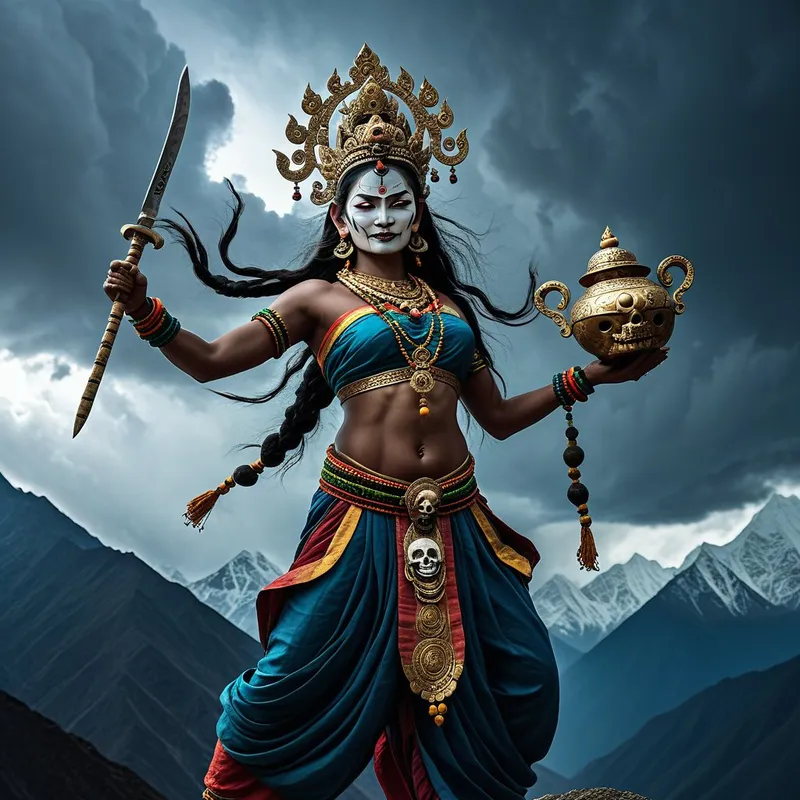
Dakinis Myth Meaning & Symbolism
Fierce sky-dancing goddesses who sever illusion, guide the lost through terror, and embody the raw, liberating power of awakened feminine energy.
The Tale of Dakinis
Listen, and let the wind carry you to the roof of the world, where the air is thin and reality wears thin as parchment. Here, in the places where life meets death—the windswept charnel grounds, the high mountain passes where vultures circle—the veil between worlds trembles. This is their domain.
They are the Dakini. Do not picture a gentle nymph. Hear first the whip-crack of thunder, the howl of a blizzard finding the gap in your shelter. Smell the iron-tang of old blood and the sacred, decaying incense of the burial grounds. They come on the edge of perception, in the moment between a heartbeat and its echo.
A seeker, bone-tired from years of futile meditation, sits among the rocks and bones. His mind is a cage of concepts; his spirit, a clenched fist. He seeks a wisdom that forever recedes like a mirage. Despair, thick and cold, settles in his marrow. This is the invitation.
The air itself begins to vibrate. It is not a sound, but a pressure, a silent shriek that resonates in the hollow of his ribs. The shadows between the rocks deepen, then move. She emerges not from a place, but from a state—from the very fabric of his fear. Her form is simultaneously terrifying and sublime: skin the color of a stormy dawn or midnight sky, eyes blazing with primordial fire. In one hand, she holds the kartika, its edge sharper than a razor of ice. In the other, the kapala, brimming with a nectar that is both promise and threat. She is adorned with the bone ornaments of the charnel ground, a crown of skulls upon her head—not of menace, but of stark, unflinching truth.
She does not speak. She dances. It is a dance of cosmic fury and infinite grace, a whirlwind that tears at the seeker’s settled world. With her knife, she does not attack his body, but the invisible knots of his identity—his cherished beliefs, his hidden shames, his arrogant certainties. It feels like annihilation. To be flayed by a Dakini is to have every comforting lie stripped away, until only the raw, quivering nerve of being remains.
In that space of utter nakedness, when the last defense has fallen, the dance shifts. The terrifying aspect melts into a boundless, fierce compassion. The skull-cup is offered. To drink is to ingest the very chaos she wielded, now transmuted into the luminous, electric clarity of rigpa. The seeker is not comforted; he is alchemized. The charnel ground has not changed, but his vision has. The bones gleam with sacred geometry; the howling wind chants secret mantras. The Dakini, her work complete, dissolves back into the sky from which she came, leaving only the echoing freedom of vast, open space.

Cultural Origins & Context
The Dakini is not a singular character from a linear epic, but a dynamic principle woven into the very fabric of <abbr title="The "Diamond Vehicle," the esoteric branch of Tibetan Buddhism">Vajrayana Buddhism. Her roots reach into ancient Indian yakshi and apsara lore, but in the Tibetan crucible, she was transformed. Here, under the vast, demanding sky, these figures were elevated from peripheral spirits to central, enlightened forces.
Their stories and iconography were transmitted orally and through terma (revealed treasure texts) by great mahasiddhas and adepts like Padmasambhava, who invoked Dakinis as protectors and guides. They functioned on multiple societal levels: as protectors of the Dharma, as embodiments of the secret, oral lineage, and as a profound challenge to monastic and societal rigidity. The Dakini, often wrathful, sexualized, and dwelling in "impure" places, represented a wisdom that could not be contained by scripture or monastery walls alone. She was the living experience of enlightenment, accessible only through direct, often terrifying, encounter.
Symbolic Architecture
The Dakini is the psyche’s own radical truth-teller. She represents the raw, unprocessed energy of the unconscious—not the personal unconscious of repressed memories, but the transpersonal, dynamic void from which all forms arise and into which they dissolve.
The Dakini does not build; she clears the ground. Her wrath is not anger, but the furious, compassionate necessity of space-making in a cluttered soul.
Her dwelling in charnel grounds symbolizes the necessity of facing decay, impermanence, and the shadow to find liberation. The flaying knife is the incisive insight that cuts through the "skin" of ego-identity, the stories we mistake for ourselves. The skull-cup is the vessel of transformation, where what is severed (ignorance) is alchemized into what nourishes (wisdom). Her dance is the chaotic, creative movement of life-force itself, which, when embraced, becomes the path. She is the ultimate spiritual friend who appears not to soothe, but to initiate.

The Dreamer's Resonance
To dream of a Dakini-like figure is to be in a state of profound psychic initiation. This is not a dream of narrative, but of sensation and atmosphere. The dreamer may find themselves in a familiar place made strange and threatening—a childhood home now a ruin, an office building that opens into an abyss. The somatic experience is key: a feeling of electric dread, of being stalked or confronted by an overwhelming, feminine-tinged force.
This signals a critical juncture in the dreamer’s psychological process. The psyche is mobilizing its own transformative energy to dismantle an outworn complex—a rigid self-image, a paralyzing belief, a dependency that has become a cage. The terror in the dream is the ego’s resistance to its own necessary deconstruction. The dream-Dakini does not represent an external threat, but the embodied, autonomous intelligence of the unconscious, intervening with fierce compassion to break a stalemate that conscious effort cannot resolve.

Alchemical Translation
For the modern individual, the Dakini myth models the non-linear, often disruptive process of true individuation. Our culture prizes construction, accumulation, and a stable, curated identity. The Dakini’s path is one of deconstruction.
Individuation is not about becoming a better, shinier version of your ego. It is about the ego’s graceful surrender to the vaster intelligence that already is.
The "charnel ground" is any life situation where our cherished structures fail—loss, failure, illness, crisis. In that bleak landscape, the Dakini-energy arises as an inner impulse toward ruthless honesty, a sudden clarity that cuts through self-pity or denial (the kartika). The "nectar" in the skull-cup is the unexpected wisdom, resilience, or creative surge that can only be born from having fully metabolized the experience of dissolution.
To work with this myth is to cultivate a relationship with one’s own inner chaos. It is to stop pathologizing periods of breakdown and to instead ask: What rigid form is being dismantled? What truth is trying to be born from this emptiness? It invites us to dance with our shadows, not to conquer them, but to let their fierce energy liberate us from the prison of a too-small self. The ultimate goal is not to become a Dakini, but to recognize that her sky-like, boundless nature is, and always has been, our own deepest reality.
Associated Symbols
Explore related symbols from the CaleaDream lexicon: