Dagda's Cauldron Myth Meaning & Symbolism
The myth of the Dagda's bottomless cauldron, a vessel of endless nourishment and impossible restoration.
The Tale of Dagda's Cauldron
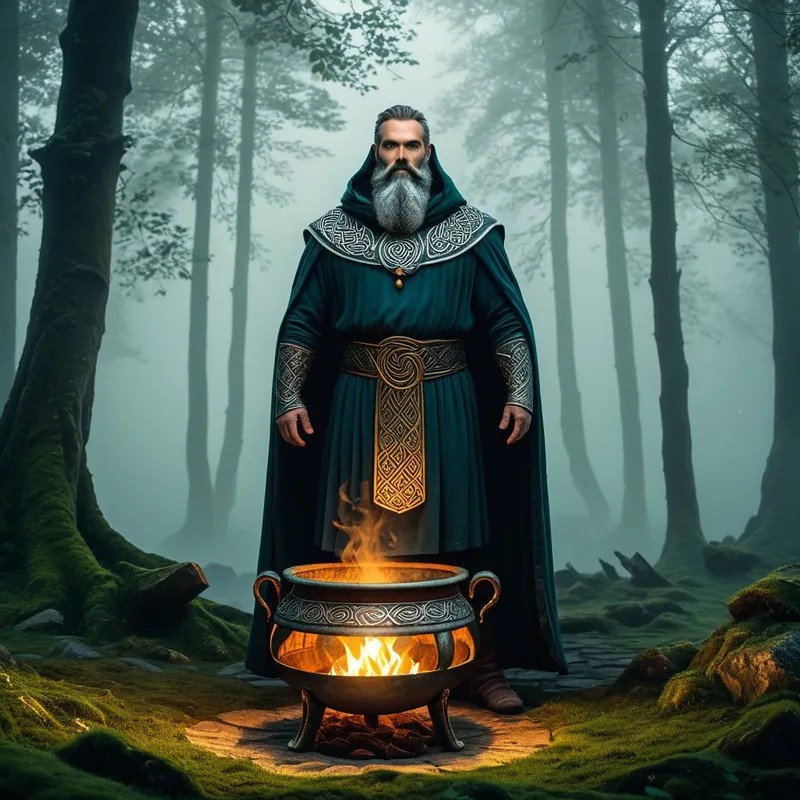
Listen. The air in the Otherworld is thick with the scent of damp earth and ripe apple. It is a time between times, when the great tribe, the Tuatha Dé Danann, hold their breath. A shadow has fallen from the northern seas: the Fomorians, beings of blight and brute strength, press their claim. In this gathering gloom, one figure stands as an oak stands against the wind. He is the Dagda, the Good God, his belly a round hill, his heart a steady drum. His club is so vast it could kill nine men with one end and restore them to life with the other.
But on this eve of war, it is not his club he tends to. In the heart of his hall rests his true treasure: the Cauldron of the Dagda. It is not forged of simple iron, but of a substance that drinks the starlight. It sits, wide-mouthed and deep-bellied, upon stones that have known no fire. For this cauldron needs no flame. It is a well of becoming.
As the council of the gods murmurs in anxiety, the Dagda approaches the vessel. He does not speak. He lifts a simple ladle—and from the cauldron’s seemingly empty depths, he draws forth a stew so rich its aroma alone fills every belly in the hall. He feeds them all, warrior and poet, smith and healer, and still the ladle finds more. The cauldron does not merely give food; it gives enough. It answers the deep, gnawing fear of scarcity with a silent, abundant “yes.”
Yet its magic cuts deeper than hunger. The stories whisper of a darker gift. When the battle horns finally sound on the plain of Mag Tuired, and the brave fall, their bodies broken, they are carried back to the cauldron. Not for burial, but for return. The fallen are placed within its curve. And there, in that dark womb of metal, what was slain is made whole. The dead warrior does not rise as a spirit or a memory, but as himself, blinking in the torchlight, the scar of the killing blow now just a silver seam on his skin. The cauldron holds the ultimate contradiction: it acknowledges the reality of death, and then, quietly, refuses its finality. It is the vessel that says loss is not the last word.
Cultural Origins & Context
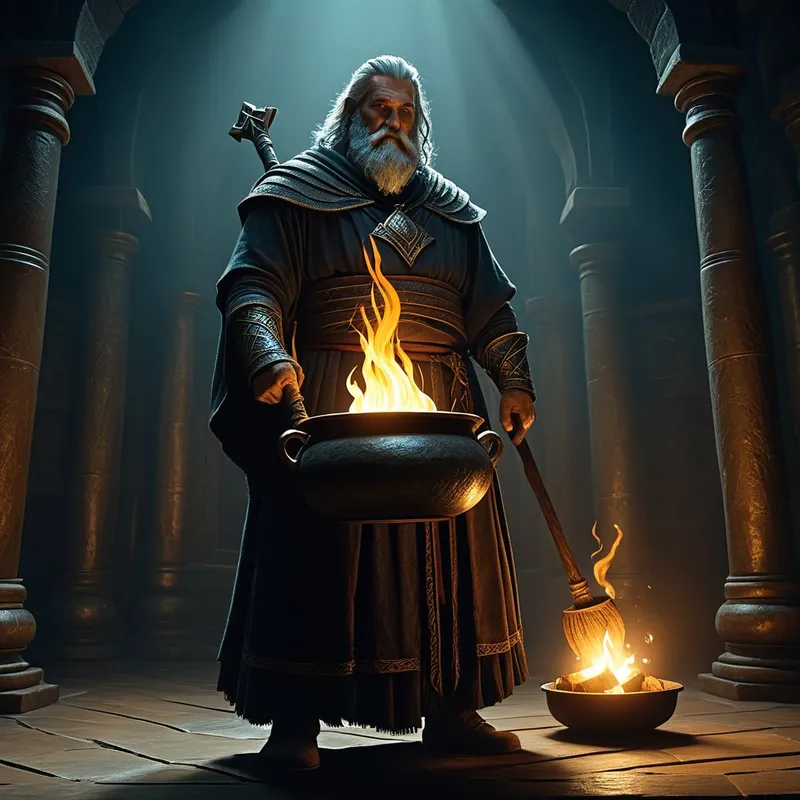
This myth survives in the medieval Irish textual tradition, primarily within the cycle of tales surrounding the Cath Maige Tuired. It is crucial to remember that these were not scriptures, but dynamic narratives preserved by the filid, the poet-seers who were the inheritors of the ancient druidic oral tradition. The story of the Dagda and his cauldron was not a simple parable; it was a functional cosmology.
In a world where agricultural failure meant starvation and battle loss meant annihilation, the cauldron represented a core cultural aspiration: resilience. It was a divine assurance of the tribe’s continuity. The Dagda himself, often portrayed as a figure of immense appetite and crude strength, is the embodiment of earthy, generative power—the father-chieftain whose primary duty is the literal and spiritual nourishment of his people. His cauldron was one of the Four Treasures of the Tuatha Dé Danann, each governing a domain of sovereignty. This vessel governed the domain of sustenance and restoration, the bedrock of any kingdom’s survival.
Symbolic Architecture
At its core, the cauldron is an archetypal symbol of the anima and the containing vessel of the psyche. It is the womb and the tomb, the crucible where opposites are held without judgment.
The cauldron does not choose between plenty and paucity, life and death; it is the space where both are true, and from that tension, a third thing—wholeness—emerges.
Psychologically, the Dagda represents the ego’s capacity for containment. His “goodness” is not moral perfection, but adequacy—the ability to hold space for the full, often messy, spectrum of life’s experiences. The endless nourishment symbolizes the psyche’s (often untapped) resources of creativity and libido. The restoration of the dead warriors speaks to the psyche’s incredible regenerative capacity, its ability to integrate traumatic wounds (“the killing blow”) back into the fabric of the self, not as weaknesses, but as marks of resilience (“silver seams”).
The cauldron’s magic requires no external fire. Its transformative power is intrinsic. This points to a profound psychological truth: the potential for healing and abundance is not “out there” to be acquired, but lies within the deep, containing structure of the psyche itself, waiting to be accessed.
The Dreamer's Resonance
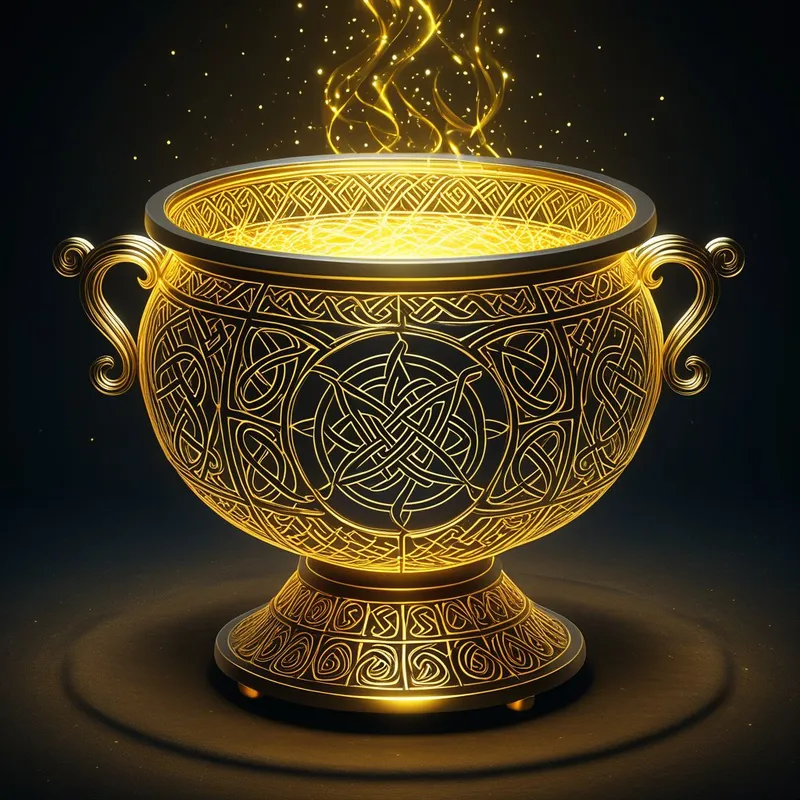
When this myth stirs in the modern unconscious, it often manifests in dreams of containers: vast pots, deep wells, empty rooms that feel pregnant with potential, or hospital wards that heal. To dream of Dagda’s Cauldron is to be in a somatic process of holding.
The dreamer may be experiencing a period of emotional or psychic depletion—feeling “eaten alive” by demands, or mourning a loss that feels fatal to part of the self. The cauldron in the dream appears as an answer to the exhaustion of scarcity consciousness. Its presence suggests the unconscious is activating the archetype of the inner container, the psychological “Dagda,” who can say, “I am big enough to hold this.”
Alternatively, the dream may feature a corrupted or stolen cauldron—one that is cracked, poisoned, or in the hands of a hostile force (the Fomorians). This signals a rupture in one’s capacity for self-care and restoration. The psychological conflict is not against an outer enemy, but against an inner attitude of self-abandonment or relentless criticism that prevents the soul from receiving its own nourishment.
Alchemical Translation
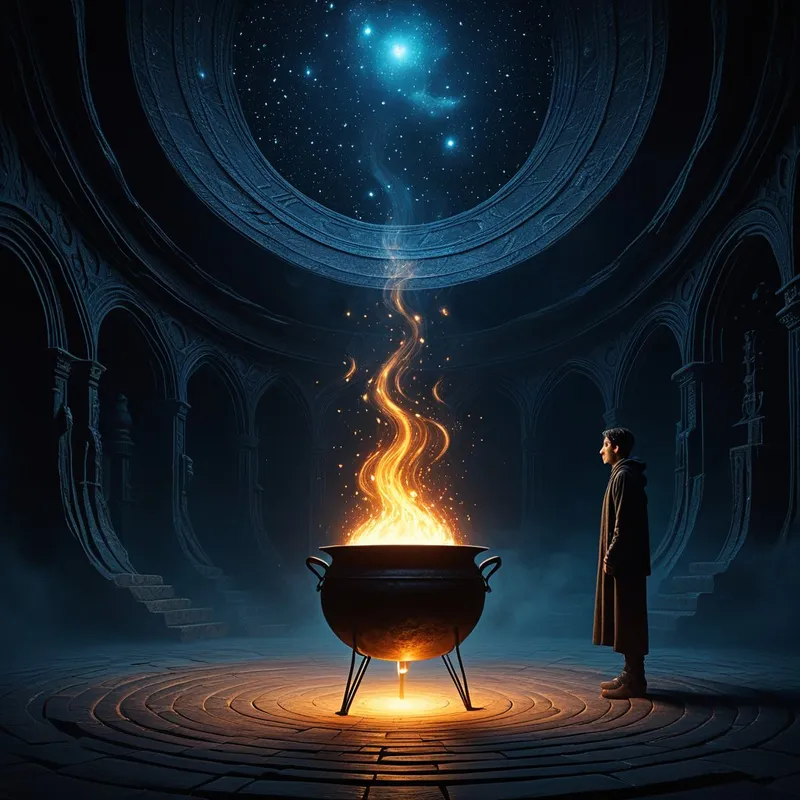
The individuation process modeled by this myth is not a heroic quest to slay a dragon, but the patient, often unglamorous work of becoming a vessel. It is the alchemical vas, the sealed container where the prima materia—the raw, conflicted stuff of our lives—is left to simmer and transform.
Individuation is less about becoming a perfect, finished hero and more about becoming a cauldron: a self that can contain its own contradictions and, from them, cook up a life of sustained meaning.
The first operation is to claim the ladle. This is the act of ego turning inward to draw sustenance from the unconscious, to feed on intuition, dream images, and creative impulses, trusting that the well is bottomless. The second, more difficult operation is placing the dead within. This is the work of shadow integration. We must identify those parts of ourselves we have “killed off”—our grief, our shame, our perceived failures, our dormant talents—and consciously lower them into the containing space of awareness. We do not resurrect them as they were; we allow the cauldron’s mysterious process to restore them as vital, integrated aspects of our wholeness, bearing the silver seams of their history.
The Dagda, with his simple, potent tools, shows us that this alchemy is grounded. It happens not in esoteric retreat, but in the daily act of showing up, of being present to both our hunger and our capacity to fill it, of acknowledging our wounds and our innate ability to heal them. The ultimate treasure is not the magical object, but the development of the inner vessel—the self that can say, like the cauldron itself, “Nothing is wasted here. Everything belongs, and everything can be transformed.”
Associated Symbols
Explore related symbols from the CaleaDream lexicon: