Daedalus' Labyrinth Myth Meaning & Symbolism
The story of a divine craftsman, a monstrous secret, and a maze that is both a prison and a map of the human soul.
The Tale of Daedalus' Labyrinth
Hear now the tale of the Daedalus, whose hands held the cunning of Athena and the pride of kings. It begins not with stone, but with shame. On the island of Crete, a queen, Pasiphaë, was cursed with a monstrous desire for a magnificent white bull sent by the sea-god Poseidon. From this unholy union, a creature was born—neither man nor beast, but both: the Minotaur. Its bellow was the sound of a broken oath, its hunger, a king’s disgrace.
King Minos, cloaking his fury in regal command, summoned Daedalus. “Build me a prison,” he commanded, his voice like cold bronze. “A holding place from which this… thing… can never escape, and into which none who enter may find their way out. Let the world forget it. Let the very earth swallow my shame.”
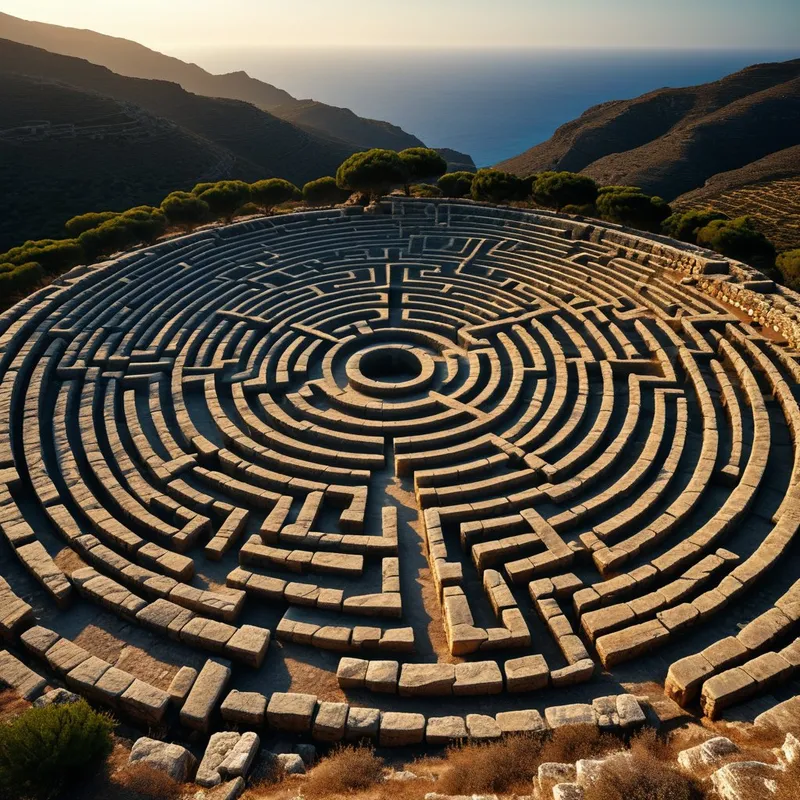
And so Daedalus, the master artificer, bent his genius to a terrible purpose. He did not build a dungeon of mere bars and chains. He conceived a living puzzle in stone—the Labyrinth. Its walls were high and seamless, its passages a twisting, turning mockery of memory. Every corner mirrored the last; every corridor doubled back upon itself in a dizzying dance of deception. The path in was the path to despair. The center was a sunless chamber where the Minotaur paced, its breath hot and ragged, a living secret at the heart of a stone lie.
For years, the monster fed on a gruesome tribute: seven youths and seven maidens sent from conquered Athens, lost in the stone maze before meeting the horn and tooth. Until a prince, Theseus, son of Poseidon in spirit if not always in blood, took his place among the sacrifices. His courage was a flame, but flame is useless in a labyrinth without a guide. And the guide was a thread—a simple, humble skein given by Minos’s daughter, Ariadne, who had been given the secret by Daedalus himself.
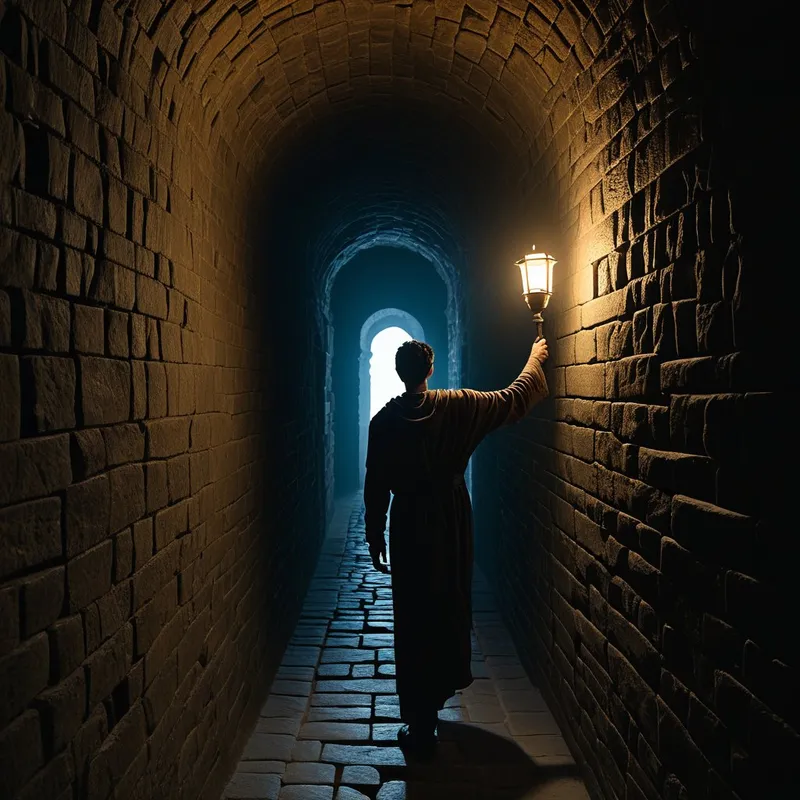
Theseus entered the mouth of the beast. The air grew cold and still, thick with the dust of lost footsteps and the damp smell of primal fear. He tied his thread to the entrance post and let it unravel behind him, a slender lifeline of reason in the belly of madness. Deeper he went, following the sounds of rage and sorrow, until he stood in the central chamber. There, in the gloom, the Minotaur awaited. The fight was not of epic poetry, but of desperate, close-quarter violence—a grunt, a clash, the hot spill of life onto the cold floor. The monster fell, and the secret died.
With the thread as his memory, Theseus retraced his steps, pulling his salvation behind him, leading the weeping Athenian youths and maidens from the tomb of twists back into the light of the sun. But for Daedalus, the architect of the maze, a different prison awaited. Enraged by his complicity, Minos locked Daedalus and his young son, Icarus, in a tower. And from that prison, the great craftsman would fashion wings of wax and feathers, dreaming of escape not through a maze on the land, but through the labyrinth of the sky—a tale with its own tragic, soaring heart.
Cultural Origins & Context
This myth is a foundational story of the Minoan and succeeding Mycenaean worlds, later codified by poets like Homer and vividly detailed in the Bibliotheca of Pseudo-Apollodorus. It functioned as an etiological myth for Athenian-Minoan relations, explaining the historical tribute Athens may have once paid to the naval power of Crete. More profoundly, it was a narrative passed down through generations, likely told in symposia and by hearths, serving as a lesson on the consequences of hubris (Minos’s insult to Poseidon), the power of cunning intelligence (metis) over brute force, and the perilous journey from adolescence to sovereignty, embodied by Theseus.
The Labyrinth itself may echo the complex, palatial architecture of Knossos, which to later Greeks seemed a bewildering maze. The myth thus translates a cultural memory of a powerful, sophisticated, and perhaps intimidating civilization into the language of heroic conquest and moral order.
Symbolic Architecture
The Labyrinth is the ultimate symbol of the unconscious psyche. It is not merely a confusing structure, but a deliberate, crafted puzzle—a representation of the complex, winding pathways of our own inner world, constructed by the ego (Daedalus) to contain what it cannot integrate.
The monster is not placed in the maze; the maze is built around the monster.
The Minotaur is the ultimate shadow—the bestial, instinctual, and shameful aspect of the self that results from a denied or perverted natural impulse (Pasiphaë’s cursed desire). It is the “family secret,” the repressed trauma, the unacknowledged rage that, if left in the dark, grows hungry and demands a sacrifice.
Theseus represents the heroic ego-consciousness that must voluntarily descend into this inner chaos. His weapons are courage, but his true tool is the Ariadne's thread—a symbol of connection, intuition, and the guiding principle of consciousness (often associated with the anima, the inner feminine guiding force). One does not defeat the shadow by memorizing the maze, but by maintaining a living link to awareness and purpose.
Daedalus, the Creator, embodies the brilliant, ambivalent power of the intellect. He can build wonders and prisons with the same skill. His story warns that the mind that designs the trap may itself become trapped by its own creations, requiring a desperate, transcendent escape.
The Dreamer's Resonance
To dream of a labyrinth is to dream of a psychic process underway. The somatic feeling is often one of anxiety, claustrophobia, or frustrating repetition—the heart pounding in a confined space, the turning of corners that lead nowhere. This is the psyche’s signal that one is navigating a complex inner conflict, a knot of emotions, memories, or choices that feels inescapable.
Dreaming of being lost in a labyrinth suggests a confrontation with a problem where linear logic fails. The dreamer is in the realm of the unconscious, where the rules of the waking world do not apply. To dream of finding a center may indicate approaching a core complex or truth. To dream of a monster within it is a direct encounter with the shadow—frightening, but a crucial step towards integration. The appearance of a guide or a thread (a voice, a light, a string) signifies the emergence of a reconciling principle from the unconscious itself, offering a way through.
Alchemical Translation
The myth of the Labyrinth is a perfect map for the individuation process. The alchemical work begins with the nigredo, the blackening: the acknowledgment of the shadow (the Minotaur) and the descent into the chaotic, confusing prima materia of the soul (the Labyrinth).
The treasure is guarded by the dragon; the Self is found by facing the Minotaur.
Theseus’s journey is the mortificatio—the killing of the old, autonomous, and terrifying complex. This is not a literal murder of part of oneself, but the dissolution of its power to rule from the shadows. The fight is the intense conscious engagement with what we have rejected.
The thread is the sustaining symbol of the coniunctio, the linking of opposites—consciousness with the unconscious, the hero with the anima (Ariadne). It ensures that in venturing inward, one does not succumb to psychosis (permanent loss in the maze) but can return, transformed, to the world.
Finally, Daedalus’s own plight shows the final stage. After the structure (the old ego-defenses, the labyrinthine complexes) has served its purpose and become a prison itself, one must craft wings of aspiration (spirit, insight) to transcend it. This flight is perilous (Icarus), demanding a balance between the heights of spirit and the grounding of reality. The ultimate triumph is not just slaying the monster or escaping the maze, but using the genius that built the prison to forge a path to freedom, integrating the craftsman, the hero, and the thread-holder into a more complete being.
Associated Symbols
Explore related symbols from the CaleaDream lexicon: