Cyclopean Masonry Myth Meaning & Symbolism
The myth of colossal, seamless stonework built by primordial giants, representing the foundational, unconscious structures of the psyche.
The Tale of Cyclopean Masonry
Before history was written, when the world was young and raw, the gods walked with giants. Listen now to the tale of the walls that hold up memory, the stones that were laid not by mortal hands, but by beings born of the earth’s first fury.
In the deep, smoky forges beneath the volcanic fires of Mount Etna, the Cyclopes labored. They were not the dim-witted brutes of later tales, but the master smiths of the cosmos, children of Ouranos and Gaia. Their single eye, burning like a furnace, saw not the surface of things, but the deep grain within. They had hammered the thunderbolts for Zeus himself, weapons that shook the heavens.
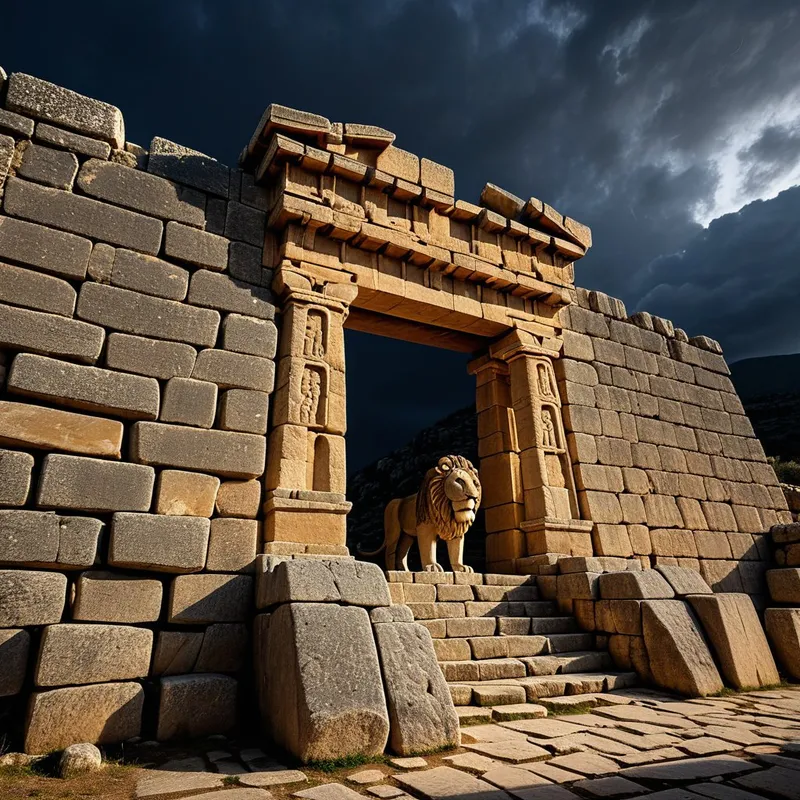
When the time came for the new gods to secure their reign, they called upon these primordial architects. The task was not to build palaces of delicate beauty, but fortresses of absolute power—bulwarks against the chaos of the old world and the ambitions of men. The Cyclopes descended from their fiery caves to the rocky citadels of the early heroes: to Mycenae, the city of the lion; to Tiryns, with its echoing galleries; and to the very walls of Athens.
They did not quarry stone as men do. They would place their massive hands upon a living cliff-face, feel its heartbeat, and with a roar that echoed in the bones of the earth, they would persuade the mountain to give up its children. Each boulder was a titan’s tooth, irregular, weighing more than a hundred oxen. No chisel marked them. No mortar, that weak paste of crushed limestone, was needed. The Cyclopes would lift these monoliths as if they were pillows, their muscles corded like ancient tree roots, and set them one upon another. They would turn each stone, listening, until it found its brother. And with a deep, grinding sigh that was the sound of the earth settling into a deeper sleep, the stones would lock. No blade could be inserted between them. The join was seamless, a puzzle wrought from bedrock itself.
These were not walls. They were the bones of the world made visible. They encircled the fledgling kingdoms of gods and men, a declaration written in granite: Here is order. Here is a space carved from the wild. Here, civilization begins. The gates they framed, like the mighty Lion Gate of Mycenae, were thresholds between the known and the unknown, guarded by symbols of raw, heraldic power. The work was done in the rumble of earthquake and the flash of lightning, a collaboration between the primal forge and the divine will. And when the last stone was set, the Cyclopes returned to their subterranean fires, leaving behind a silence that was heavier than the stones—a silence that whispered of an age when the makers of things were forces of nature, and architecture was a form of magic.
Cultural Origins & Context
The myth of Cyclopean Masonry is not a single, codified story but a pervasive etiological legend woven into the fabric of early Greek identity. It arose to explain the awe-inspiring, pre-classical ruins that dotted the Greek landscape—most notably the massive fortifications of the Mycenaean civilization (c. 1600–1100 BCE), which had collapsed centuries before the rise of Archaic and Classical Greece. To the later Greeks, these structures were so colossal, so seemingly superhuman, that their origin demanded a mythic explanation beyond human history.
The tales were passed down orally, likely by bards and local guides, as a form of "deep time" storytelling. They served a crucial societal function: to connect the contemporary Greek world to a heroic, semi-divine past. By attributing these walls to the Cyclopes, the Greeks acknowledged the Otherness of their own ancestors. It placed the foundations of their city-states, their poleis, in a time of direct interaction between gods, monsters, and heroes. This wasn't mere archaeology; it was psychic archaeology. The myth functioned as a cultural memory of a foundational trauma and triumph—the violent establishment of order (the Olympian gods, represented by the citadels) over chaos (the primordial Titans and Giants, whose kin, the Cyclopes, were paradoxically enlisted to build the new order's defenses).
Symbolic Architecture
At its core, Cyclopean Masonry is a profound symbol of the unconscious foundation. The rough, irregular, yet perfectly fitted stones represent the primal, unprocessed contents of the psyche—the emotions, instincts, and archetypal patterns that are not neat or logical, but massive and enduring.
The wall is not meant to be pretty; it is meant to hold. It is the psyche's first, most brutal act of self-definition against the formless void.
The Cyclopes themselves symbolize a focused, instinctual intelligence. Their single eye is the eye of the unconscious, seeing wholes, patterns, and deep connections rather than analytical, dualistic details. They are the creator archetype in its most raw, chthonic form. They do not "build" consciously; they enact a process of intuitive fitting, a kind of psychic geology where one trauma locks into another, one complex interlocks with its opposite, to form a stable, if rugged, structure—the foundation of the ego.
The seamless joints, where no mortar is needed, symbolize the self-regulating principle of the psyche. In depth psychology, this is the guiding function of the Self, which seeks wholeness. The "fit" is not engineered from the outside but discovered from within the nature of the materials themselves. It speaks to an integration that is innate, waiting to be realized.
The Dreamer's Resonance
When Cyclopean walls appear in modern dreams, they often signal a process of confronting the foundational, often archaic, structures of one's personality. The dreamer may be encountering something that feels ancient, immovable, and larger than their conscious life.
- Somatic Feeling: The dream often carries a somatic weight—a feeling of pressure, solidity, or being dwarfed. One might dream of touching the cold, rough surface of the stone and feeling a vibration, a deep hum from within the earth.
- Psychological Process: This is the psyche working on its own infrastructure. It may indicate:
- Encountering a Complex: A specific, massive "stone" may represent a core complex—a pattern of emotion, memory, and perception formed around early trauma—that is now being recognized as a load-bearing part of the personality's architecture.
- Foundation Work: The dream suggests the ego is not building something new, but rather discovering and coming to terms with what has always been there, the pre-existing, often unconscious, foundations of identity.
- Seeking Integration: Finding a new stone that fits perfectly into a gap in the wall symbolizes the conscious integration of a previously rejected or unknown part of the self, leading to greater stability.
Alchemical Translation
The myth models the early, crucial stage of the individuation process: the confrontation with and integration of the shadow and the personal unconscious. This is the prima materia—the raw, unrefined substance of the soul.
The alchemical work begins not with gold, but with lead; not with a polished temple, but with a pile of uncut mountain stone.
The conscious ego (the heroic king in his citadel) believes it is the ruler. But for the kingdom to be truly secure, it must acknowledge and enlist the power of the primordial, instinctual forces (the Cyclopes) that dwell beneath it. This is not a battle to be won, but a collaboration to be forged. The "transmutation" here is the shift from seeing these forces as monstrous threats to recognizing them as essential builders.
The process involves:
- Descent: Leaving the sunny, conscious world to engage with the "subterranean" aspects of the self—the anger, the grief, the raw creativity, the instinctual drives.
- Apprenticeship: Learning the Cyclopean "vision"—the intuitive, non-rational way of seeing how these massive, rough elements of one's nature might actually fit together. This is the work of therapy, active imagination, or deep reflection.
- Construction: The slow, often arduous, lifting and fitting of these stones. Each act of acknowledging a shadow trait, owning a projection, or accepting a deep need is a stone set into the wall. The mortarless joint is the moment of insight, where a connection clicks into place with the force of a personal truth.
The resulting "Cyclopean" psyche is not a perfectly smooth, civilized edifice. It is robust, authentic, and grounded. It can withstand the earthquakes of crisis because its strength comes from the deep, interlocking truth of its own components, fitted together not by the ego's will alone, but by the guiding intelligence of the unconscious Self. The citadel that emerges is not a prison, but a sacred space—a temenos—carved from the wild mountain of being, where the conscious self can dwell in relative safety, forever in awe of the primordial forces that hold up its walls.
Associated Symbols
Explore related symbols from the CaleaDream lexicon: