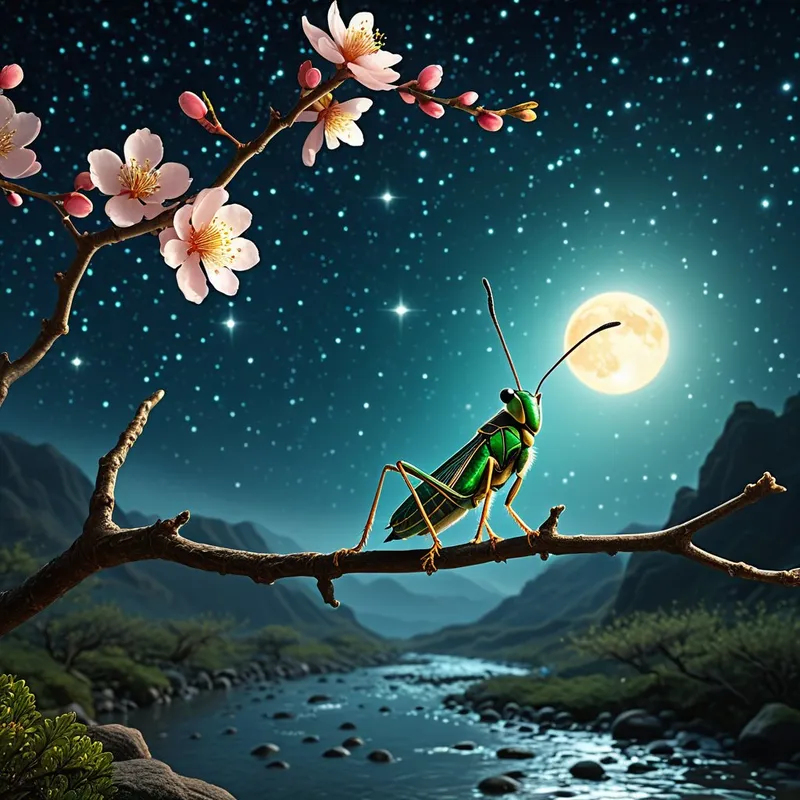
Cricket as Luck-Bringer Myth Meaning & Symbolism
A tale of a humble cricket chosen by celestial forces to restore fortune, embodying the alchemy of smallness into profound, resonant power.
The Tale of Cricket as Luck-Bringer
Hear now the tale whispered on the autumn wind, carried on the scent of chrysanthemums and dry earth. In an age when the Huangdi was but a memory in stone, a great silence fell upon the Middle Kingdom. It was not a silence of peace, but of stagnation. The rivers of Qi grew sluggish. Fortunes withered like late-summer grass. Men toiled, but their harvests were meager; scholars studied, but their insights were dust. The very connection between Heaven and Earth, the Dao, seemed frayed and thin.
In the Heavenly Court, the Jade Emperor observed this earthly malaise. The harmonious music of the spheres, usually maintained by the celestial bureaucracy, had developed a dissonant hum. The Minister of Fate presented ledgers of declining luck, his brush hovering over names with diminishing ink. A solution was needed, but not one of thunderous power or dazzling spectacle. Such forces would only shatter the fragile world further. The need was for a subtle repair, a vibration precise and pure enough to re-tune the world’s latent song.
The Emperor’s gaze passed over dragons and phoenixes, over noble tigers and wise tortoises. His eyes then fell to the humblest corner of creation, to the gardens of the immortal Xiannu. There, amidst roots and fallen leaves, a small cricket sang its twilight chorus. Its song was not grand, but it was true—a clear, rhythmic pulse that resonated with the fundamental frequency of the earth itself. Here was an instrument of perfect simplicity.
A celestial decree, softer than a silk thread, descended. The cricket was infused not with might, but with purpose. Its humble form became a vessel for a sliver of celestial intent: to become the Luck-Bringer. It was not commanded to conquer, but to connect; not to shout, but to sing the world back into alignment.
The cricket descended on a moonbeam into a world grey with despair. It alighted not in an emperor’s palace, but in the desolate courtyard of a failed scholar, a man whose spirit was as parched as his inkstone. That night, as the man contemplated the void, the cricket began its work. It did not speak in words. It sang. Its chirp was a tiny, sharp needle of sound, piercing the thick silence around the man’s heart. With each rhythmic pulse, a memory stirred—not of grand ambition, but of the simple joy of a single coherent thought. The next morning, almost without thinking, the scholar mended his broken fence. The act was small, but it was a completion. A merchant, passing by, noticed the repaired fence and, sensing a thread of order restored, struck a conversation that led to a forgotten debt being repaid.
The cricket moved on, unseen, a tiny pivot upon which fortune turned. It sang near a sick child, and the rhythm seemed to steady the fever’s chaos, guiding the grandmother to remember an old herbal remedy. It chirped in the warehouse of an anxious trader, and the sound, cutting through his worry, clarified a decision that saved his cargo. Wherever it went, it did not create luck from nothing. It sang the discordant fragments of possibility—the overlooked opportunity, the latent skill, the dormant connection—into a resonant, coherent pattern. Its song was the catalyst for the world’s own latent luck to crystallize. The great stagnation began to thaw, not with a flood, but with a million tiny, resonant clicks, a symphony of small rightnesses orchestrated by the most unassuming of celestial messengers.

Cultural Origins & Context
This myth, in its many localized variations, is woven deeply into the fabric of Chinese agrarian and literary culture. It is less a single canonical epic and more a pervasive folk motif, passed down through oral tradition, seasonal festivals, and later, classical literature. Its primary carriers were the farmers and common folk who lived in intimate dialogue with the land. The cricket’s autumnal song was a fundamental part of the soundscape, marking the harvest, the change of seasons, and the approach of the introspective winter months.
In this context, the cricket was never merely an insect. It was a Shen of the hearth and field, a protector of the home. The myth formalized this intuition, providing a narrative that explained why the presence of a cricket in one’s home was considered an omen of imminent good fortune and a guard against evil spirits. Its song was a protective chant. During the Zhongqiu Festival, stories of the Luck-Bringer would be shared, linking the insect’s earthly presence to celestial benevolence.
The scholarly class also embraced the symbol, but through a different lens. For the literati, the cricket represented resilience, virtuous conduct in obscurity, and the power of a clear, unwavering voice (a metaphor for the scholar’s own writings). Its ability to bring luck was allegorized as the natural consequence of aligning oneself with the subtle, correct rhythms of the Dao. The myth thus functioned on multiple levels: as a folk superstition ensuring domestic harmony, as a philosophical parable for the gentry, and as a cosmological story explaining how celestial will operates through the most mundane channels.
Symbolic Architecture
At its core, the myth is an ode to the power of resonance over force. The cricket is the archetypal symbol of the potent fragment, the insignificant detail that contains the code for systemic change.
The universe is not moved by the shout of giants, but by the precise frequency of a humble chirp that finds its echo in the architecture of destiny.
The cricket’s smallness is its primary virtue, not a drawback. It represents the overlooked aspect of the psyche, the quiet intuition, the minor talent, or the repressed memory that seems too trivial to matter. Its song is symbolic of authentic expression—a clear, rhythmic, and true emission of one’s essential nature. This is not a performance for an audience, but a necessary pulse of being. The luck it brings is not random chance, but the principle of synchronicity made manifest. It is the external world rearranging itself to mirror the internal clarity and rhythm the cricket embodies. The celestial decree represents a moment of alignment between the individual soul (no matter how humble) and a transpersonal, archetypal pattern—the Dao itself.
Psychologically, the cricket is the Ego-Self axis in its most functional form. It is the ego that has consented to be a small, clear vessel for the directives of the larger Self. Its mission—to re-tune a stagnant world—mirrors the psyche’s need to integrate unconscious contents to restore a state of flowing vitality, or Qi.

The Dreamer's Resonance
When this myth pattern activates in the modern dreamscape, it often surfaces during periods of felt impotence or stagnation. The dreamer may feel that their efforts are futile, that they are shouting into a void, or that their life is on the wrong frequency.
To dream of a cricket, especially one that is luminous, large, or singing an irresistibly clear song, signals a profound somatic and psychological process. It is the unconscious announcing the arrival of the "luck-bringer" function within. Somaticly, this may feel like a slight, almost imperceptible quickening—a "click" of alignment in the chest or solar plexus. It is the body sensing the rightness of a path before the mind can articulate it.
Psychologically, the dream marks a shift from striving to attuning. The ego is being asked to relinquish its grand, effortful campaigns and instead listen for its own essential rhythm. The cricket’s song in the dream is the sound of the Self communicating through a channel that bypasses the noisy, anxious ego. The "luck" that follows in waking life manifests as meaningful coincidences, unexpected opportunities that feel strangely "right," or the sudden solution to a problem from an overlooked detail. The dream is a directive: stop trying to move the mountain. Find your precise note, and sing it. The mountain will rearrange itself around the sound.

Alchemical Translation
The myth of the Cricket as Luck-Bringer is a perfect map for the alchemical stage of Solutio, followed by Coagulatio. The initial "great stagnation" is the nigredo, the leaden state of depression, meaninglessness, and psychic inertia. The celestial decree is the influx of the anima mundi (the world soul), the transcendent function that initiates change from a level beyond the ego.
Individuation is not about becoming large, but about becoming resonant. The Self does not seek to inflate the ego, but to tune it to a pitch so pure it becomes a conduit for fate.
The cricket’s journey is the alchemical process itself. Its acceptance of its small, appointed role is the dissolution of ego-inflation (Solutio). Its song is the constant, rhythmic distillation (Distillatio) of essence—the act of repeatedly expressing one's truth until it is pure vibration. Each instance where its song catalyzes "luck" is a minor coagulation, a small, tangible proof of the alignment between inner truth and outer reality.
For the modern individual, the alchemical translation is clear: your power does not lie in the volume of your will, but in the fidelity of your signal. The "celestial decree" is the call of vocation, the nagging pull toward an activity that feels intrinsically meaningful, however insignificant it may seem. The "stagnant world" is your life situation. The "song" is the daily, disciplined practice of that vocation—writing the paragraph, making the sketch, tending the garden, analyzing the data with care. The "luck" that emerges is the synchronicitous support of the universe for a path that is in true harmony with the Self. You are not called to be the Jade Emperor commanding the heavens. You are called to be the cricket, singing in the dark, trusting that your precise note is the one needed to re-weave the tapestry of your world.
Associated Symbols
Explore related symbols from the CaleaDream lexicon: