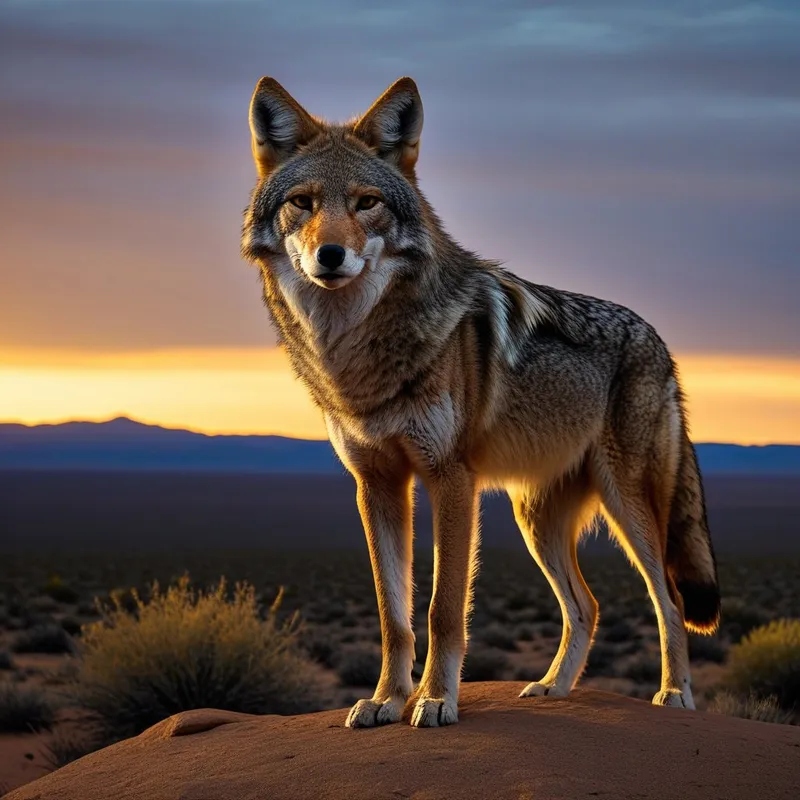
Coyote Myth Meaning & Symbolism
A shape-shifting trickster, creator, and fool whose chaotic antics bring both fire and folly, teaching that wisdom is born from the mess of living.
The Tale of Coyote
Listen. In the time before time, when the world was soft and the people were still dreaming themselves into being, there walked a figure of dust and laughter. He was Coyote. His footsteps did not follow the path; they were the path, appearing only after he had passed.
He walked through the raw clay of creation, and finding the world too quiet, too still, he stole the sun. Not from malice, but from a restless, itching curiosity. He bundled it in a woven bag of shadows, and as he ran, the light leaked out, scorching his back, creating the first sunrise—a gift born of theft. He brought fire to the people by letting it chase him, a blazing brand clamped in his jaws, his tail alight like a comet. He gave them laughter by tripping over his own grand plans, tumbling down a canyon in a cloud of feathers and outrage.
He was the architect of necessity. When the people were hungry, he tricked the Buffalo into the hunting grounds, not with strength, but with a song so ridiculous the great beasts came to laugh and were caught. When death came to stay forever, he was sent to bargain with the spirits. But on the return journey, burdened with the heavy gift of mortality for all, he grew tired. He placed the bundle containing life and death beside the trail to rest. A lizard, quick and sly, darted out and switched the bundles. Coyote, in his haste, picked up the wrong one and brought it to the people. And so, death remained in the world. A mistake that defined existence.
He is the one who, seeking to fly like the eagles, strapped himself with feathers borrowed from every bird. He climbed the highest cliff, crowed his defiance to the sky, and leaped. For a glorious moment, he soared. Then the glue of pride melted, and he fell, not as a hero, but as a shower of mismatched plumes and a yelp that echoed into a lesson. He is forever chasing his own tail, and in the dizzying circle, he sometimes catches a glimpse of the truth.
Cultural Origins & Context
The Coyote stories are not a single, monolithic myth, but a vast, living tapestry woven across hundreds of Indigenous nations, from the Pueblo peoples to the Plains tribes and the Plateau cultures. He is known by many names, but his essence is a constant: the ultimate Trickster.
These narratives were not mere bedtime stories; they were the foundational texts of a philosophical and ethical education. Told around winter fires or during communal work, often by skilled elders, the Coyote cycle served multiple vital functions. It taught social norms by illustrating the hilarious and often painful consequences of greed, arrogance, and foolishness. It explained the origins of the world's features—why the river bends here, why the rock has that face. Most importantly, it modeled a way of being in a world that is neither purely benevolent nor purely hostile, but inherently unpredictable. Coyote stories cultivated resilience, adaptability, and a deep, ironic sense of humor about the human condition. They were a reminder that the universe contains a wild, uncontrollable principle, and that wisdom often comes skinned and muddy from the ditch of a well-intentioned mistake.
Symbolic Architecture
Coyote is the embodied paradox. He is not evil, nor is he purely good. He is the necessary chaos that precedes and provokes order. His symbolism is a complex architecture built on foundational contradictions.
He is the sacred fool, whose stupidity unveils profound truth, and the arrogant genius, whose cleverness leads to catastrophic blunder.
Psychologically, Coyote represents the Shadow in its most dynamic form. He is the untamed instinct, the rebellious impulse, the creative madness that the conscious ego tries to suppress. He is the hunger that steals the fire, the lust that disrupts the ceremony, the curiosity that opens the forbidden box. Yet, without this energy, there is no innovation, no passion, no life force. He is the catalyst. His "tricks" are the universe's way of breaking rigid patterns, of forcing growth through disruption. The bundle of death he mistakenly brings is not a tragedy, but the very condition that gives life its precious, poignant meaning. He symbolizes the creative-destructive principle that dismantles the old, comfortable world so a new, more complex one can be born—often messily and with much complaining from those caught in the change.
The Dreamer's Resonance
When Coyote pads into the modern dreamscape, he announces a period of psychic upheaval and potential transformation. He appears when life has become too rigid, too predictable, or when the dreamer is taking themselves far too seriously.
To dream of Coyote is often to dream of chaotic events: plans unraveling in absurd ways, finding yourself naked in a boardroom, or being chased by a laughing, shapeshifting force. Somaticly, this can correlate with feelings of restless energy, nervous laughter bubbling up in inappropriate moments, or a sense of being "out of control." Psychologically, Coyote arrives to dismantle a persona that has grown too tight. He steals the "sun" of your cherished identity, your polished self-image, and in the ensuing scramble, your raw, unadorned self is exposed. He is the embodiment of the process where a carefully constructed life plan falls apart, only to reveal a more authentic, though messier, path forward. He does not comfort; he provokes. His presence in a dream is a call to engage with your own inner trickster—to acknowledge the rebellious, foolish, and creatively chaotic parts of yourself that you have exiled, for they hold the key to your next evolution.
Alchemical Translation
The Coyote myth is a masterclass in the alchemy of individuation, the Jungian process of becoming whole. It models not a heroic, linear ascent to perfection, but a spiraling, often embarrassing, journey toward integration.
The process begins with the prima materia of the naïve ego, convinced of its own plans. Coyote-energy, as the catalyst, is introduced: an impulsive decision, a sudden failure, a humiliating mistake. This is the nigredo, the blackening, the descent into chaos and "foolishness." The ego is dissolved in the acid of its own miscalculation. This is not a step to be avoided, but the essential furnace of transformation.
The alchemical gold is not found in purity, but in the acceptance of the alloy—the wisdom fused with folly, the order born of chaos.
From this dissolution comes the albedo, the whitening, a moment of clarity glimpsed from the bottom of the canyon. "Ah," the humbled self says, "I see now." The final stage, the rubedo or reddening, is the integration. The individual does not become Coyote, but they make a pact with him. They learn to hold seriousness and laughter in the same hand. They accept that their greatest strengths are entwined with their flaws, that their creative fire is the same energy that can burn down their house. The triumph is not over chaos, but a reconciliation with it. The individuated self is not a flawless ruler, but a resilient, adaptable, and deeply humorous being who has made peace with the trickster in their own soul, understanding that the crooked, Coyote-made path is the only one that leads to a truly lived life.
Associated Symbols
Explore related symbols from the CaleaDream lexicon: