
Corona Myth Meaning & Symbolism
A nymph's selfless sacrifice transforms her into a constellation, a crown of stars symbolizing eternal fidelity and the ultimate reward of a pure heart.
The Tale of Corona
Listen, and let the night sky tell its oldest story. It begins not in the marble halls of Olympus, but in the whispering, wine-scented groves sacred to Bacchus. Here, among the ivy and the hidden springs, lived Corona, a nymph whose loyalty was as deep as the earth’s roots and as bright as a sun-dappled stream.
She served not as a queen, but as a devoted companion to the god himself, a keeper of his sacred rites and a guardian of his vulnerable moments. For even a god can know peril. On a day when the air grew thick with divine malice, the wrath of Juno, consumed by a stepmother’s jealousy, fell upon Bacchus. She sent a madness upon him, a tearing of the soul that drove the god of ecstasy into a torment of his own making. He fled, not in triumph, but in anguish, into the deepest wilds.
It was Corona who followed. She tracked his frantic path through briar and over stone, her heart a drum of fear not for herself, but for him. She found him at last, broken and exhausted, his divine light guttering like a dying flame. As he lay vulnerable, the shadows of the forest seemed to coalesce, and from them stepped a figure of vengeance sent by Juno’s will—a mortal assassin or a spectral fury, the tales vary—but its intent was singular: to extinguish the god in his moment of weakness.
Without a thought for the consequence, Corona threw herself between the god and the blade. She did not raise a weapon; she raised herself as a shield. Her plea was not a spell, but a testament. “You will not touch him,” she declared, her voice steady against the rustling malice of the trees. “My life for his sanctuary.”
In that moment of ultimate fidelity, the cosmos took notice. The assassin’s strike was stayed by a force greater than vengeance. Jupiter, from his high throne, witnessed the pure, selfless arc of her sacrifice. A heart offered not for power or glory, but for love and protection, is a rarity that even the gods must honor.
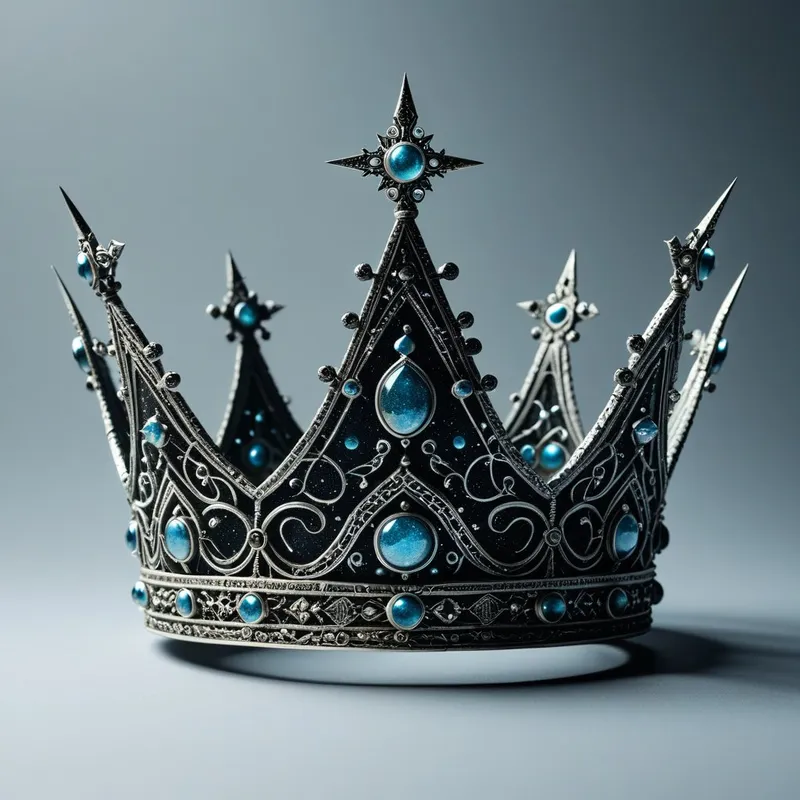
Where Corona stood, a brilliant light began to emanate from her very being. It did not consume her; it translated her. Her form grew luminous, insubstantial, and began to rise. She dissolved not into nothing, but into everything—into the eternal dark. Her essence was woven into a pattern of seven stars, a delicate, unbroken circle placed among the fixed lights of the northern sky. The nymph of the earth became Corona Borealis, a celestial diadem, a crown forever shining as a testament to the heart that chose another’s safety over its own survival. Bacchus, restored, could only look up, his gratitude and grief forever fixed in the silent, sparkling memorial above.

Cultural Origins & Context
The myth of Corona, known to the Romans as Corona Borealis, is a fascinating artifact of cultural syncretism. It entered Roman mythology largely through the rich tapestry of Greek storytelling, where it was known as the Crown of Ariadne. The Romans, adept at absorbing and reframing the myths of conquered and neighboring peoples, made the story their own, often associating it closely with their god Bacchus.
This was not a tale for the state priesthood or the grand epics of foundation like the Aeneid. Instead, it lived in the more intimate spaces: told by poets like Ovid in his Metamorphoses, a catalog of transformations that served as a mythological handbook for the Roman literate class. It was a story that explained a feature of the natural world—a recognizable constellation—by rooting it in deep human (and divine) emotion. Its societal function was twofold: to offer an aetiology for the stars and to model a specific, powerful virtue: fides (faithfulness, loyalty) of the most extreme and self-abnegating kind. It showed that the ultimate reward for such perfect fidelity was not earthly treasure, but eternal, celestial remembrance.
Symbolic Architecture
At its core, the Corona myth is an alchemical diagram of the soul’s most potent transaction: the exchange of the mortal for the eternal through the currency of selfless love. The crown, as a symbol, is universally an emblem of completion, authority, and the highest state. But Corona’s crown is not seized; it is bestowed as a consequence of letting go.
The true crown is never taken; it forms in the vacuum left by a surrendered heart.
Corona represents the part of the psyche that chooses connection over self-preservation, that values the integrity of a bond more than individual survival. Psychologically, she is the anima figure—the soul-image—that guides through devotion, not domination. Her transformation into a constellation signifies the moment a personal act of love becomes an impersonal, eternal principle. She is no longer a person who loved, but the very archetype of loving sacrifice. The circular, unbroken form of the crown symbolizes the wholeness achieved through this process: a life given in fragments (through service, through the final act) is returned as a perfect, complete circle of light.
The Dreamer's Resonance
When the pattern of Corona appears in the modern dreamscape, it rarely manifests as a literal nymph or constellation. Instead, the dreamer may find themselves in a situation of critical, silent choice: standing between a loved one and a looming threat, offering their own well-being to protect a vulnerable aspect of their own life (a creative project, a healing inner child, a fragile new relationship), or witnessing a part of themselves dissolve into light.
Somatically, this can feel like a profound hollowing out in the chest—not a painful emptiness, but a sacred vacancy. There is a sensation of weight leaving the shoulders even as the heart feels exposed. Psychologically, this dream signals a culmination of a fidelity test. The ego is being asked: What are you willing to not hold onto for the sake of something greater? The reward in the dream—often a sudden appearance of beautiful light, a sense of expansion, or being seen and acknowledged by a powerful, benevolent presence—mirrors the stellar apotheosis. It is the unconscious confirming that the soul’s integrity, forged in sacrifice, is the only currency that buys immortality.

Alchemical Translation
The Corona myth is a perfect map for the Jungian process of individuation—the journey toward psychic wholeness. The initial state is one of service: the ego (Corona) is in relation to a powerful, often chaotic content of the unconscious (Bacchus, the god of ecstasy and madness). This is the necessary, but incomplete, first stage of engaging with the deeper Self.
The crisis comes when that unconscious content is attacked by another complex—often the critical, punishing, or jealous super-ego (Juno’s wrath). The ego faces a choice: abandon the vulnerable Self to its fate, or intervene at total cost to itself. Individuation demands the latter. The ego must sacrifice its primary commitment to its own security and autonomy.
The alchemical gold is consciousness forged in the fire of a choice that prefers soul to safety.
This “death” of the ego’s old stance is the nigredo, the blackening. But in Jungian alchemy, putrefaction is followed by illumination. Jupiter’s intervention represents the transcendent function—the emergence of a new, reconciling perspective from the total psyche. The transformation into the crown is the albedo, the whitening, and the rubedo, the reddening into permanence. The ego-consciousness is not destroyed; it is transmuted. It becomes a fixed, guiding structure in the inner sky—a crown of consciousness. The individual no longer just has a psyche; they see their psyche as a coherent, beautiful, and eternal pattern. They have become, in a sense, both the faithful servant and the crowned sovereign of their own inner kingdom, their loyalty to the Self now a permanent, shining fixture of their being.
Associated Symbols
Explore related symbols from the CaleaDream lexicon: