Cornucopia Myth Meaning & Symbolism
The horn of plenty, born from the infant Zeus's struggle with a divine goat, symbolizes unending nourishment born from primal conflict and divine power.
The Tale of Cornucopia
Hear now the tale of the horn that never empties, born not from peace, but from a god’s first struggle.
In the beginning, there was a hunger. Not of the belly, but of the soul—the titan Cronus, devouring his own children, consumed by a prophecy of his own downfall. But his wife, Rhea, her heart a well of cunning love, tricked him. When her youngest son was born, she wrapped a stone in swaddling clothes and gave it to the ravenous titan. The true child, a spark of thunder in a tiny form, was spirited away to the island of Crete.
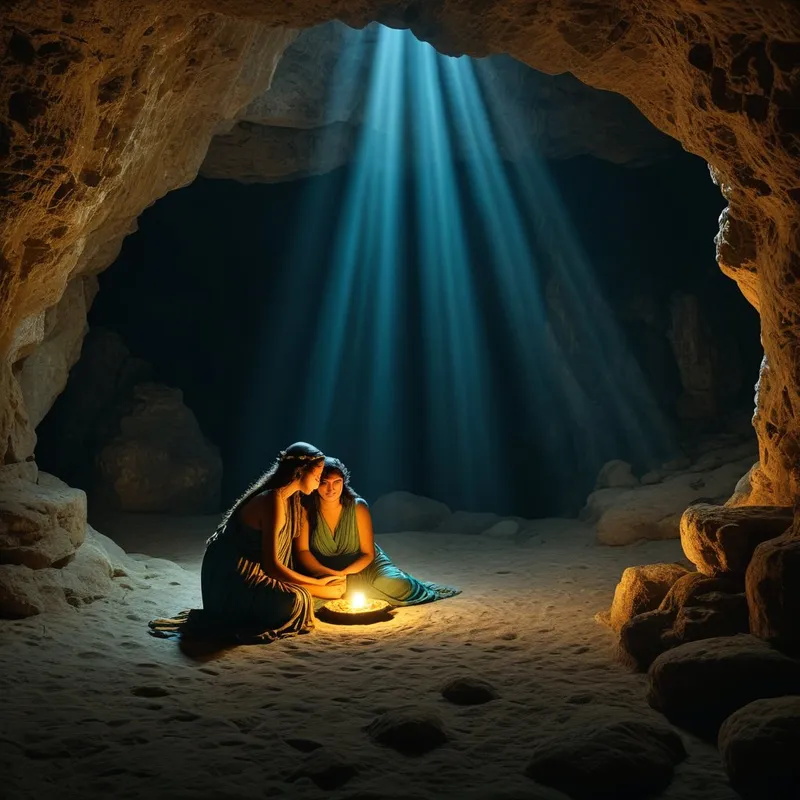
There, in a hidden cave echoing with the drip of sacred water, the infant Zeus was given to the care of nymphs. Adrasteia and Ida became his silent mothers, their laughter the first music he knew. But a child of destiny needs more than song. He needed a font of life itself. This was provided by a creature of gentle power and formidable horn: the goat Amalthea.
Amalthea was no ordinary beast. Her hide shimmered with a celestial light, and her milk was the nectar of potential. From her teat, the future king of Olympus drank deep, drawing strength not just for his body, but for his nascent divinity. The cave filled with the warm, sweet scent of milk and the soft bleating of his foster-mother. Yet, within the god-child, the raw, untamed power of the storm already stirred.
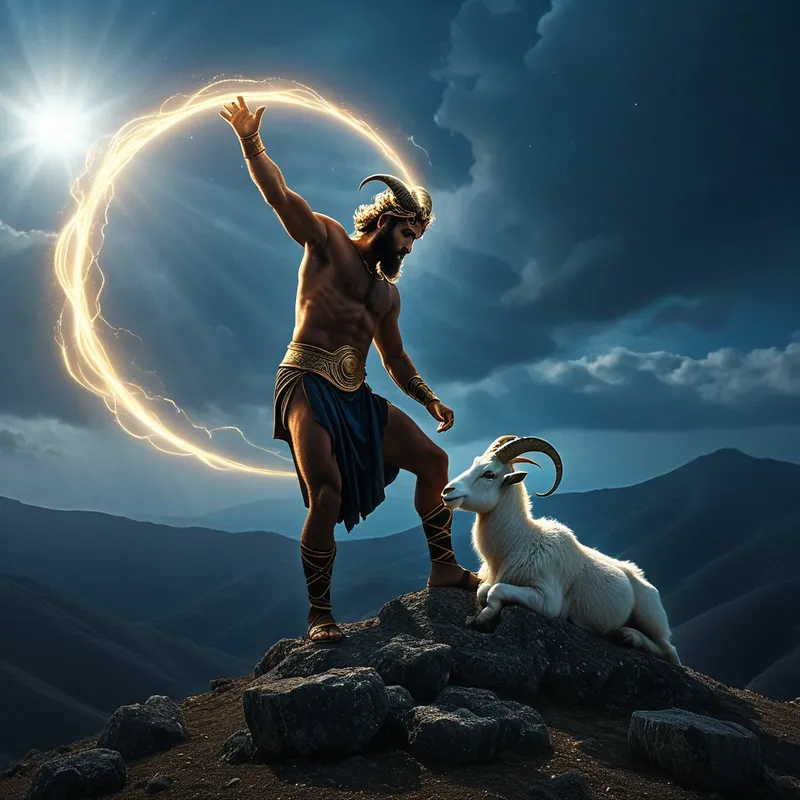
One day, as the young Zeus played with his mighty nurse, a surge of that unbounded strength overtook him. In a moment of divine clumsiness or perhaps instinctual testing, he grasped one of Amalthea’s magnificent horns. Not with malice, but with the overwhelming force of a nature not yet understood. He pulled. There was no scream, but a resonant crack that shook the very roots of the mountain, a sound of breaking and becoming. The horn came away in his small, powerful hands.
In that instant, the world held its breath. But from the rupture, a miracle flowed. The broken horn did not bleed ichor; it bled abundance. It overflowed with a cascade of ripe fruits—figs, pomegranates, grapes that glistened like jewels. It spilled forth grains, rich oils, and sweet honey. The hollow of the horn became a womb of perpetual giving. The nymphs gasped, their fear turning to awe. The goat Amalthea, her sacrifice accepted, was transformed, her broken horn replaced by an eternal spring of nourishment. The first Cornucopia was born, not from careful crafting, but from an act of primal, transformative force—a god’s first lesson in the power he wielded, and the bounty that can spring from a sacred rupture.
Cultural Origins & Context
The myth of the Cornucopia, or keras amaltheias (horn of Amalthea), is woven from the very fabric of Greek attempts to explain the origins of prosperity and divine favor. Its primary sources are the Hesiodic corpus and later bibliographers like Apollodorus, who collected and systematized these oral traditions.
This was not a myth confined to temple liturgy, but a living story told in households and at harvest festivals. It functioned as an aetiological myth, answering a fundamental human question: where does our abundance come from? The answer was divine, but not easily given. It was born from conflict, nurture, and an accidental act of power. The Cornucopia became a central symbol in the worship of deities associated with earth, harvest, and fortune—Demeter, Tyche, and Dionysus. It was a reminder that the land’s generosity was sacred, a direct gift from the divine order established by Zeus, flowing from the very moment of his nurturing.
Symbolic Architecture
At its core, the Cornucopia is a paradox: a symbol of infinite nourishment born from a break. Its symbolic architecture is built on this foundational tension.
The horn itself is a profound symbol. It is an extension of the animal’s life force, its power and fertility. To possess the horn is to channel that vital energy. When broken by the infant Zeus, it undergoes an alchemical reversal: from a instrument of the animal (for defense, for dominance) into a vessel of civilizing abundance (fruit, grain). It represents the taming and redirecting of wild, primal nature into sustenance for community and culture.
The most profound abundance is not found in peaceful accumulation, but in the sacred rupture that transforms raw power into generative flow.
The figures surrounding it deepen its meaning. Amalthea, the nurturing goat, represents the Great Mother archetype in its animalistic, providing form. Her broken horn is a voluntary sacrifice, an offering of part of herself to fuel a greater destiny. The nymphs represent the hidden, nurturing forces of nature that protect and rear potential. And Zeus, the divine child, embodies the emerging consciousness—powerful, impulsive, and ultimately responsible for transmuting the resources he is given into a new, enduring order of prosperity.
The Dreamer's Resonance
When the Cornucopia appears in the modern dreamscape, it rarely manifests as a simple horn of fruit. It is a dream of the source. To dream of finding or receiving a Cornucopia often signals a psychological process of opening to inner resources that the dreamer fears are broken, depleted, or inaccessible.
The somatic feeling can be one of overwhelming fullness or anxious wonder—a cascade of potential that feels almost too much to handle. Psychologically, this dream pattern arises when an individual is at the cusp of recognizing an inner wellspring, often following a period of felt “rupture”: a career end, a relationship closing, a personal failure. The dream says: Your nourishment is not outside you. The break itself has created the vessel. What you perceived as loss has hollowed out a space for a different kind of wealth to flow. The struggle with the “goat”—perhaps a stubborn problem, a primal fear, or a demanding aspect of the self—is the necessary prelude to accessing this flow.

Alchemical Translation
The myth of the Cornucopia is a perfect map for the process of psychic transmutation, or individuation. It models how we turn the raw, often disruptive materials of our psyche into sustained inner abundance.
The first stage is The Hidden Nurture (The Cave): Our potential, our nascent “divine” self, is often hidden away, protected and nourished by unconscious, instinctual forces (the nymphs, the goat’s milk). This is the period of incubation, where we are fed by insights, dreams, and supports we barely acknowledge.
The second is The Necessary Rupture (The Broken Horn): Growth requires a break with the very source that nurtured us. This is the painful, often clumsy act of differentiating—asserting our own power, even if it damages an old dependency or a comforting, animalistic state of being. It feels like a violation, an accident of our own burgeoning strength.
Individuation is the alchemy of turning the horn you broke into the horn that fills itself.
The final stage is The Transmuted Flow (The Overflowing Vessel): The broken piece itself becomes the tool. The energy that was once used for simple survival (the goat’s defense) is repurposed. The hollow of our wound, our conflict, becomes the vessel for a new kind of creativity, insight, and generative power. We no longer just consume nourishment; we become the source. The Cornucopia teaches that our deepest abundance is not granted from afar, but is forged in the intimate, tumultuous struggle between our nurturing instincts and our emerging, sovereign self. The horn of plenty is not a gift; it is a trophy of transformation.
Associated Symbols
Explore related symbols from the CaleaDream lexicon:
- Buffet
- Supermarket
- Endless Pasta
- Filled Donut
- Cheese Mountain
- Drawstring Bag
- Fruit-Laden Branches
- Bowl of Abundance
- Christmas Stocking
- Gautama Buddha's Alms Bowl
- Polished Silver Spoon
- Offering Bowl
- Cattail Pollen
- Burlap Sack
- Animal Horn
- Tightly Bound Basket
- Surplus
- Abundance
- Full
- Abundant Cornucopia