
Corn Maidens Myth Meaning & Symbolism
A sacred story of divine beings who become the first corn through sacrifice, establishing the cycle of life, death, and rebirth for a people.
The Tale of Corn Maidens
Listen. In the time when the world was still soft from being sung into existence, the people walked a land of stark beauty. The sun was a fierce father, the earth a patient mother, but between them hung a great silence—the silence of hunger. The people knew the hunt and the wild berry, but their bellies were never full, and their children’s cries were a constant wind.
Then, they came. From the Four Directions they walked, two sisters of impossible grace. They were the Corn Maidens. One had hair the color of summer sunlight spun into silk, and skin like pale clay. The other had hair like a waterfall of black obsidian, and skin the rich brown of river soil. Where they stepped, the hard ground softened. Where they breathed, the air grew sweet. They did not speak, but sang—a low, humming song that made the seeds in the parched earth tremble with longing.
The people watched, awestruck. The Maidens moved among them, their hands brushing gaunt cheeks, their song filling empty bowls with a sense of peace that felt like food. For a time, there was no hunger, only the presence of their grace. The people loved them, but with a love that grew possessive and fearful. They began to argue over who would sit closest to the Maidens, who would receive their smile. The sacred song became drowned by the noise of human want.
The Corn Maidens grew sad. Their light dimmed. They saw that their very presence, their gift of being, was becoming a poison. One evening, as the people quarreled, the sisters looked at each other with a deep, knowing sorrow. They walked away from the village, past the last firelight, into the embracing darkness of the plain.
The people, realizing their loss, were stricken with a grief sharper than hunger. A wise elder, his heart a hollow drum, followed their faint trail at dawn. He found them in a quiet hollow. They were not fleeing. They were waiting. “Do not leave us,” he pleaded, his voice cracking. “We are lost without you.”
The Maidens smiled, a smile of infinite tenderness and resolve. The elder with golden hair spoke, her voice like wind through dry stalks. “We are not leaving. We are changing. You must learn to receive the gift, not hoard the giver.” The elder with hair of night added, “To keep us, you must let us go. To live, we must die.”
They instructed him to build two mounds of earth. With a love that cost him everything, the elder did as he was told. The Corn Maidens lay down, each upon a mound. They sang their humming song one last time, a lullaby to the earth itself. Then, they allowed the elder to cover them with the soil, to bury them alive in a act of sacred trust.
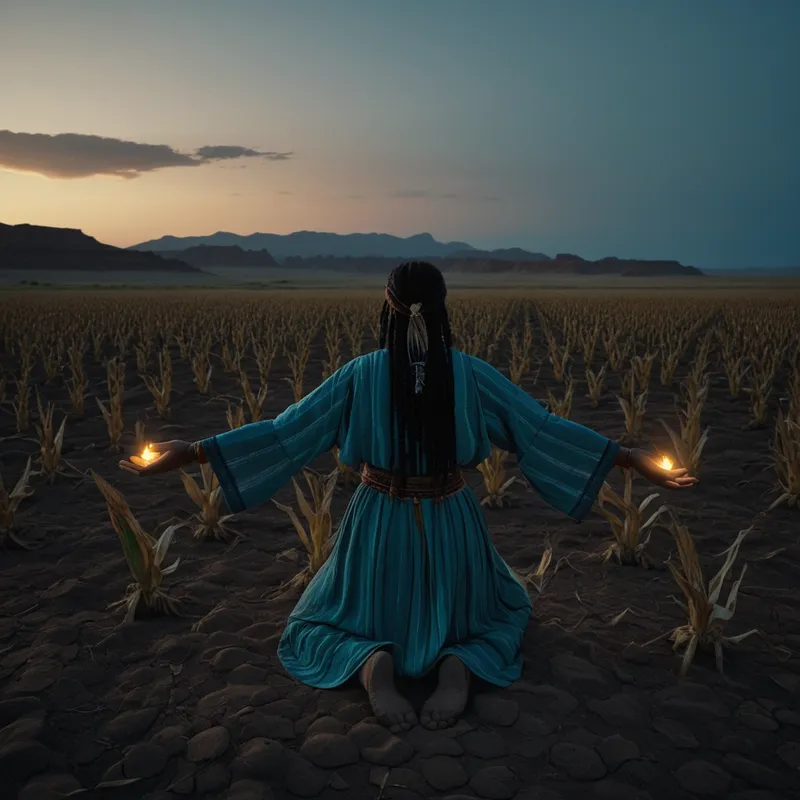
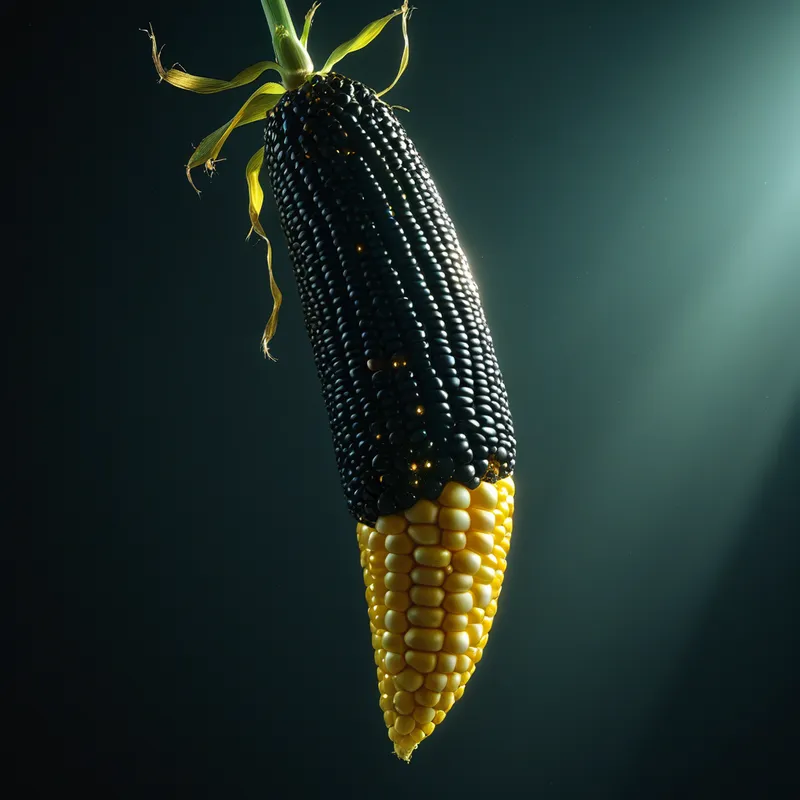
The elder returned to his people, empty-handed, his soul a winter field. For four days, the village held its breath. On the fifth morning, a child pointed to the hollow. Where the mounds had been, two new kinds of plants had sprung forth, tall and green. From one grew ears of corn with kernels of purest gold. From the other, ears with kernels of deep, blue-black. The Corn Maidens were gone. But they had become. They had transformed their very bodies into the first corn, the sustenance that would forever hold their spirit. The people wept, but now their tears watered the gift. They had learned, at last, the covenant: life feeds on sacred death, and abundance is born of sacrifice.
Cultural Origins & Context
The myth of the Corn Maidens is central to the Pueblo peoples of the American Southwest, particularly the Hopi, Zuni, and Keresan language groups. It is not merely a story but a foundational cosmogonic myth that encodes the principles of agriculture, ecology, and social order. Passed down orally through generations by elders and ceremonial priests, the tale was (and is) recounted during specific times in the agricultural calendar, such as planting or harvest, to ritually re-enact the original sacrifice and ensure its continuance.
Its societal function is multifaceted. It establishes the sacred origin of corn (maize), which is not just a crop but a divine being, a relative. It teaches the ethics of reciprocity: the people must care for the corn through ritual, song, and respectful farming practices, and in return, the corn gives its body for their life. The myth also serves as a cautionary narrative about human nature—the danger of taking a blessing for granted, of allowing greed and possessiveness to corrupt a sacred relationship. It grounds the people’s identity, reminding them that their survival is literally woven from the transformed bodies of the sacred.
Symbolic Architecture
At its heart, this is a myth of metamorphosis. The Corn Maidens represent the undomesticated, pure spirit of abundance—a gift that is freely given but cannot be owned. Their departure is not a punishment, but a necessary step in the alchemy of creation. They must descend into the earth (the underworld) to be reborn in a new, sustainable form.
The ultimate nourishment is not consumed, but transmuted. The giver becomes the gift, and in the receiving, the receiver becomes part of the cycle of giving.
Psychologically, the Maidens embody the archetype of the Great Mother in her most essential form: the one who feeds. Their sacrifice dismantles the human fantasy of eternal, unearned nurture. It insists that true sustenance requires a participatory relationship—a cycle of loss, work, faith, and gratitude. The elder who buries them performs the ultimate act of faith, representing the ego’s agonizing surrender to a process larger than itself.
The Dreamer's Resonance
When this myth stirs in the modern dreamscape, it often surfaces during life phases of profound nourishment crisis or transformation. Dreaming of a beautiful, nurturing presence that must leave or die may feel like abandonment, echoing the people’s initial grief. Somatic sensations might include a hollow feeling in the gut, or conversely, a strange warmth in the hands as if burying or planting something.
Psychologically, this dream pattern signals that a form of sustenance—be it a relationship, an identity, a career, or an old way of being—has reached its limit in its current form. The psyche is initiating a burial ritual. The dreamer is the grieving elder and the buried Maiden simultaneously. The process is one of sacrificial release, where what is most cherished must be consciously surrendered to the dark, fertile ground of the unconscious, with only the promise of an unknown future harvest. It is the dream of learning to feed oneself from a source that requires one’s own participation in the cycle of death and rebirth.
Alchemical Translation
The myth of the Corn Maidens is a perfect map for the individuation process, specifically the nigredo and albedo. First, we have the initial state of psychic hunger—the unconscious yearning for wholeness (the people’s famine). Then arrives a transcendent content, a beautiful, nourishing archetypal image that feels like salvation (the Maidens).
Individuation demands that we do not worship the archetype, but allow it to perform its work of transformation within us, even if that means its beautiful form must be destroyed.
The conflict arises when the ego tries to possess and control this numinous energy, corrupting it (the people’s quarreling). The crucial, alchemical step is the willing sacrifice—the burial. This is the ego’s agreement to let the transformative content descend into the unconscious (nigredo: the blackening, the burial in earth). There, in the darkness, it decomposes and is reconstituted. The waiting period is the fertile void.
The final emergence—the corn—is the albedo, the whitening. The transcendent, ephemeral nourishment (the Maidens’ presence) has been transmuted into an ordinary, sustainable, and incarnate form (corn) that can be integrated into daily life. The modern individual undergoing this process learns that true, lasting sustenance does not come from clinging to fleeting spiritual highs or perfect solutions, but from participating in the gritty, cyclical work of planting, tending, sacrificing, and harvesting the contents of one’s own soul. The divine is not lost; it is made edible.
Associated Symbols
Explore related symbols from the CaleaDream lexicon:
- Seed — The potential for life and transformation, buried in darkness; the promise left behind by the Corn Maidens that contains their entire future being.
- Earth — The womb and the tomb, the receptive feminine principle that receives the sacrifice and transforms it into nourishing life.
- Sacrifice — The voluntary giving up of a cherished form, which is not a loss but the essential catalyst for creation and renewal in the mythic cycle.
- Mother — The Corn Maidens embody the ultimate nurturing archetype, one who feeds her children from the substance of her own transformed body.
- Death — Not an end, but a necessary phase of metamorphosis where one state of being is relinquished so a new, sustainable one can emerge.
- Rebirth — The emergence of the corn from the burial mounds; the tangible, life-giving result of the sacred sacrifice.
- Grief — The essential human response to sacred loss, which waters the ground of transformation and teaches the depth of the covenant.
- Harvest — The fulfillment of the cycle, the tangible abundance that results from correct relationship, ritual, and respect for the sacrificial process.
- Cycle — The eternal pattern of life, death, and rebirth established by the myth, governing seasons, agriculture, and the human soul.
- Gift — The corn is not taken, but received as a sacred gift born of relationship, demanding reciprocity and reverence from those who benefit.
- Forage Basket