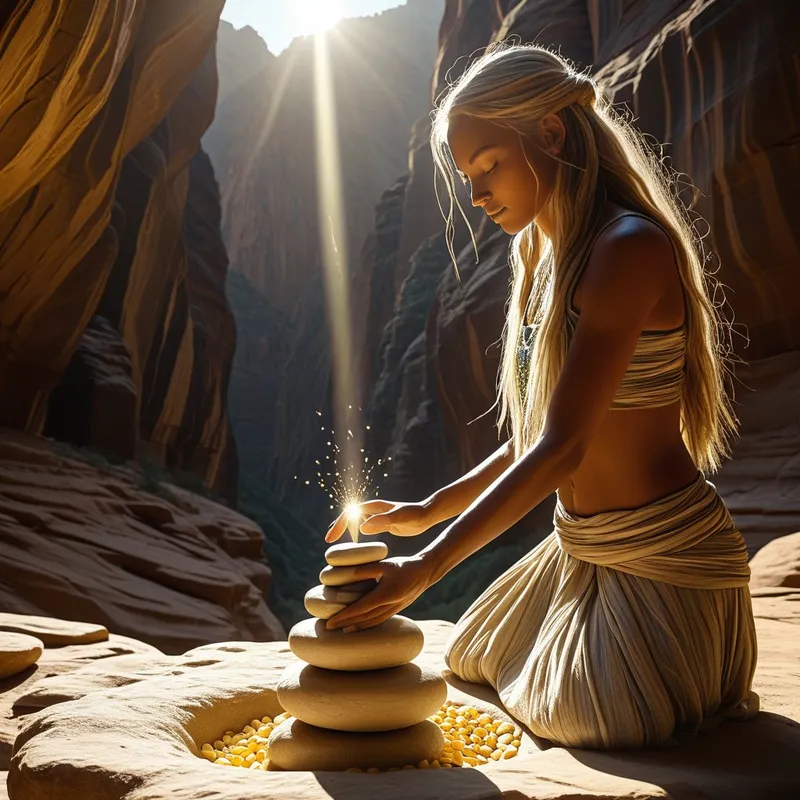
Corn Grinding Stones Myth Meaning & Symbolism
A myth where a sacred being transforms into the first corn and grinding stones, gifting humanity with sustenance through an act of ultimate sacrifice.
The Tale of Corn Grinding Stones
In the time before time, when the world was soft and new, the People walked the red earth. Their bellies were hollow, their spirits thin. They gathered what they could—bitter roots, tough seeds—but their hunger was a constant companion, a shadow that lengthened with the sun. They cried out to the spirits of the earth and sky, a lament carried on the dry wind.
From the heart of the canyon, she came. She was not born of woman, but of the land itself. Some knew her as Yellow Woman, others by names whispered only in ceremony. Her skin held the warmth of clay, her hair the softness of corn silk, and in her eyes shone the patient light of the seasons. She saw the People’s suffering, a pain that etched lines into the stone of her own spirit.
“Your hunger is a song without rhythm,” she said, her voice like water over rock. “You gather, but you do not transform. You take, but you do not make.”
She walked among them, and where her feet touched the earth, green shoots dared to rise. She showed them a plant with tall stalks and tassels like sun-captured fire. “This is my body,” she said, plucking a hard, golden kernel. “But as it is, it is a promise locked in stone. It must be changed.”
Then, she led them to a place where the canyon walls opened to the sky. There lay two great stones, one flat and broad, the other rounded and smooth. “Watch,” she commanded, and a profound silence fell.
She knelt before the flat stone. A great sigh escaped her, a sound that held the weight of all growing things. She placed her hands upon the rounded stone. Then, she began to sing—a low, grinding hymn that was not made of words but of movement itself. As she sang, as she pressed and turned, a terrible and beautiful transformation began. Her hands fused with the stone she held. Her arms grew heavy, their flesh darkening to the color of storm cloud and granite. Her song deepened, becoming the very sound of stone meeting stone.
The People watched, tears cutting paths through the dust on their cheeks, as the sacred being poured her essence into her labor. She ground her own substance upon the stone. From between the meeting faces, not stone dust, but a fine, golden meal began to flow—the first pinole. The air grew thick with a scent both earthy and sweet, the smell of life itself being released.
When the song ended, she was gone. In her place remained the two stones: the metate, and the mano. And piled beside them, a mound of golden corn, a gift from her vanished form. The first woman of the People approached, her own hunger a sharp stone in her gut. Trembling, she took up the mano. She placed a kernel of the sacred corn on the metate, and she pushed.
The sound that echoed through the canyon was the same song. The meal that flowed was the same life. The being had not left; she had become the process itself.
Cultural Origins & Context
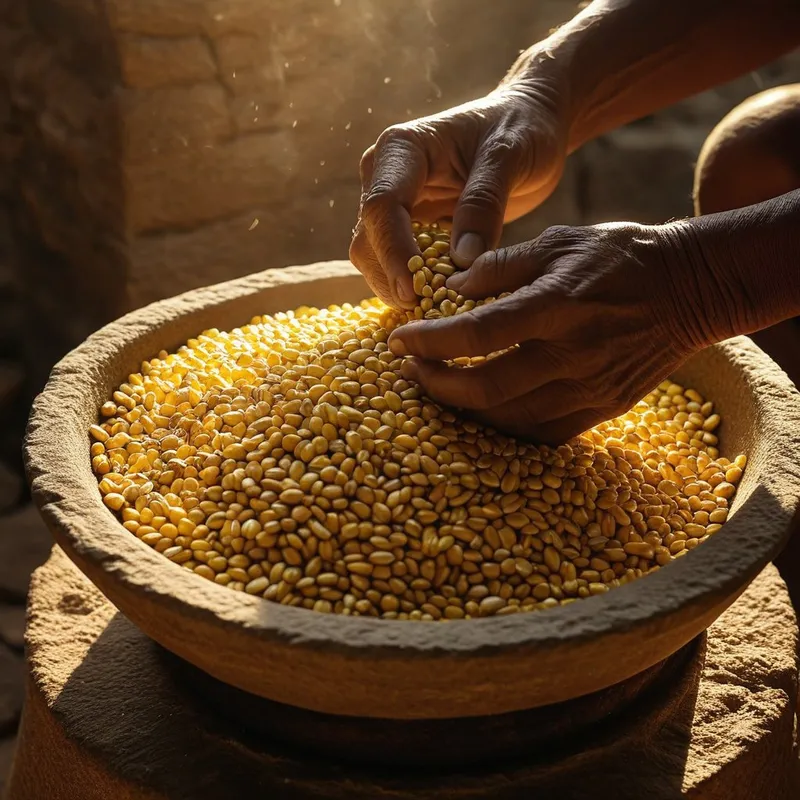
This myth, in its many variations, is foundational among numerous Pueblo and other Southwestern cultures, including the Hopi, Zuni, and Diné (Navajo). It was not a story told lightly, but one woven into the very fabric of daily ritual and seasonal ceremony. It was passed down by grandmothers and uncles, not as mere history, but as a living instruction manual for existence.
The telling often accompanied the actual work of grinding corn, the rhythmic sound providing a percussive backdrop to the narrative. Its societal function was multifaceted: it was a sacred charter for agriculture, an explanation for the origin of women’s primary technological and spiritual contribution (the transformation of raw grain into food), and a profound ethical lesson. It taught that sustenance is not a free gift, but the result of sacred, reciprocal labor—a cycle initiated by a supreme sacrifice. The myth established grinding as not merely a chore, but a holy act, a re-enactment of the primordial transformation that sustained life.
Symbolic Architecture
At its core, the myth is a masterful depiction of the archetype of divine sacrifice and the alchemy of necessity. The sacred being—Yellow Woman or her analogues—represents the undifferentiated, abundant potential of nature. The People represent nascent consciousness: aware of need, but lacking the means to fulfill it. The conflict is the gap between potential nourishment and actual sustenance.
The stone is not an obstacle, but the necessary partner in the creation of the meal. Resistance is the womb of transformation.
The grinding stones are the central symbol. They are not tools in a modern sense, but sacred instruments of transmutation. The metate represents the stable, receptive world, the foundation of reality. The mano represents focused, rhythmic effort, the will applied. The act of grinding symbolizes the essential psychological and physical process of breaking down a hard, complex whole (a problem, a raw material, an experience) into something usable, digestible, and life-giving.
The being’s transformation into the stones is the ultimate lesson: the divine does not hand us finished bread. It becomes the very process by which we learn to make it ourselves. Sustenance is born from the marriage of gift and labor, of sacrifice and grateful, repetitive action.
The Dreamer's Resonance
When this myth pattern surfaces in modern dreams, it rarely appears as a literal narrative. Instead, one might dream of endlessly polishing a rough stone until it reveals a hidden core of light; of chewing on something hard that slowly dissolves into sweetness; of a repetitive, somatic motion that feels both arduous and deeply peaceful.
Such dreams often visit during periods of necessary, difficult integration. The psyche is working on a “hard kernel” of experience—a grief, a trauma, a complex professional challenge, or a period of artistic struggle. The dream signals that the raw material of the experience is present, but it must be ground down by the slow, patient mill of conscious attention and time.
The somatic feeling is key: the fatigue in the shoulders, the rhythmic motion, the focus required. This is the dream-ego being initiated into the myth’s central truth: that profound nourishment comes not from avoiding resistance, but from engaging with it fully, rhythmically, until it yields its hidden sustenance. The dream is an invitation to embrace the grind, not as meaningless toil, but as sacred, shape-giving labor.
Alchemical Translation
For the modern individual navigating the path of individuation—becoming who one truly is—the myth of the Corn Grinding Stones models the alchemy of the Self. Our lives present us with hard, unprocessed kernels: innate talents that feel rough and unusable, shadow aspects that are difficult to digest, painful memories that seem sealed in stone.
The heroic, ego-driven impulse is to seek a magical solution, a finished loaf. The myth instructs otherwise. The alchemical work is to build your own metate—a stable foundation of practice, routine, and conscious values. It is to take up the mano of disciplined, daily effort. The sacred being who sacrifices herself is the old fantasy of effortless transformation; she dies so that the real, human work can begin.
Individuation is the slow grind. The ego is the kernel, and the Self is the meal that can only be revealed through the faithful, wearing friction between who you are and who you must become.
We are both the grinder and the ground. The goal is not to escape the repetitive motion, but to find the sacred song within it. Each act of conscious effort—each time we work through a difficult emotion, practice a skill, or reflect on a failure—is a turn of the mano. We are not just making cornmeal; we are grinding down the hard shell of the provisional personality to release the golden, nourishing substance of the authentic Self. The myth promises that the process itself, undertaken with reverence and patience, is the sustenance. The meal that results is a life made truly one’s own, earned through the sacred, grinding love of becoming.
Associated Symbols
Explore related symbols from the CaleaDream lexicon: